AI Use: AI tools were used to support source discovery and to structure the article for clarity. All research, verification, drafting, and final editorial decisions are fully human led. Learn about our AI policy.
UKPoliticsDecoded is an IMPRESS regulated public interest publisher. Read our editorial standards.
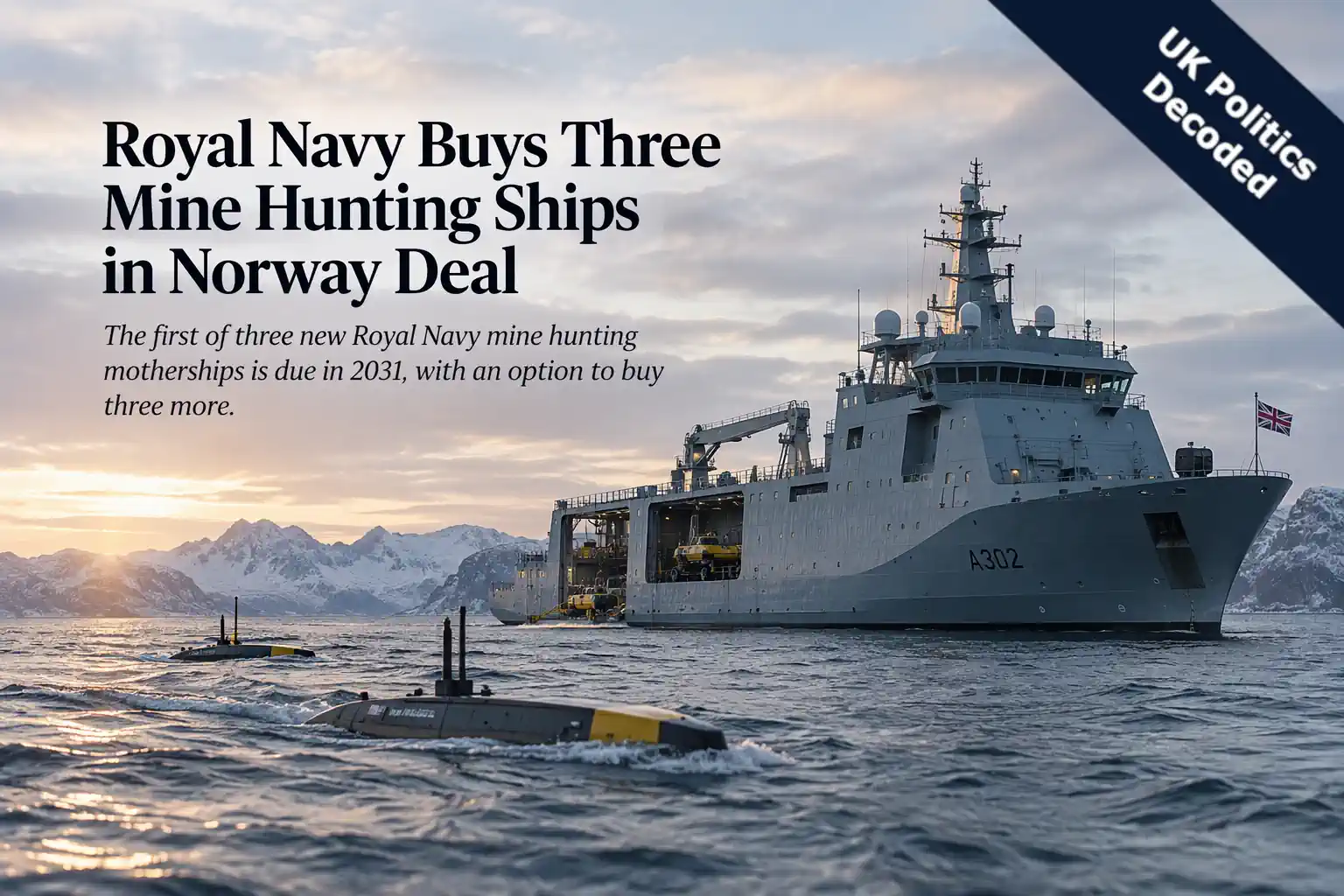
The Royal Navy has committed to buying three new ships that will act as motherships for uncrewed mine hunting systems. The Ministry of Defence announced the deal on 12 November 2026, saying the vessels will make the detection and disposal of sea mines safer, quicker and more effective.
The ships will be bought through a partnership with Norway, tied to the Type 26 frigate export agreement that the government describes as the UK's biggest ever warship export by value. Defence Secretary Wes Streeting and his Norwegian counterpart, Tore O. Sandvik, confirmed the commitment at the Atlantic Future Forum in Oslo.
At a Glance
- The Royal Navy will receive the first of three Offshore Support Vessels in 2031, with an option to buy an additional three.
- The UK is joining Norway's P1118 Standardised Vessel Programme to buy the ships.
- The Ministry of Defence says an additional £90 million was announced in the Defence Investment Plan for the acquisition.
- The Type 26 export agreement with Norway supports 4,000 jobs across the UK supply chain, including more than 2,000 at BAE Systems' Glasgow shipyards.
- The announcement was made in Oslo on 12 November 2026 by Defence Secretary Wes Streeting and Norwegian Defence Minister Tore O. Sandvik.
What the Royal Navy Is Buying and When It Arrives
Under the agreement, the UK will buy three Offshore Support Vessels. In Norway they are known as “standardised vessels”. The first is due to reach the Royal Navy in 2031, and the deal includes an option for a further three.
Their job is to act as motherships for uncrewed mine hunting systems. Rather than sending crewed ships into suspected minefields, the Navy will use the vessels as a base from which uncrewed systems do the detecting and disposing. The Ministry of Defence says this keeps sailors further from danger.
The government also says the ships are globally deployable and will support anti submarine warfare capabilities on NATO’s northern flank. It describes them as a key step in building what it calls the Hybrid Navy, and as central to the modernisation of the Royal Navy’s mine hunting capability.
How the UK-Norway Ship Deal Works
The UK will join Norway’s existing P1118 Standardised Vessel Programme rather than design a ship of its own. The Offshore Support Vessels will be delivered through the Maritime Capability Partnership Framework, a government to government arrangement between the two countries.
The deal sits alongside the Type 26 export. Norway’s procurement of Type 26 frigates in December 2025, valued by the government at £10 billion, means the two navies will operate similar ships. The Ministry of Defence says that strengthens interoperability between two close NATO allies.
Norway’s Defence Minister said the UK’s purchase would “further strengthen our strategic partnership, rooted in the Lunna House agreement”. He added that operating similar platforms would improve navy to navy cooperation and the ability to operate together on NATO’s northern flank.
Why the Government Says the Royal Navy Needs Mine Hunting Ships
The government links the purchase directly to events in the Gulf. In its announcement, it says the threat from sea mines has been brought into sharp focus by Iran’s mining of the Strait of Hormuz, which it says has caused major disruption to global trade in energy. UKPoliticsDecoded is reporting the government’s characterisation here and has not independently verified it.
Ministers say the new vessels will help the UK stay at the forefront of protecting freedom of navigation from fast evolving mine threats. Streeting said the deal “strengthens our ability to protect freedom of navigation, which is critical to our security and our economy”.
He also tied the purchase to defence spending, saying the government is using “the biggest sustained increase in defence spending since the Cold War” to put modern technology in the hands of sailors.
How Many Jobs Does the Norway Ship Deal Support?
The government says the Offshore Support Vessels are part of the same package as the Type 26 export to Norway, which supports 4,000 jobs across the UK supply chain. More than 2,000 of those are at BAE Systems’ Glasgow shipyards. The announcement does not say how many jobs, if any, the mothership purchase itself will support.
The cost of the ships is not given in the announcement. The Ministry of Defence says only that an additional £90 million was announced in the Defence Investment Plan for the acquisition.
Other commitments were highlighted at the Atlantic Future Forum. Arondite plans to invest £35 million over five years to open an Oslo office and grow its European operations. A £90 million contract, called Atlantic Net, has been awarded by the Ministry of Defence and Royal Navy to Ocean Infinity. It will combine autonomous and uncrewed systems with advanced sensors to detect and monitor underwater threats across the North Atlantic.
Allied navies also held discussions through the International Sea Power Conference, convened by the First Sea Lord, General Sir Gwyn Jenkins.
When Will the New Royal Navy Ships Arrive?
The first vessel is not due until 2031, so the capability is some way off. The announcement does not name a shipbuilder or a delivery schedule for the second and third vessels, and it does not say whether the option for three more will be taken up.
What the government has set out is a commitment to the first three ships, a delivery route through the existing Norway framework, and a link to the Type 26 export that it says underpins thousands of UK jobs.
Key Takeaways
- The Royal Navy has committed to three new mine hunting motherships, with the first due in 2031 and an option for three more.
- The UK will buy the ships by joining Norway’s P1118 Standardised Vessel Programme through a government to government framework.
- The Ministry of Defence says an additional £90 million was announced in the Defence Investment Plan for the acquisition.
- The deal is part of the Type 26 export agreement with Norway, which the government says supports 4,000 UK supply chain jobs.
- The announcement does not name a shipbuilder, give a total cost or confirm whether the option for three further vessels will be exercised.