AI Use: AI tools were used to support source discovery and to structure the article for clarity. All research, verification, drafting, and final editorial decisions are fully human led. Learn about our AI policy.
UKPoliticsDecoded is an IMPRESS regulated public interest publisher. Read our editorial standards.
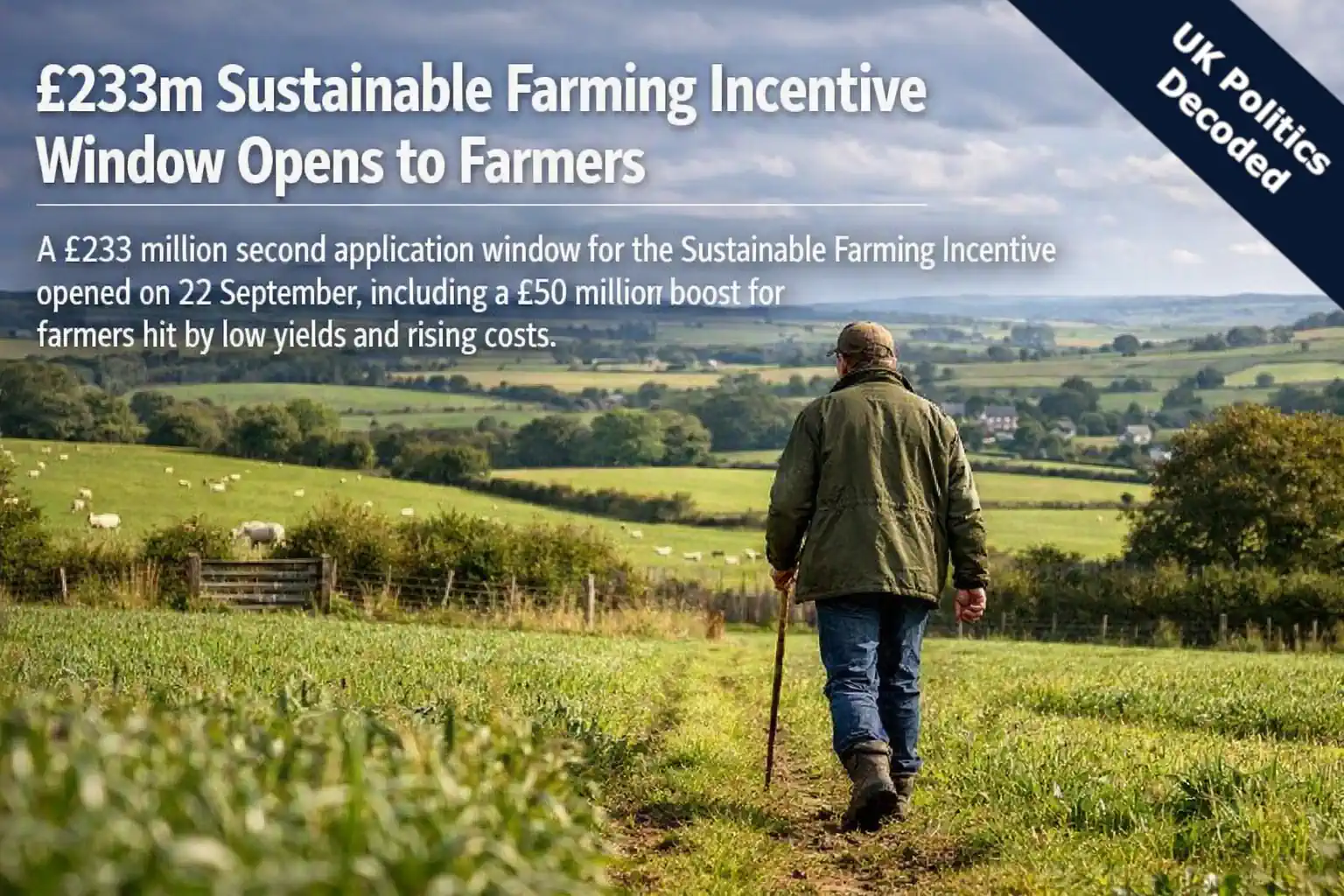
A £233 million fund for English farms opened on Tuesday, as the government launched the second application window of the Sustainable Farming Incentive 2026. The Department for Environment, Food and Rural Affairs said the money is part of a wider push to help farmers produce food sustainably while shoring up income against a volatile climate.
The window includes a £50 million boost that the Prime Minister announced in August, aimed at farmers struggling with low yields and rising costs, alongside £3 million left over from the scheme's first window. Every eligible farmer or land manager with at least three hectares of agricultural land can now apply.
The timing is deliberate. Defra has framed the package as support for "drought resilient, sustainable farming practices," a reference to the pressures many growers faced earlier this year, and as part of a wider effort to give farming businesses breathing space on costs while growing the rural economy in every part of the country.
At a glance
- A £233 million second application window for the Sustainable Farming Incentive 2026 opened on 22 September.
- The total includes a £50 million boost announced by the Prime Minister in August and £3 million unallocated from the first window.
- The first window received 7,000 applications, with 3,100 new agreements live by 1 September and payments already reaching farmers.
- Around 21,000 farms with environmental land agreements expiring by the end of February 2027 can apply early for their next agreement.
- Farming Minister Stephen Morgan said growing domestic food is "a matter of national security" and part of the government's Farming Roadmap.
What the £233m SFI26 Window Actually Covers
The Sustainable Farming Incentive pays farmers and land managers for actions that improve soil health, water quality and biodiversity, alongside their normal food production. SFI26 is the current iteration of the scheme, and this second window builds directly on demand from the first, which closed for applications on 28 August after receiving 7,000 applications, including from many small farms.
By 1 September, 3,100 of those had become live agreements, with payments already reaching farmers' bank accounts, according to Defra. The department says the second window is designed to give applicants "clear guidance, predictable processes and the confidence to apply when they are ready," in the words of Rural Payments Agency chief executive Oliver Munn.
Farming Minister Stephen Morgan framed the funding as protection against climate pressures rather than a routine subsidy top up. "Farmers shouldn't have to carry the risk of a changing climate alone," he said, adding that the money should help build "resilient, sustainable businesses that can better withstand whatever the weather throws at them next."
Morgan also tied the announcement to a national food security argument, describing growing domestic food as "a matter of national security and part of our long term plan for English farming, the Farming Roadmap." That framing has become a consistent theme in Defra's messaging around SFI funding rounds this year, positioning environmental payments as complementary to, rather than in competition with, food production targets.
Why 21,000 Farms Can Now Apply Early
One of the more significant practical changes in this window is an early application option for farmers whose existing environmental land management agreements are due to expire by the end of February 2027. Defra estimates around 21,000 farms fall into that category, and they will now be able to secure their next SFI agreement before their current one runs out, avoiding a gap in payments.
That group also includes small farms that held off applying in the first window specifically so they could use the early application route once it became available. Defra said it has made changes to SFI so the scheme is "more focused, more transparent and fairer," language that echoes recurring criticism from farming groups that earlier versions of environmental land management schemes were too complex to navigate.
Rural Payments Agency chief executive Oliver Munn said the agency's teams had "worked hard to make this year's scheme clearer, more focused and easier to navigate for farmers and land managers," and pointed to the strength of demand in the first window as evidence that the changes were landing well with applicants.
Who Can Apply and When
- Any eligible farmer or land manager with at least three hectares of agricultural land can apply from 22 September.
- Farms with environmental land agreements expiring by 28 February 2027 can apply early for their next SFI agreement.
- Small farms that delayed applying in window one to use the early application route can now do so.
- Countryside Stewardship remains open separately to new applicants invited by Natural England.
SFI26 or Countryside Stewardship? How the Two Schemes Compare
SFI26 is not the only environmental land management route open to farmers. Countryside Stewardship, which offers 10 year agreements combining 132 land management actions and capital grant items, remains open to new applicants invited by Natural England. Defra has also introduced a simpler Expression of Interest process for Countryside Stewardship Higher Tier, letting farmers register interest in woodland improvement, agroforestry, species rich grassland management and scheduled monument management. The department describes this as a simpler route into the scheme than the standard Higher Tier application, aimed at farmers who want to explore single focus agreements without committing to the full 132 action framework straight away.
Management information released alongside the announcement, covering data extracted on 18 September, shows the overall scale of environmental land management uptake. Across all schemes, 54,300 businesses currently hold live agreements, while 21,300 have agreements expiring by 28 February 2027, the same cut off point that determines eligibility for SFI26's early application option.
Live Agreements by Scheme
- Countryside Stewardship (including capital agreements): 37,500 businesses.
- SFI 2023: 23,400 businesses.
- SFI Expanded Offer (SFI24): 17,900 businesses.
- SFI 2026: 3,100 businesses, reflecting window one's new agreements.
Agreements Expiring by 28 February 2027
- Countryside Stewardship: 15,200 businesses due to expire.
- SFI 2023: 9,100 businesses due to expire.
- SFI Expanded Offer (SFI24): 10 businesses due to expire.
- Total across all schemes: 21,300 businesses, close to Defra's 21,000 early application estimate.
Defra notes this breakdown is management information from the Rural Payments Agency rather than official statistics, and that a single farm business identifier can be linked to more than one agreement, which is why individual category totals may not sum exactly to the overall figures. Official statistics on environmental land management uptake, by contrast, are published separately on the ELM statistics page and follow a different reporting methodology.
Why Defra Is Calling This a Food Security Measure
The £233 million window sits inside the government's broader Farming Roadmap, its long term plan for English farming. Morgan described the roadmap and the department's work as being "backed with real co-operation with our farmers," arguing that policy on rural land tends to work best when it draws on the experience of the people actually working it.
Defra says it has worked closely with the farming sector to shape this year's SFI offer, and has committed to continuing that engagement as the scheme develops further. The rhetoric around "clearer, more focused" processes suggests officials are trying to head off the administrative complaints that dogged earlier stages of the environmental land management transition, when farmers and industry bodies frequently flagged confusing guidance and slow agreement processing as barriers to take up.
Whether that ambition holds up will depend largely on how quickly the Rural Payments Agency can turn window two applications into live agreements. The first window's conversion, from 7,000 applications to 3,100 live agreements within roughly a month of closing, gives some indication of the pace farmers might expect this time, though a larger funding pot and the addition of early applicants could change how that timeline plays out.
The department has been careful to describe the £50 million uplift as targeted rather than universal, aimed specifically at farmers affected by low yields and rising costs rather than a blanket increase to every agreement. That distinction matters for how the extra money will actually be distributed once applications close, and it is likely to shape which farms see the biggest benefit from this window compared with the last.
How to Apply for SFI26 Before the Window Fills Up
Applications for SFI26's second window are being taken now through the standard online process, with the scheme's rules and guidance, most recently updated to version 4.0 in August, setting out the mandatory requirements for each available action. Defra has also added new guidance materials alongside the window's opening, including a video explaining how to fix land use error codes that have previously caused problems for applicants submitting land parcel details.
For farms with agreements expiring soon, the practical decision is whether to use the early application route now or wait. Defra's guidance notes that farmers using the early application functionality may see a delayed start date for their new agreement, a detail worth checking against an individual farm's existing agreement end date before applying.
The latest version of the scheme rules and guidance, v4.0, was published in August specifically to remove references to the closed first window, and Defra has continued updating supporting material since the second window opened, including guidance on printing and saving application documents alongside the error code video.
For everyone else, eligibility remains straightforward on paper, at least three hectares of agricultural land, but the scale of interest in window one suggests farmers should expect processing to take time even where guidance has been simplified.
Key Takeaways
- A £233 million second window of the Sustainable Farming Incentive 2026 opened on 22 September, including a £50 million August boost and £3 million carried over from window one.
- Window one drew 7,000 applications, with 3,100 agreements live and paying out by 1 September.
- Around 21,000 farms with agreements expiring by 28 February 2027 can now apply early for their next SFI agreement.
- Countryside Stewardship remains open separately, alongside a new simpler Expression of Interest route for Higher Tier agreements.
- 54,300 businesses currently hold live environmental land management agreements across all schemes, with 21,300 due to expire by February 2027.