AI Use & Transparency: AI tools were used to support source discovery and to structure the article for clarity. All research, verification, drafting, and final editorial decisions are fully human led. Learn about our AI policy.
UKPoliticsDecoded is an IMPRESS regulated public interest publisher. Read our editorial standards.
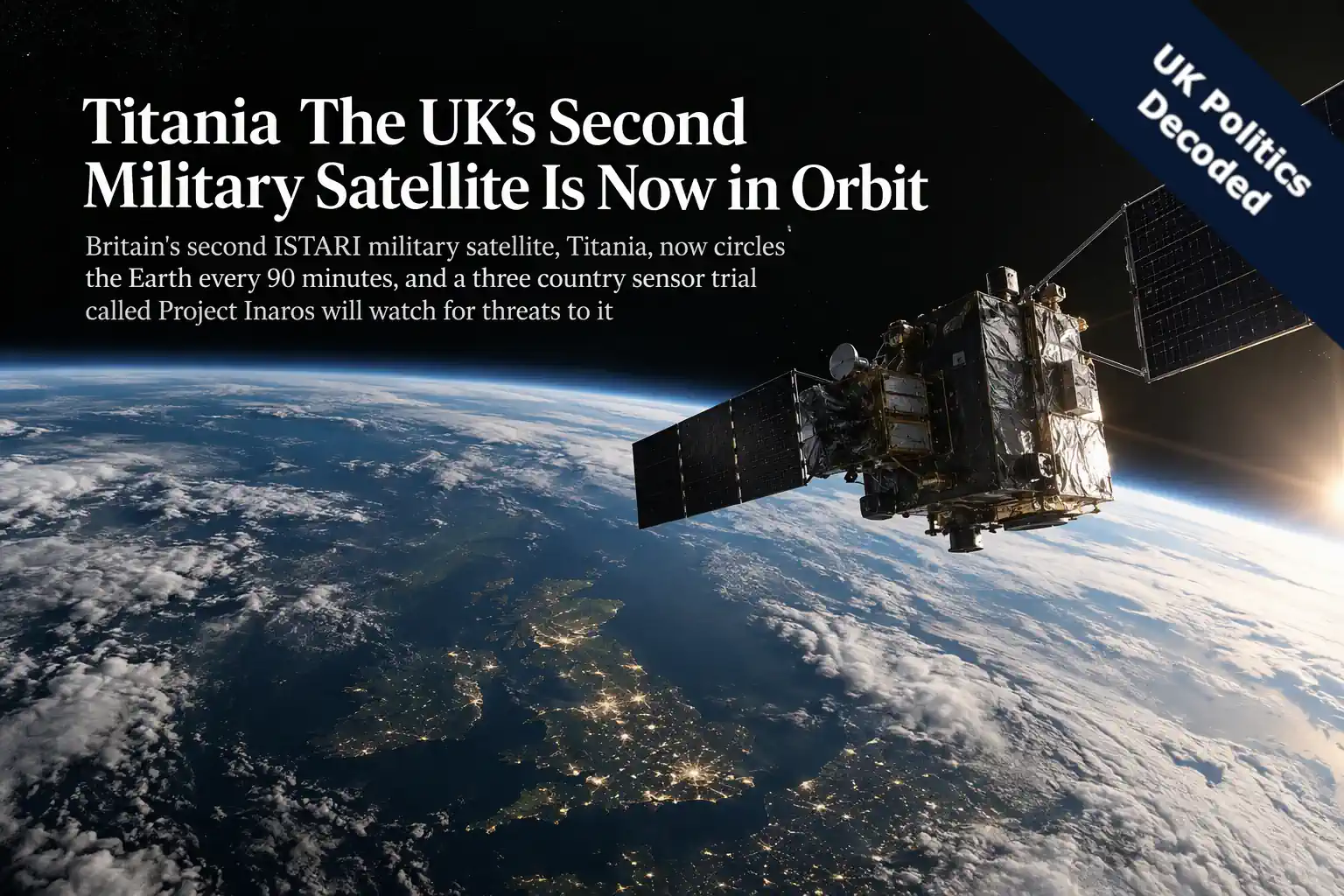
Titania, a British built military satellite, is now in orbit, the Ministry of Defence announced on 7 November 2026. It is the second satellite in the UK's growing military constellation, after Tyche.
The department also confirmed a new trial called Project Inaros, a network of ground sensors designed to monitor space from three sites around the world. Both projects sit within what the government describes as more than £3 billion of defence investment in space over the next four years.
At a Glance
- Titania is the second satellite in the UK's military constellation and will be operated by UK Space Command under the ISTARI programme.
- The satellite weighs around 100kg, orbits the Earth every ninety minutes and travels at twenty seven thousand kilometres per hour.
- Titania was designed and built in Hampshire by Dstl and BAE Systems under a £9.5 million contract.
- Project Inaros will trial three ground based sensors in the UK, Australia and Cyprus to monitor movements near British satellites.
- The work forms part of more than £3 billion the government says it is investing in space capabilities over the next four years.
What Is Titania, the UK's New Military Satellite?
Titania is a small satellite with a large job. The Ministry of Defence says it will help the Armed Forces coordinate their efforts on and above Earth by improving their ability to observe military activity from space.
It is about the size of a washing machine and weighs around 100kg. The MOD says it orbits the Earth every ninety minutes at twenty seven thousand kilometres per hour. Its sister satellite Tyche, launched in October, is the same size.
The launch was completed last month, according to the announcement, although the government published the news on 7 November. UK Space Command will operate the satellite as part of ISTARI, a programme through which the MOD is buying satellites and supporting ground systems to expand space based intelligence, surveillance and reconnaissance. The department says the aim is to give British troops around the world an operational advantage.
Who Built Titania? Dstl, BAE Systems and the Satellites Still to Come
Titania was designed and built in Hampshire by the Defence Science and Technology Laboratory (Dstl) working with BAE Systems. The contract was worth £9.5 million, according to the MOD.
Two more satellites are planned. Juno will be built with SSTL and Oberon with Airbus Defence and Space. The Chief of the Air Staff, Air Chief Marshal Sir Harv Smyth, said Tyche and Titania will be joined by Juno and Oberon "in the years ahead". The announcement does not give launch dates for either.
Dr Paul Hollinshead, Dstl's chief executive, said the laboratory had been "at the heart of Titania, from the original concept" through to launch. Andrea Thompson, managing director of BAE Systems Digital Intelligence & Land, said the programme shows the strength of the UK's sovereign space capability and supports highly skilled jobs across the country.
Project Inaros, The Sensors Watching for Threats to UK Satellites
Launching satellites is one half of the story. Protecting them is the other, and that is where Project Inaros comes in.
The trial will use three ground based neuromorphic sensors developed by Optera, a British Australian company, in partnership with the National Security Strategic Investment Fund. They will be sited in the UK, in Australia and at British facilities on the island of Cyprus.
Neuromorphic sensors mimic biological processes by detecting changes in light. The MOD says that approach could be developed into an early warning system to spot unusual or threatening activity near UK satellites. It is described as a trial, not a finished capability.
What the sensors gather will feed into UK Space Command units, including No. 1 Space Operations Squadron, No. 2 Space Warning Squadron and the new No. 3 Space Effects Squadron. The MOD says those units safeguard satellites that guide British ships, connect mobile phones and warn of missile attacks.
How the £3bn Space Investment Fits the Wider Defence Plan
The government places Titania and Inaros within the £3 billion it says the Defence Investment Plan has committed to space based capabilities. The stated purpose is to protect UK assets in space and strengthen deterrence on Earth. The plan as a whole commits £298 billion of defence spending over the next four years, according to the announcement.
Defence Secretary Wes Streeting said space "underpins everything from weather forecasts and financial transactions to sat navs and mobile phone connections". He said having Titania in orbit and Inaros watching over satellites "means we can see threats sooner, making the UK safer". He added that the projects are British built and British designed, and that the investment means skilled jobs and a stronger industrial base.
The announcement says the work responds to the Strategic Defence Review's recognition that space is increasingly vital to national security and daily life. It does not say how much of the £3 billion has been spent so far, what Inaros will cost, or when the trial will report its findings.
Key Takeaways
- Titania is the second British military satellite in orbit under the ISTARI programme, following the launch of Tyche in October.
- Dstl and BAE Systems built Titania in Hampshire under a £9.5 million contract, and Juno and Oberon are due to follow.
- Project Inaros will trial three neuromorphic sensors in the UK, Australia and Cyprus to detect threatening activity near UK satellites.
- The Ministry of Defence says the satellites and sensors form part of more than £3 billion of space investment over the next four years.
- The government has not published launch dates for Juno and Oberon, a cost for Inaros, or a date for the trial's results.