AI Use & Transparency: AI tools were used to support source discovery and to structure the article for clarity. All research, verification, drafting, and final editorial decisions are fully human led. Learn about our AI policy.
UKPoliticsDecoded is an IMPRESS regulated publisher. Read our editorial standards.
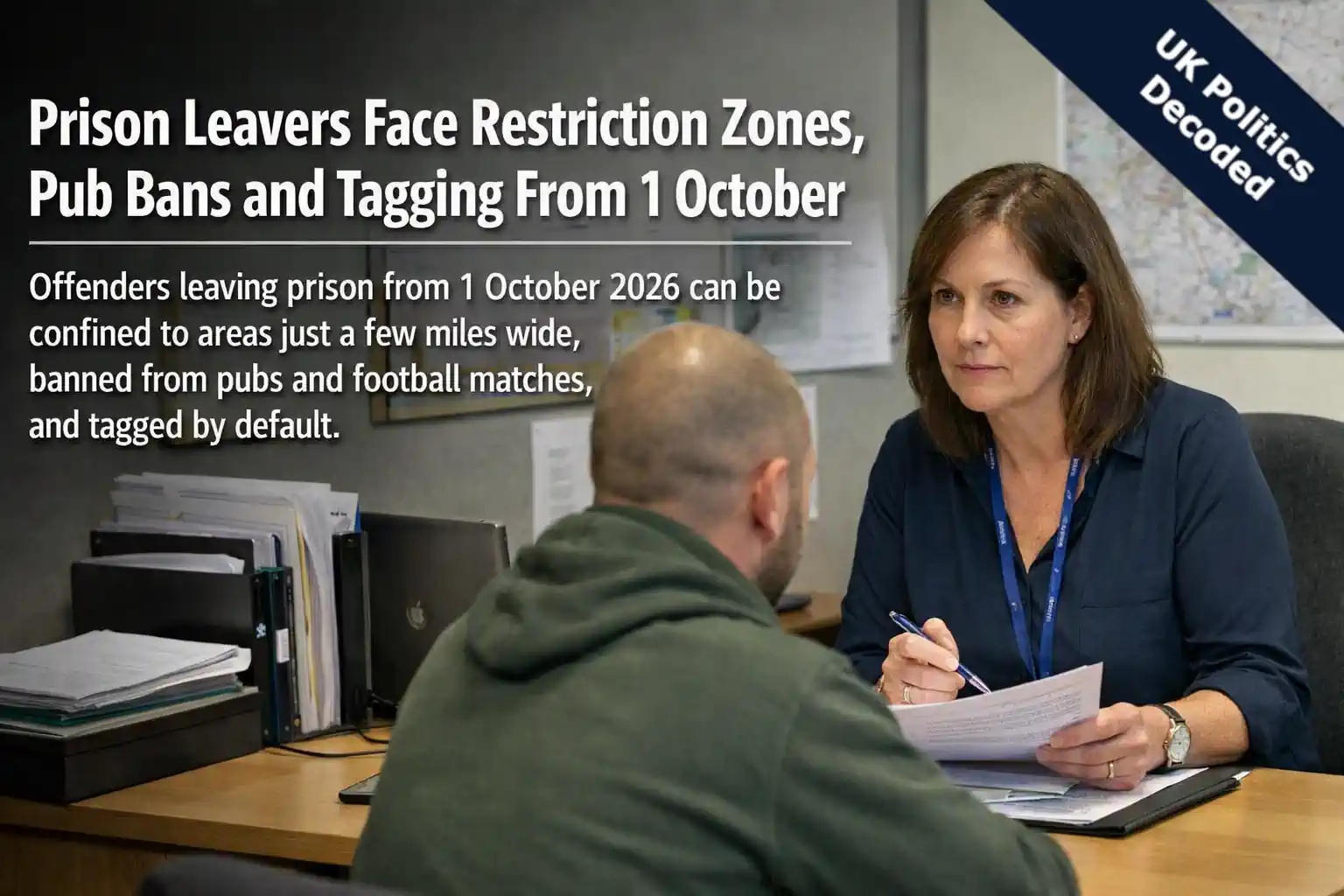
Offenders leaving prison from 1 October 2026 will be supervised under a tougher licence regime, after new powers to restrict their movements came into force, the Ministry of Justice announced. The government describes the package as the toughest supervision of prison leavers in British history.
At its centre are restriction zones for the highest risk sexual and violent offenders, a new presumption that released prisoners will be electronically tagged, and the power to bar offenders from pubs, clubs and public events. A new helpline for victims launched on the same day.
At a glance
- New powers that came into force on 1 October 2026 allow restriction zones to confine the highest risk sexual and violent offenders to areas just a few miles wide.
- Prison leavers will now be presumed to be electronically tagged, and probation staff will get near live access to tagging data later this year.
- Offenders on licence can now be banned from pubs, clubs and public events such as football matches.
- Victim Support has launched an Offender Release Helpline, and £18.9 million will strengthen local therapeutic support and victim advocacy.
- The Ministry of Justice says adult male prisons are at 98% capacity and the government has delivered more than 3,300 of a planned 14,000 prison places.
What the New Licence Rules Mean for Prison Leavers
The government says the changes mean the prison gate is no longer where punishment ends, creating what it calls a prison in the community. The restriction zones are the most striking element. According to the Ministry of Justice, this is the first time anywhere in the world that zones will tightly control the movements of the highest risk sexual and violent offenders, confining many to an area just a few miles wide.
The stated aim is to keep offenders away from the people they have harmed, so victims can rebuild their lives without fear. The government has not published, in its announcement, how the zones will be drawn for individual offenders.
Offenders can also now be banned from pubs, clubs and public events such as football matches, a measure the ministry says is designed to prevent disruption and harm to the community. From next year, the government will also launch random drug testing for thousands of offenders.
Will Prison Leavers Now Be Tagged? What Changes
The announcement describes the biggest ever expansion of electronic monitoring in British history. Under a new presumption, offenders will be electronically tagged and monitored when they leave prison, rather than tagging being the exception.
New technology rolling out this year will give probation near live access to tagging data. The ministry says this will help staff spot breaches and act quickly when offenders step out of line. It also describes a record number of offenders now being tagged.
The funding behind this is part of a record £700 million investment in probation and community punishment, according to the notes to editors. That includes £100 million to expand electronic monitoring and 1,300 additional probation staff to strengthen supervision.
New powers in force from 1 October 2026
- Restriction zones for the highest risk sexual and violent offenders, confining many to an area a few miles wide.
- A presumption that offenders will be electronically tagged and monitored on release.
- Bans from pubs, clubs and public events such as football matches.
- Random drug testing for thousands of offenders, due from next year.
Who Stays Locked Up Longer and Who Faces Deportation
The announcement follows action by the Prime Minister and Lord Chancellor to block more of the most dangerous offenders from leaving prison early, including those serving time for manslaughter and death by drunk or dangerous driving. Criminals locked up for rape and serious and historic child sex offences, such as grooming, will also stay locked up.
When those offenders are eventually released, the government says they will face the highest levels of contact and oversight, including being forced to live in secure accommodation with strict curfews.
Separately, the ministry says it will introduce a new power from early next year to deport some foreign criminals immediately after sentencing, blocking them from returning to the country. Those in prison for the most serious crimes would be kept locked up for a substantial period before they are removed.
New Offender Release Helpline for Victims. Number and Funding
The tougher controls come with changes for victims. A new helpline, run by Victim Support, launched on 1 October. Victim Support's Offender Release Helpline is available on 0808 168 9280, Monday to Friday, 9am to 5pm.
Local therapeutic support and victim advocacy will also be strengthened through an £18.9 million cash injection, so victims can reach specialist help when they need it. The government says it is investing £550 million in victim support services as part of its mission to halve violence against women and girls. That sits on top of £500 million to give domestic abuse victims and their children safe accommodation, place domestic abuse specialists in 999 call centres and roll out Domestic Abuse Protection Orders.
Why Ministers Say Prisons Are 98% Full and What They're Building
Lord Chancellor and Justice Secretary Alex Norris said the government was introducing "the toughest ever range of tools to control prison leavers and better protect the public." He acknowledged the anxiety victims feel ahead of release dates, but said the greatest danger to victims would be prisons running out of cells for dangerous criminals, which he described as the crisis the government inherited.
The ministry says adult male prisons are now at 98% capacity after more than a decade of underinvestment, when just 500 net spaces were added. It says the government has delivered more than 3,300 prison places so far, as part of a pledge to build 14,000 over the next five years. Norris said the plan would ensure the shortage never happens again, while subjecting offenders to the toughest ever controls.
The government says the building programme will put prisons on a sustainable footing, keep cells available for dangerous criminals and end the cycle of emergency release measures used before July 2024.
Key Takeaways
- Restriction zones, a presumption of electronic tagging and bans from pubs, clubs and public events came into force for offenders leaving prison on 1 October 2026.
- The Ministry of Justice says the highest risk sexual and violent offenders can now be confined to areas just a few miles wide.
- The government is investing £700 million in probation and community punishment, including £100 million for electronic monitoring and 1,300 extra probation staff.
- Victim Support's new Offender Release Helpline is on 0808 168 9280, open Monday to Friday, 9am to 5pm.
- Ministers say adult male prisons are at 98% capacity, with more than 3,300 of a planned 14,000 new places delivered.
Sources & Further Reading
- GOV.UK - Toughest restrictions ever imposed on offenders on licence Archived copy (OGL): archived page