AI Use: AI tools were used to support source discovery and to structure the article for clarity. All research, verification, drafting, and final editorial decisions are fully human led. Learn about our AI policy.
UKPoliticsDecoded is an IMPRESS regulated public interest publisher. Read our editorial standards.
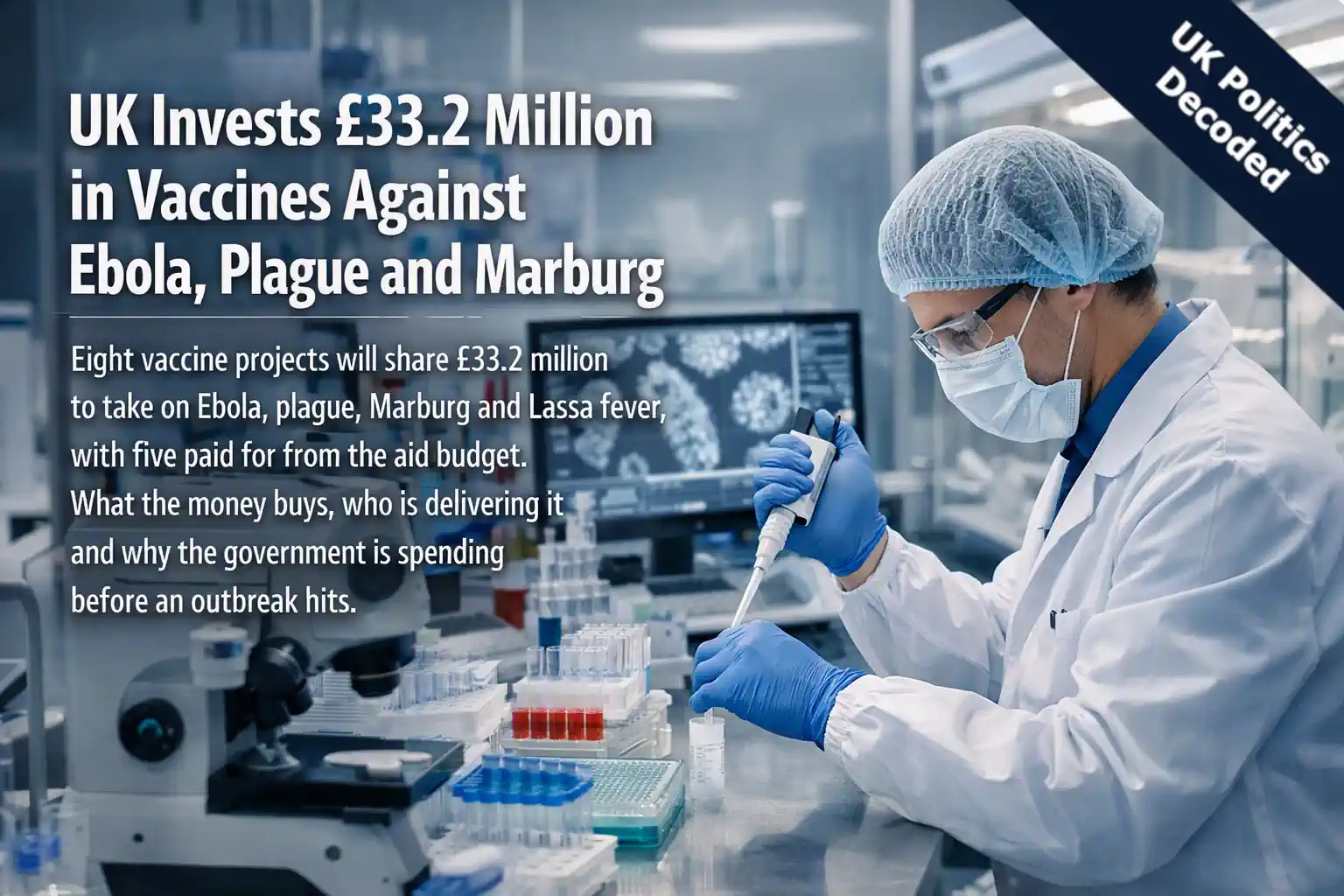
The government has committed £33.2 million to eight vaccine projects aimed at some of the world's deadliest infectious diseases. Announced on 8 October 2026, the money targets Ebola, plague, Marburg, Lassa fever, Nipah virus, chikungunya and Mayaro, with the stated aim of helping scientists develop, test and deploy vaccines faster when a new threat emerges.
The funding comes through the UK Vaccine Network and is delivered by Innovate UK, part of UK Research and Innovation. Five of the eight projects are paid for from official development assistance, the part of the aid budget that supports the economic development and welfare of eligible developing countries.
At a glance
- The government has announced £33.2 million for eight vaccine projects targeting diseases including Ebola, plague, Marburg, Lassa fever, Nipah virus, chikungunya and Mayaro.
- Five of the eight projects are funded through official development assistance, and the awards are delivered by Innovate UK on behalf of the Department of Health and Social Care.
- The programme previously supported development of the Oxford/AstraZeneca COVID-19 vaccine, according to the government.
- Ebola has an average case fatality rate of around 50%, and there is still no approved vaccine or antiviral treatment for Marburg.
- The Department of Health and Social Care has not said which organisations won the eight awards in the announcement.
What the £33.2 Million Will Pay For
The eight awards are meant to advance promising vaccines, clinical trials and technologies that make vaccine design and manufacture quicker and more effective. The government says they will also build the research, clinical trial and technical capability the UK needs to respond at speed, and help make vaccines affordable and accessible in the countries at greatest risk.
That last point reflects the thinking behind the whole programme. Outbreaks of the deadliest diseases tend to be intermittent and often hit the world's poorest countries, which means the pharmaceutical industry has little commercial incentive to develop vaccines for them. Government describes its funding as action to address that market failure.
The announcement does not name the eight projects, the organisations leading them or how much each will receive. Those details sit in documents the government publishes separately on the UK Vaccine Network page, so the breakdown is not yet clear from the press release alone.
Why Ebola, Marburg and Plague Are the Priority Diseases
The government points to recent events to explain the choice of diseases. Ebola has an average case fatality rate of around 50%. Marburg outbreaks were reported in Rwanda in 2024 and Tanzania in 2025, and there is still no approved Marburg vaccine or antiviral treatment.
It also cites reports of a suspected pneumonic plague case linked to a laboratory worker's death in Russia's Irkutsk region, with nearly 200 contacts placed under precautionary medical observation. Richard Pebody, Director of Epidemic and Emerging Infections at the UK Health Security Agency, referred to the ongoing Ebola outbreak in the Democratic Republic of the Congo as a reminder that emerging infectious diseases are not a distant threat.
Pebody said preparedness, detection and response are only part of the picture. Effective vaccines, and the manufacturing capability to produce them quickly, are essential too, he said, and working in partnership with affected countries can help stop outbreaks and make the UK safer.
How the UK Vaccine Network Decides Where Money Goes
The UK Vaccine Network is an expert advisory group that brings together industry, academia and funders to guide government investment in vaccines for diseases that could cause epidemics in low and middle income countries. It is chaired by Professor Sir Chris Whitty, the Chief Medical Officer for England, and its members sit in a personal capacity rather than representing their organisations.
The network works from a priority list of 12 pathogen families, drawn up by one of its working groups. Lassa fever, Marburg, Nipah, chikungunya and plague all appear among the exemplar pathogens. It will not fund research on diseases that already have a licensed vaccine or an advanced candidate, and it excludes SARS-CoV-2 and influenza. For influenza, the network says existing investment is already significant and the work would be unlikely to meet the test for aid eligibility.
The money is also meant to support technology that works against new or newly recognised threats, the so called 'disease X' category, rather than only known pathogens.
The Programme Behind the Oxford/AstraZeneca Vaccine, Funded Through 2029
Ministers lean on the programme's history. The government says it supported development of the Oxford/AstraZeneca COVID-19 vaccine. Between 2016 and 2022, the UK committed £134 million of official development assistance to the first phase of the UK Vaccine Network Project, and further investment has been committed for 2023 to 2029.
Chris McDonald, Health Minister for Science, Innovation and Investment, said investing before a crisis hits is how the UK can better protect the public and save lives, while supporting the life sciences sector. Professor Sir Chris Whitty said the projects aim to prevent some of the most dangerous infectious diseases in the world today.
Claire Spooner, Director of Innovation as a Service at Innovate UK, said the projects bring together science, technical expertise and international collaboration for priority pathogens. None of the sources set out timelines for when any of the eight vaccines might reach clinical use, and vaccine development for rare diseases can take years.
Key Takeaways
- The £33.2 million investment, announced on 8 October 2026, will fund eight vaccine projects through the UK Vaccine Network and Innovate UK.
- Five of the projects draw on the official development assistance budget, which is meant to support the welfare of eligible developing countries.
- The targeted diseases include Ebola, plague, Marburg, Lassa fever, Nipah virus, chikungunya and Mayaro.
- The UK Vaccine Network, chaired by Professor Sir Chris Whitty, excludes SARS-CoV-2 and influenza from its funding.
- The government has not named the eight projects or published timelines for when any vaccine could be ready for use.
Sources & Further Reading
- GOV.UK - £33.2 million to protect public from future epidemics and pandemics (8 October 2026) Archived copy (OGL): archived page
- GOV.UK - UK Vaccine Network Archived copy (OGL): archived page