AI Use: AI tools were used to support source discovery and to structure the article for clarity. All research, verification, drafting, and final editorial decisions are fully human led. Learn about our AI policy.
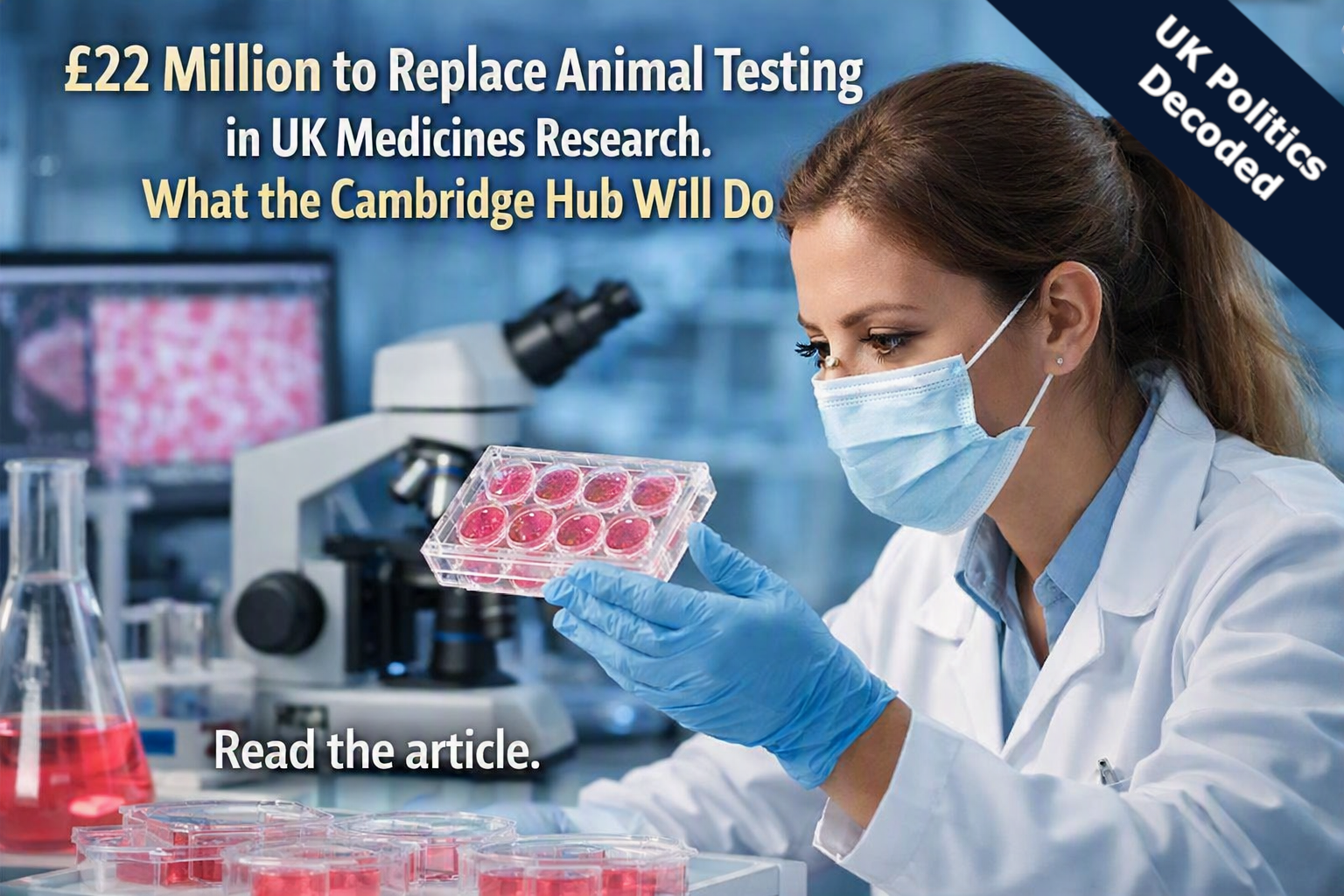
Science Minister Chris McDonald announced a £22 million package on 12 August 2026 to accelerate the UK's shift away from animal testing in medicines research. £20 million will fund a new national hub in Cambridge. Innovate UK is putting up to £2 million into nine projects developing tests that do not use animals.
Ministers say researchers will be able to test treatments on human biology rather than animals, and that this could shorten the path to medicines for conditions including cancer and inflammatory bowel disease. Animal testing is not being banned. Under the Animals (Scientific Procedures) Act 1986, animals can already only be used where no validated alternative exists.
At a glance
- Total package: £22 million, announced by the Department for Business, Innovation, Science and Trade on 12 August 2026
- Cambridge hub: £20 million for a Pre clinical Translational Models Hub growing organoids from NHS patient tissue
- Nine projects: Up to £2 million from Innovate UK, targeting safety studies that still rely on dogs and monkeys
- Animal use: 2.54 million scientific procedures in Great Britain in 2025, down 3.8% on 2024
- Not a ban: The November 2025 strategy still allows animal research where reliable alternatives do not yet exist
The Pre clinical Translational Models Hub will sit on the Cambridge Biomedical Campus, with co-leads at the MRC Laboratory of Molecular Biology and the Wellcome Sanger Institute. It will draw on around 60 principal investigators, and is described as minutes from NHS and industry partners including AstraZeneca and GSK.
The hub will grow and share models of human tissue from NHS patients. These include organoids, tiny, simplified versions of a human gut, tumour or brain, grown from donated cells. Because they keep features of a patient's own biology, researchers can study how a person might respond to a drug. The government says this will complement information currently obtained from animals. Universities and drug companies will then be able to use the techniques in their own labs.
Professor Matthias Zilbauer of the University of Cambridge said organoids retain many of a patient's unique biological characteristics, so researchers can test potential treatments before they reach the clinic.
Alongside the hub, Innovate UK is investing up to £2 million in nine projects. This is phase 1 of a two phase competition for validated non animal pharmacokinetic and cardiovascular safety assays. Phase 2 will take the most promising towards real world use. Many target safety studies that still rely on dogs and monkeys.
- CN Bio Innovations: miniature working versions of human organs, small enough to fit on a microscope slide
- VivoSphere UK: lab grown human heart like tissue, intended to spot dangerous side effects earlier
- CamGene Therapeutics: lab grown human ear models for hearing loss therapies
- Ioteach: PKBridge, an AI platform that predicts how medicines move through the human body from laboratory data
- InoCardia: a feasibility study on replacing dog and monkey cardiovascular drug safety studies
The remaining awards went to Biofoundry Energy Ltd, BiomimX Srl, Nanograb Ltd, and the University of Nottingham. The National Centre for the 3Rs is partnering with Innovate UK on the competition.
Home Office statistics recorded 2.54 million scientific procedures on living animals in Great Britain in 2025, down 3.8% from 2.64 million in 2024, and the lowest figure under the 1986 Act. Experimental procedures made up 52% of the total. Mice, fish, birds and rats accounted for 95%. The figures cover England, Scotland and Wales.
The funding sits inside the Replacing Animals in Science Strategy, published on 11 November 2025 and backed by £75 million. That document set a five year programme towards phasing out animal use except in exceptional circumstances. It also committed to creating a preclinical translational models hub by the end of 2026, supported by £30 million of government funding. Wednesday's announcement puts £20 million behind the hub. A delivery update, with key performance indicators, is due later in 2026.
In March 2026 the Medicines and Healthcare products Regulatory Agency became the first UK regulator to offer early review of non animal data. By the end of 2026, companies with a product developed without animal testing will be able to have Module 4 of a Marketing Authorisation application reviewed in advance. MHRA guidance states that this service relates to marketing authorisations and does not change Clinical Trial Authorisation applications.
Science Minister Chris McDonald called the announcement "another significant step forward in the UK's move away from animal testing in science and research," and said it was about giving researchers tools to deliver more effective treatments "while also preventing the need for animal testing wherever possible."
Key Takeaways
- £22 million was announced on 12 August 2026, £20 million for a Cambridge organoid hub and up to £2 million for nine Innovate UK projects
- The hub will grow miniature human tissues from NHS patient cells so researchers can test how a person might respond to a drug
- Many of the nine projects target safety studies that still use dogs and monkeys, they are phase 1, not a replacement for existing regulatory tests
- Great Britain recorded 2.54 million animal procedures in 2025, the lowest figure under the 1986 Act
- Animal testing is not being banned, the November 2025 strategy still allows it where no reliable alternative exists
Sources & Further Reading
- Patients to benefit from faster access to medicines as UK moves away from animal testing in science - GOV.UK, 12 August 2026 Archived copy (OGL): archived page
- Replacing animals in science: A strategy to support the development, validation and uptake of alternative methods - GOV.UK, 11 November 2025 Archived copy (OGL): archived page
- Annual statistics of scientific procedures on living animals, Great Britain 2025 - Home Office Archived copy (OGL): archived page
- MHRA action boosts drive to phase out animal testing - GOV.UK, 24 March 2026 Archived copy (OGL): archived page