AI Use & Transparency: AI tools were used to support source discovery and to structure the article for clarity. All research, verification, drafting, and final editorial decisions are fully human led. Learn about our AI policy.
UKPoliticsDecoded is an IMPRESS regulated publisher. Read our editorial standards.
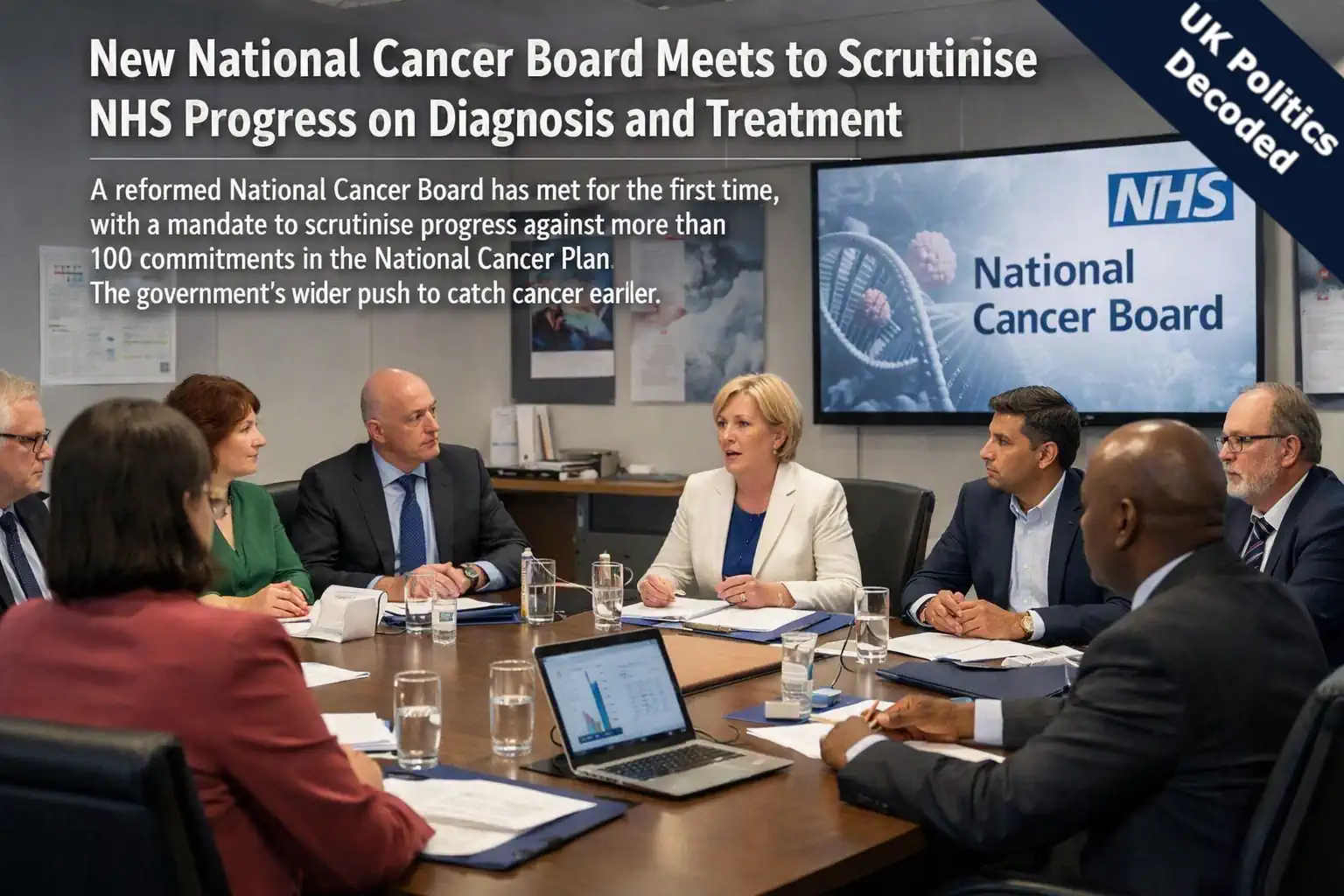
A newly reformed National Cancer Board met for the first time on 21 September 2026, taking on the job of checking whether the NHS is keeping pace with its own cancer improvement plan. The board, announced by the Department of Health and Social Care, NHS England and Health Secretary Yvette Cooper, will scrutinise progress against more than 100 commitments set out in the National Cancer Plan, identifying where things are slipping and advising ministers on what needs to change.
The plan itself, published in February 2026, set a long term ambition that three in four people diagnosed with cancer should be cancer free or living well five years after diagnosis by 2035. The board's job is to hold the system to that promise, rather than simply cheerleading it.
At a glance
- The reformed National Cancer Board held its first meeting on 21 September 2026, with a remit to track more than 100 commitments in the National Cancer Plan.
- Around 250,000 more people were diagnosed on time, or had cancer ruled out, over the past year compared with the year before the last election, according to the Department of Health and Social Care.
- All three national cancer waiting time standards are now performing better than they were a year ago, the department says.
- The board has dedicated leads covering rare cancers, children and young people, and inequalities in cancer care.
- Anita Charlesworth and Mark Cubbon will co-chair the board, which will meet quarterly and publish an annual progress assessment.
Why the National Cancer Board Was Rebuilt to Track 100+ NHS Commitments
The National Cancer Board is not a brand new body so much as a rebuilt one, given sharper teeth and a narrower focus. Rather than acting as a general advisory forum, it now exists specifically to check delivery against the National Cancer Plan and to tell ministers, in Charlesworth's words, "where the plan needs to be strengthened or refreshed."
Cooper framed the change as a response to how widely cancer touches families across the country. "Most families are affected by cancer at some point in our lives," she said. "That is why our National Cancer Plan is so important to provide earlier diagnosis, more advanced treatment and improve outcomes for everyone affected by cancer." She said she was looking forward to working with Charlesworth's team "to deliver the change that every person in our country wants to see."
The department points to recent progress as evidence the plan is already moving the dial. It says all three national cancer standards are performing better than a year ago, and that around 250,000 more people were diagnosed on time, or had cancer ruled out, over the past year than in the year before the last general election. Whether that improvement continues, and how quickly, is precisely what the board now exists to monitor.
Meet the Five People Now Holding the NHS to Its Cancer Plan
Anita Charlesworth, an independent co-chair, will lead the board alongside Mark Cubbon, who represents both NHS England and the Department of Health and Social Care. The government says pairing an independent figure with an NHS insider is intended to reassure patients and the public that progress is being scrutinised properly rather than marked by the system itself.
Three further members hold dedicated briefs. Dr Rob Metcalf is the clinical lead for rare cancers, including brain tumours. Dr Dianne Addei leads on inequalities in cancer care. Ashley Ball-Gamble, chief executive of the Children and Young People's Cancer Coalition, represents children and young people with cancer. The department says these roles exist so that groups who can be overlooked in broader NHS statistics, such as patients with rare tumours or from under served communities, have a specific voice attached to the board's work.
Professor Peter Johnson, NHS England's national clinical director for cancer, said bringing together "clinical experts, charity leaders and patients" would help ensure the plan's commitments are delivered, while the dedicated leads would "give a stronger voice to those who can too often be overlooked."
The board is due to meet every quarter. It will publish an annual assessment of progress against the plan, with a more detailed review scheduled after three years to work out whether the plan itself needs strengthening or revising.
Cancer Charities Welcome the Board But Want Faster Diagnosis, Not Just Oversight
Several major cancer charities responded to the board's launch, broadly welcoming the added scrutiny while pressing for it to translate into visible change. Michelle Mitchell, chief executive of Cancer Research UK, said delivering lasting change "will require strong leadership and clear accountability," and singled out earlier diagnosis, waiting times and treatment access as the areas that matter most to patients.
Gemma Peters, chief executive of Macmillan Cancer Support, said the board's first meeting was "an important moment for turning the National Cancer Plan from ambition into action," adding that patients "now need to see those commitments translated into real change." She also welcomed the dedicated inequalities lead as central to delivering the plan fairly.
Chris Walden, chief executive of the umbrella charity Cancer52, said his organisation was "proud to bring the collective voice and experience" of its member charities to the board, particularly for people with rare and less common cancers. Rachel Kirby-Rider of Young Lives vs Cancer welcomed the appointment of Ashley Ball-Gamble specifically, noting that 12 children and young people are diagnosed with cancer every day in the UK.
The reactions suggest broad support for the principle of stronger scrutiny, but also an expectation among charities that the board's quarterly meetings and annual assessments will need to show concrete movement on diagnosis times and treatment access, not just structural change at the top of the system.
Key Takeaways
- The reformed National Cancer Board met for the first time on 21 September 2026, with a mandate to track delivery of the National Cancer Plan's 100 plus commitments.
- The Department of Health and Social Care says around 250,000 more people were diagnosed on time, or had cancer ruled out, over the past year than before the last election.
- Dedicated board leads now cover rare cancers, children and young people, and inequalities in cancer care.
- Anita Charlesworth and Mark Cubbon co-chair the board, which will meet quarterly and publish annual progress assessments.
- Major cancer charities welcomed the relaunch but said patients need to see the scrutiny translate into faster diagnosis and better access to treatment.
Sources & Further Reading
- GOV.UK - Expert team to drive improvements in cancer care Archived copy (OGL): archived page