AI Use: AI tools were used to support source discovery and to structure the article for clarity. All research, verification, drafting, and final editorial decisions are fully human led. Learn about our AI policy.
UKPoliticsDecoded is an IMPRESS regulated public interest publisher. Read our editorial standards.
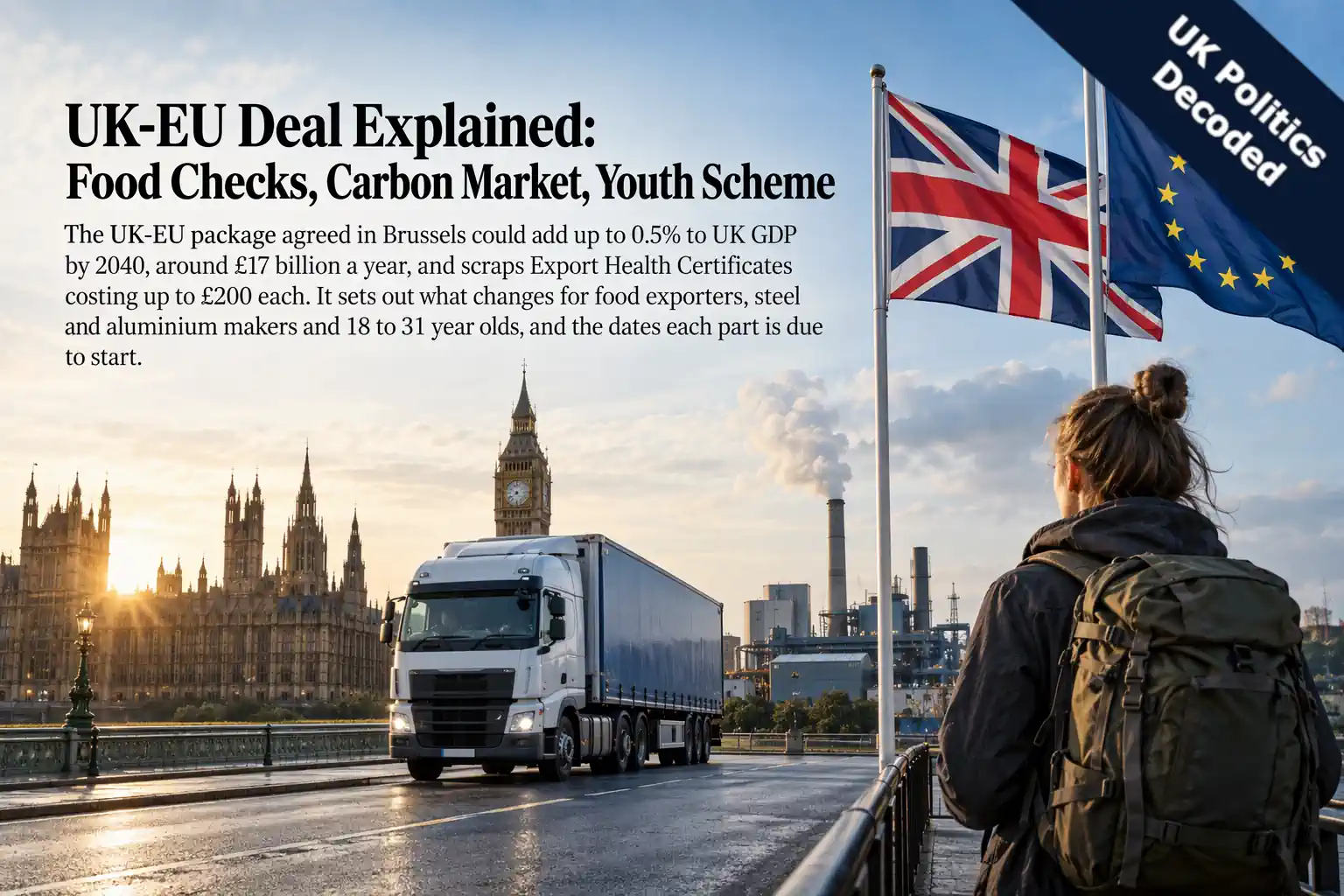
Prime Minister Andy Burnham has agreed a package of deals with the European Union at the UK-EU Summit in Brussels, covering food and farming trade, carbon markets and a new youth mobility scheme. The government says that together they could add up to 0.5% to UK GDP by 2040, equivalent to around £17 billion a year.
The announcement came on 20 November 2026, with a set of GOV.UK explainers published alongside it. Most of the changes will not bite for some time. The food trade agreement is due to apply from 1 March 2028, the carbon market link is aimed at 1 January 2028, and the first young people are not expected to travel under the new scheme until January 2030 at the latest. Legislation is still to come.
At a Glance
- The government says the deals agreed in Brussels on 20 November 2026 could add up to 0.5% to UK GDP by 2040, equivalent to around £17 billion a year.
- Export Health Certificates, which can cost up to £200 each, will be scrapped for food and farm goods moving between Great Britain and the EU under a new Sanitary and Phytosanitary Agreement due to apply from 1 March 2028.
- Linking the UK and EU carbon markets would exempt around £6.5 billion of UK exports from the EU Carbon Border Adjustment Mechanism, with the link aimed at 1 January 2028.
- A Youth Experience Scheme will open to 100,000 UK and 100,000 EU people aged 18 to 31 every year, letting them live, work, study or travel in each other's territories for up to three years.
- The UK and EU also agreed a new Structured Dialogue on migration and a wider security and defence package, including joint action on Russia's shadow fleet.
What the UK-EU Summit Deal Actually Includes
The package has three headline agreements and a wider set of commitments around them. The headline deals cover trade in food, agricultural goods, animals and plants, the linking of the UK and EU emissions trading systems, and a Youth Experience Scheme. Around them sit agreements on migration, law enforcement, security and defence, plus a longer list of work that is still to be negotiated.
Downing Street describes the package as a "win-win" and says it addresses "the shortcomings of a threadbare Brexit deal". Speaking at the summit, the Prime Minister said that "ten years on from Brexit, today we open a new chapter", and that the deal "cuts costs for business, helps with the cost of the weekly shop, and creates opportunities for young people". Those are the government's own characterisations, and the economic estimates behind them are government projections to 2040 rather than forecasts of what will happen next year.
The figures break down by deal. According to the government, the food and drink agreement could add up to £5.1 billion a year to the economy by 2040, equivalent to up to 0.14% of GDP. HM Treasury analysis suggests the carbon market link could add up to £3.8 billion a year by 2040. The youth scheme is credited with increasing GDP by up to 0.2%. The sources do not set out how these individual estimates combine into the 0.5% total, so the three should not simply be added together.
Will Food Prices Fall? How the SPS Agreement Changes Trade
The Sanitary and Phytosanitary Agreement, usually shortened to SPS, is the part of the package with the most direct link to supermarket shelves. It sets new rules for trade in food, agricultural goods, animals and plants, and creates what the government calls a Common SPS Area in which the UK and EU apply the same rules.
The government's starting point is a figure on the damage done since Brexit. It says UK agrifood exports to the EU have fallen by 32.5% since 2019, and that goods moving between Great Britain and the EU have faced extra checks and paperwork ever since. Ministers argue the new agreement will make it easier and cheaper to move many products, and that this will help to ease pressure on food prices. The sources say the deal will "ease the pressure on supermarket prices". They do not put a number on any change in what shoppers pay.
The savings for businesses are more specific. Export Health Certificates, which can cost up to £200 each, will no longer be needed for goods moving between Great Britain and the EU, and the requirement will also go for movements from Great Britain to Northern Ireland. Phytosanitary certificates will be scrapped too, saving around £25 per certificate and at least £127.60 per load in inspection fees. Time consuming SPS border checks on goods such as dairy, fish and meat will be eliminated. Certificates of Inspection for organic products will go as well.
Some British products blocked from the EU market after Brexit will be able to return. The government names fresh sausages, burgers, seed potatoes and molluscs, and the Prime Minister's press release adds Welsh mussels and Scottish seed potatoes. Pet owners get a smaller but visible change, instead of an animal health certificate for every trip, a multi use pet passport valid for travel to the EU.
Northern Ireland is covered through the interplay of the SPS Agreement and the Windsor Framework. For the vast majority of agri-food goods, plants and agricultural machinery moving from Great Britain to Northern Ireland, traders will no longer need regulatory certificates, routine checks or additional paperwork. The NI Plant Health Label Scheme will no longer be needed, and the NI Retail Movement Scheme will stay only for goods covered by transition arrangements.
Does the UK Have to Follow EU Food Rules? Dynamic Alignment Explained
The agreement works on the basis of what the government calls dynamic alignment. That means the UK and EU apply the same rules at the same time, on an ongoing basis, across the areas the agreement covers. Where the UK aligns, the government says it will have "an early decision shaping role" on EU rules while they are still being developed.
The Common SPS Area covers a long list of subjects, including animal health and breeding, plant health, food and feed safety, animal welfare, fishery products, food labelling, organics, and the regulation of pesticides and biocides. It does not cover wine and spirits. It also does not include the EU's Common Fisheries Policy or fisheries management rules, so the UK keeps control of those. Fisheries products caught by EU vessels outside UK waters will be able to be sold on the GB market in line with EU minimum marketing size requirements.
Three exceptions to alignment have been agreed. The UK will keep its ban on exporting livestock and horses for fattening or slaughter outside the British Islands. It will bring in its own measures against pet smuggling, including stricter rules banning dogs and cats under six months old or heavily pregnant from being brought to Great Britain, with tightly controlled exemptions including for genuine EU pet owners, and a review after five years. And England's precision breeding framework will stay in place until July 2028, when the EU's new genomic technique framework for plants takes effect, with businesses able to keep marketing precision bred products under the English rules until October 2029.
The government also stresses that biosecurity is protected. The UK will gain access to EU bodies and systems including the European Food Safety Authority, the Community Plant Variety Office and biocides related elements of the European Chemicals Agency, while keeping the ability to take targeted action where there is a clear biosecurity threat. The agreement applies to Great Britain and to the Crown Dependencies of Jersey, Guernsey and the Isle of Man.
Transition Periods Agreed Under the SPS Agreement
- Goods already on the Great Britain market when the deal applies can continue to be sold and used, even if they do not comply with EU rules.
- Farmers get between 9 and 21 months for final use up of certain pesticides, depending on the product, while Assam tea imports under current GB residue rules can continue for a further 12 months.
- Biocide products have targeted transitional arrangements of up to 42 months, and certain treated articles get a 6 month transition.
- Organic poultry housing and egg production changes have a 12 month transition, and cell cultivated products, precision fermentation products and cannabidiol foods authorised before the deal applies can continue until October 2029.
What the UK-EU Carbon Market Link Means for Steel and Exporters
The second major agreement links the UK Emissions Trading Scheme with the EU Emissions Trading System. An emissions trading scheme caps total greenhouse gas emissions and lets participants buy and sell allowances, which creates a financial incentive to cut pollution. The UK set up its own scheme in 2021 after leaving the EU. At the May 2025 summit, both sides committed to pursue a link, and negotiations began in late 2025.
The commercial pressure behind the deal is the EU's Carbon Border Adjustment Mechanism, known as CBAM, which puts a carbon cost on certain imports. The government says UK exports in scope of CBAM are worth around £6.5 billion, and that linking the two schemes will secure exemptions from the UK and EU versions of the mechanism. The press release names steel and aluminium among the exports that would be exempt. Without an exemption, the government says, UK exporters would face a significant administrative burden and financial costs that would flow to the EU budget.
Both sides are working to operationalise the link for 1 January 2028. From that point, allowances issued in either scheme can be used for compliance across both. The first surrender deadline where UK and EU allowances will be accepted across both schemes is 30 September 2028, covering operators' obligations for the 2027 compliance year. The UK and EU will pass the necessary legislation in 2027 and make technical changes to their registries. The legal agreement itself has not yet been published, and the government says it will be released in due course alongside a more detailed explainer.
The government says the link creates the world's largest linked carbon market, giving industry access to a deeper and more liquid market and greater price certainty. Airlines and shipping companies that operate under both schemes would no longer have to comply with two separate systems. The government also points to opportunities for British firms to sell CO2 storage services to European neighbours, and vice versa. It cites the Carbon Capture and Storage Association's estimate that this market could be worth over £4 billion a year in export revenues and £7 billion in private investment. That figure is the association's estimate, not a government forecast.
The UK ETS and EU ETS will stay as two separate but linked systems. The UK ETS Authority, made up of the UK, Scottish and Welsh governments and Northern Ireland's Department of Agriculture, Environment and Rural Affairs, keeps decision making powers over the UK scheme. The government says the agreement preserves flexibility to set the UK cap in line with Carbon Budgets, UK specific transitional arrangements for free allocation, and the UK's ability to pursue its own model for integrating greenhouse gas removals. The agreement also includes dynamic alignment, as the food deal does.
Youth Experience Scheme: Who Can Apply and for How Long
The Youth Experience Scheme is the most visible change for individuals. Young people from the UK and the EU aged 18 to 31 will be able to live in each other's territories for up to three years to work, study, au pair, volunteer or simply travel. The age is measured on the day the visa starts. There is no need for a job offer, and the press release says there will be no language or salary requirements. Participants are not tied to any particular activity.
The scheme is capped at 100,000 EU and 100,000 UK young people every year, with places distributed between Member States by relative population size. A visa or residence permit will be valid for two years initially, with the option to extend for a third. UK citizens apply to one participating Member State and can later switch, up to two times, so that they spend time in a maximum of three Member States over three years. A minimum of 12 months' residence in a state is required before switching.
It is not open ended freedom of movement. The government describes the scheme as capped, time limited and visa based, with no access to benefits and no right to bring dependants. At present, UK citizens can visit the Schengen Area visa free for up to 90 days in any rolling 180 days, and longer stays require a visa or residence permit tied to a specific purpose. The government notes that young people from Canada, Japan and New Zealand can already rely on bilateral working holiday arrangements in many Member States.
What Applicants Will Need Under the Youth Experience Scheme
- Applicants must be within the age range, hold the right nationality and not have taken part in the scheme before.
- They must pay an application fee, provide biometric information where required and show they have enough funds to support themselves.
- They must state their intended primary activity when applying.
- EU participants coming to the UK pay the Immigration Health Surcharge at a discounted rate of 75% of the full charge, while UK participants must hold comprehensive healthcare coverage.
Some details are still to come. The agreement lets the UK and each participating Member State restrict participants' access to the labour market, although the government says both sides intend to offer broad access and that the vast majority of participating Member States do not plan to impose work restrictions on UK participants. The exact terms, including any restrictions, will be published before the agreement is signed. The government expects the first young people to travel no later than January 2030.
Channel Crossings, Defence and Digital: The Rest of the UK-EU Package
Beyond the three main deals, the UK and EU agreed to set up a new Structured Dialogue on migration, which will take what the government calls a whole of route approach covering irregular migration, smuggling networks and border management. They also agreed to work together under the Channel Action Plan to break up the criminal networks behind people smuggling and human trafficking. Ministers say cooperation with Europe has already helped stop over 50,000 attempted small boat crossings, and that Channel crossings are down 40% on last year.
The law enforcement elements include enhanced information exchange, with stronger sharing of biometrics, criminal records and electronic evidence. A Working Arrangement with the EU Agency for Asylum is in development.
On security, both sides committed to a shared ambition on peace, security and defence, building on the Security and Defence Partnership agreed in 2025. They will consult more regularly and coordinate rapidly on serious security challenges. The government lists three commitments, cracking down on Russia's shadow fleet through intelligence sharing, joint action and better protection of vital infrastructure at sea, working together to defend against cyber attacks and other hostile activity, including through joint exercises and starting new talks on protecting democracies, including keeping elections free and fair. Support for Ukraine remains the top priority, building on the £260 million package, including 1,000 long range drones, which the Prime Minister announced at the Coalition of the Willing meeting in Berlin on Thursday.
A number of other items were left open. The two sides will work towards a Digital Partnership covering AI, quantum, digital infrastructure, digital credentials and online safety, which they aim to conclude early next year. A Dialogue on Economic Security will be established, with work on supply chains in steel, electric vehicles and emerging technologies reviewed every four months. Negotiations on tuition fees for UK and EU students are due to conclude within six months. The UK and EU also agreed to expedite an agreement on recognising professional qualifications for architects and to explore solutions for touring artists.
When Do the UK-EU Changes Start? The 2028 Timetable
The SPS Agreement and the detailed domestic changes it needs will be implemented through the European Partnership Bill and a programme of secondary legislation. The government has said it intends to legislate for early access to EU food and feed market authorisations and health and ID marks, and for some early alignment measures on pesticides and biocides. The details remain subject to legislative processes. The agreement applies from 1 March 2028 subject to UK and EU procedures, with targeted transition arrangements in limited areas.
Dates and Terms Set Out So Far
- The carbon market link is aimed at 1 January 2028, with a first joint surrender deadline of 30 September 2028.
- The SPS Agreement is due to apply from 1 March 2028, subject to UK and EU procedures.
- The first Youth Experience Scheme participants are expected to travel no later than January 2030.
- Tuition fee negotiations are due to conclude within six months.
Still to Be Published or Agreed
- The legal text of the emissions trading link and a detailed explainer on it.
- The exact labour market terms and any restrictions under the Youth Experience Scheme.
- The details of the European Partnership Bill and secondary legislation.
- The Digital Partnership, which the two sides aim to conclude early next year.
For businesses, the government says it will work with industry and producers to help them prepare, and it encourages firms to check GOV.UK guidance and sign up for updates. The ETS link will also come with a programme of webinars for stakeholders. For individuals, nothing changes today, there is no application route for the youth scheme, and the savings on food trade paperwork depend on the agreement taking effect in 2028.
An earlier UKPoliticsDecoded explainer on the planned SPS agreement is linked in the related coverage below. Readers should note it was written before the final terms were agreed, so the dates and detail in this article, drawn from the government's 20 November publications, take precedence.
Key Takeaways
- The government says the UK-EU deals agreed on 20 November 2026 could add up to 0.5% to UK GDP by 2040, equivalent to around £17 billion a year.
- The SPS Agreement will remove Export Health Certificates, phytosanitary certificates and most border checks on food and farm goods, but requires the UK to align dynamically with EU rules in the areas it covers.
- Linking the carbon markets would exempt around £6.5 billion of UK exports from the EU Carbon Border Adjustment Mechanism, with the link aimed at 1 January 2028.
- The Youth Experience Scheme is capped at 100,000 places each way a year, lasts up to three years and gives no access to benefits or right to bring dependants.
- Legislation through the European Partnership Bill is still to come, and several details, including the ETS legal text and youth scheme labour market terms, have not yet been published.
Sources & Further Reading
- GOV.UK: Prime Minister secures deal with EU to cut costs, keep prices down and create opportunities for young people Archived copy (OGL): archived page
- GOV.UK: UK-EU Summit 2026 Explainer Archived copy (OGL): archived page
- GOV.UK: UK-EU Summit 2026 Explainer, Sanitary and Phytosanitary Agreement Archived copy (OGL): archived page
- GOV.UK: UK-EU Summit 2026 Explainer, Emissions Trading Systems Linking Archived copy (OGL): archived page
- GOV.UK: UK-EU Summit 2026 Explainer, Youth Experience Scheme Archived copy (OGL): archived page