AI Use & Transparency: AI tools were used to support source discovery and to structure the article for clarity. All research, verification, drafting, and final editorial decisions are fully human led. Learn about our AI policy.
UKPoliticsDecoded is an IMPRESS regulated public interest publisher. Read our editorial standards.
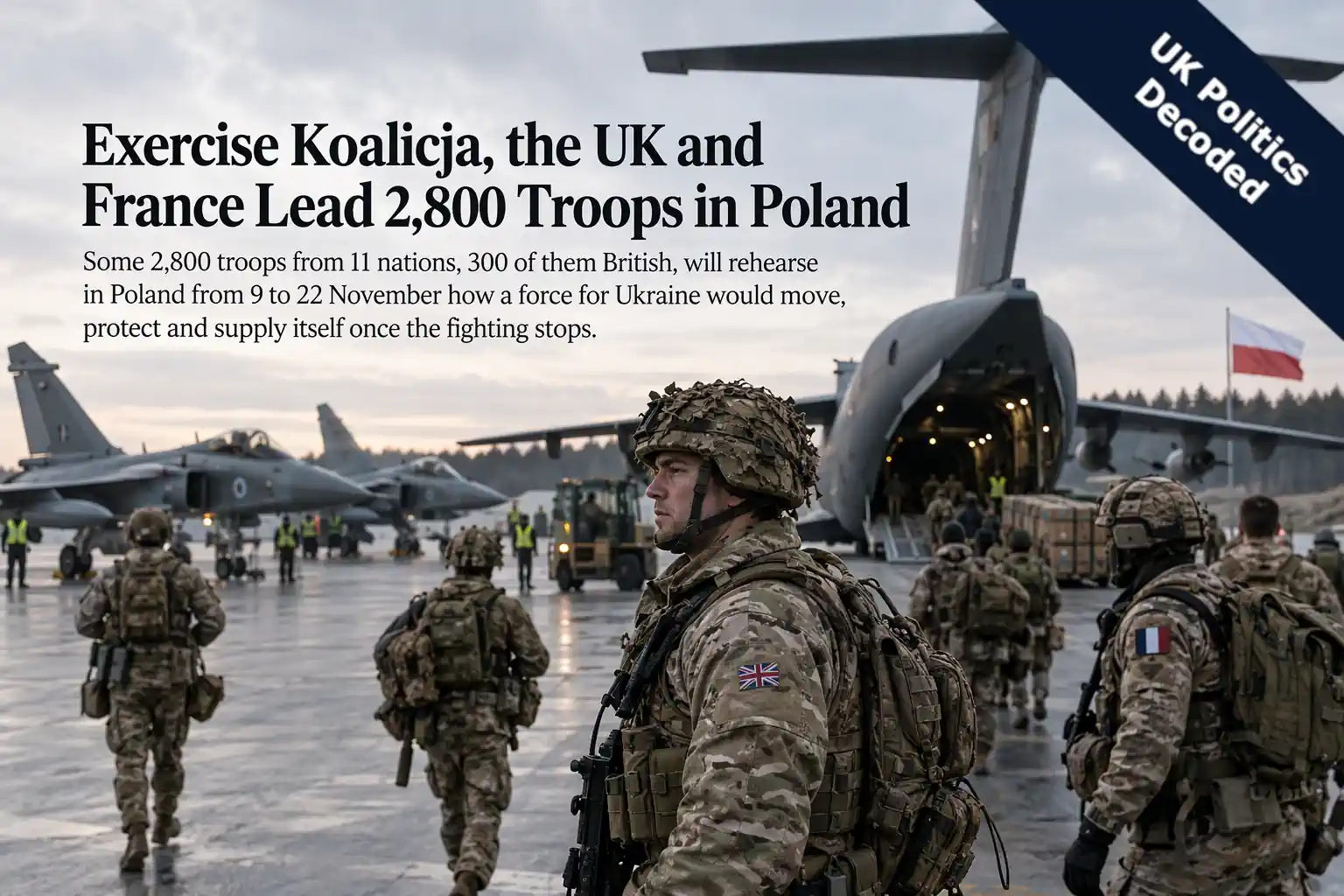
The UK and France will jointly lead Exercise Koalicja, a two week military exercise in Poland that the Ministry of Defence says will rehearse how to secure lasting peace in Ukraine once the fighting ends.
The government announced the exercise on 3 November 2026. It is the first major exercise run by the Multinational Force Ukraine, known as MNF-U, and it runs from 9 November to 22 November.
At a Glance
- The UK and France will jointly lead Exercise Koalicja in Poland from 9 to 22 November 2026, the first major exercise run by the Multinational Force Ukraine.
- About 2,800 troops from 11 nations will take part on land, in the air and at sea, including 300 UK personnel.
- The Ministry of Defence says the force would only enter Ukraine after fighting has ceased and at the request of Ukraine's government.
- The force would not carry out peacekeeping or ceasefire monitoring duties, according to the department.
- British Lieutenant General Tom Bateman commands the force, and its headquarters is due to move from Paris to London this year.
What Is Exercise Koalicja and Who Is Taking Part?
Koalicja is Polish for "coalition", and the name fits. The exercise is the first major test of MNF-U, which the Ministry of Defence describes as the military arm of the Coalition of the Willing. That is a group of nations that have pledged stronger military, economic and diplomatic support to Ukraine.
Around 2,800 troops will take part. Eleven countries are sending forces, Belgium, Estonia, France, Germany, Lithuania, the Netherlands, Poland, Spain, Sweden, Türkiye and the UK.
Britain's contribution is 300 personnel. Soldiers from the Army's 7 Brigade, known as the Desert Rats, will rehearse logistical movements, while RAF Typhoons and a Voyager refuelling aircraft fly sorties overhead. The MOD says the jets will simulate how they would reassure commercial air travel once Ukraine's skies reopen.
There is a maritime strand too. Turkish forces will stand up the force's maritime element in Istanbul, testing arrangements for mine clearance so that commercial shipping can safely return to Ukraine's ports.
What the Multinational Force Ukraine Would and Would Not Do
The department is explicit about the limits. In the event of peace, MNF-U would help underpin Ukraine's future security by enabling safer Ukrainian skies and seas and by regenerating Ukrainian forces. It would move into Ukraine only once fighting has ceased, and only at the request of Ukraine's government.
It would not act as a peacekeeping force or monitor a ceasefire. That distinction matters, because the exercise is framed around rebuilding Ukraine's Armed Forces rather than policing a line between two armies.
Command sits with a Briton. Lieutenant General Tom Bateman, a three star general, leads the force, and the UK and France share leadership of the wider structure. According to the MOD, the headquarters is set to move from Paris to London this year.
What Will 2,800 Troops Practise in Poland?
The exercise is built around three jobs, moving, protecting and supplying a force that would help rebuild Ukraine's Armed Forces. In practice, the MOD says that means testing command and control arrangements, rehearsing the movement of personnel, equipment and supplies, and assessing how different components can operate as one multinational force.
Those are unglamorous tasks, but they are where coalition forces tend to find problems. Eleven nations bring different equipment, procedures and chains of command, and the exercise is designed to show whether they can work together before any real deployment is considered.
Streeting and Bateman on a "Real Force, Ready to Help Ukraine"
Defence Secretary Wes Streeting said the exercise shows the UK "is stepping up, alongside France and our allies, to prepare for the day peace comes to Ukraine". He described it as "not a hypothetical plan" but "a real force, ready to help Ukraine once the fighting stops". He added that "Ukraine's security is our security".
Lieutenant General Bateman said the exercise "will show that the Multinational Force, Ukraine is a real, capable, readily deployable force". He said the force would be "more ready every day" to support Ukraine when the fighting ends, so that Ukraine's Armed Forces are "in the strongest possible position to deter future aggression".
The MOD's wider argument is that a stable Ukraine helps protect the UK, Europe and the rules based international order. It says Britain continues to provide military aid and training to Ukrainian forces and to work with allies on economic and diplomatic pressure on Russia. In the department's words, the UK "has never sought confrontation with Russia", but "not seeking confrontation does not mean failing to defend ourselves and our Allies".
Cost and Deployment Date, What the Government Hasn't Said
The announcement closes with a funding line. The government says it is delivering the biggest sustained increase in defence spending since the Cold War, reaching 2.7% of GDP from 2027-28, with nearly £300 billion over four years.
The announcement does not give a cost for Exercise Koalicja itself, and it does not say when or whether the force would deploy. Any move into Ukraine, the MOD says, depends on the fighting ending first.
Key Takeaways
- Exercise Koalicja runs from 9 to 22 November 2026 in Poland and is the first major exercise run by the Multinational Force Ukraine.
- About 2,800 troops from 11 nations are taking part, including 300 UK personnel, RAF Typhoons and a Voyager refuelling aircraft.
- The Ministry of Defence says the force would enter Ukraine only after fighting has ended and at the request of its government.
- The force would not carry out peacekeeping or ceasefire monitoring duties, and its focus is helping to regenerate Ukraine's Armed Forces.
- The government has not published a cost for the exercise or a date for any deployment.