AI Use: AI tools were used to support source discovery and to structure the article for clarity. All research, verification, drafting, and final editorial decisions are fully human led. Learn about our AI policy.
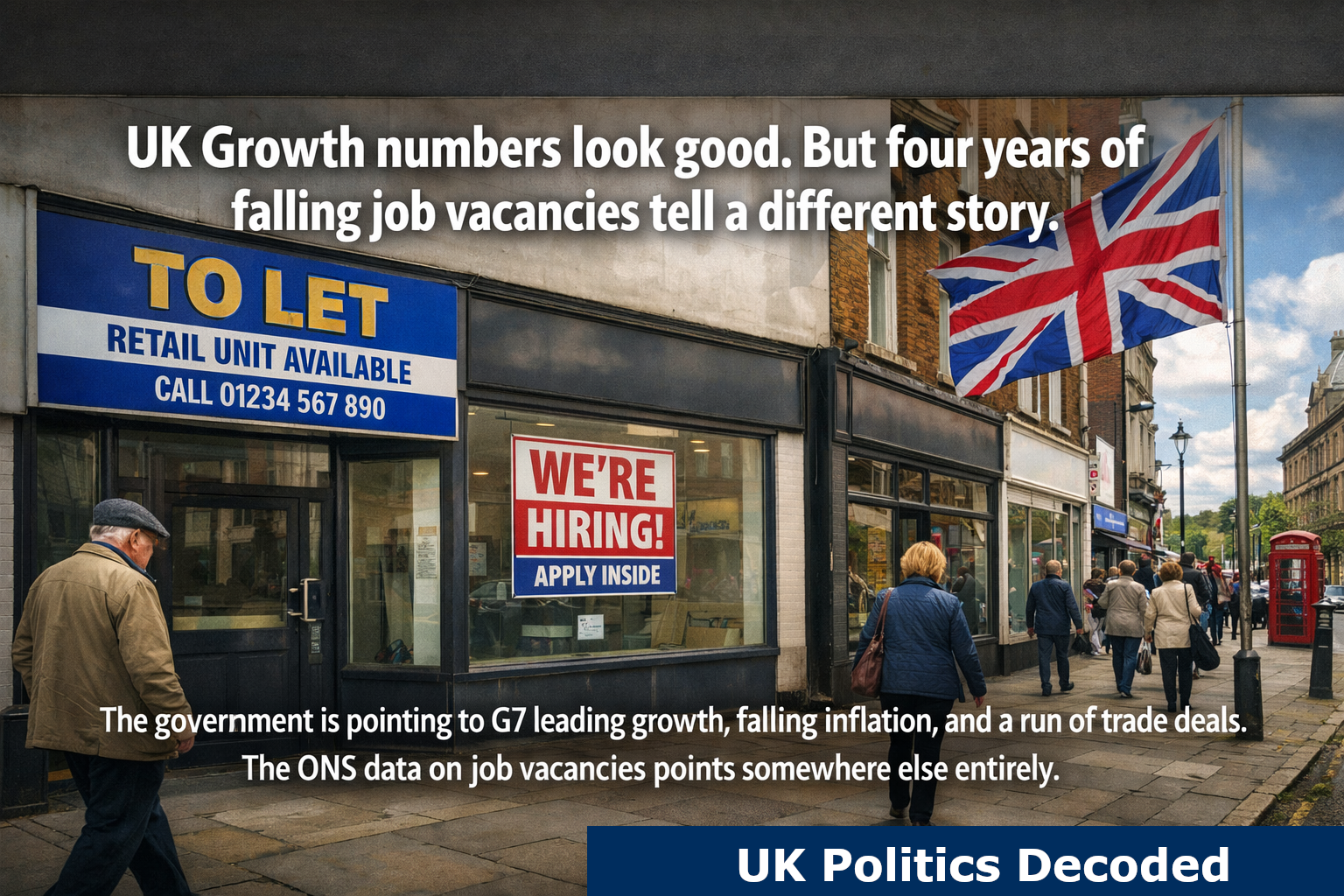
The UK is the fastest growing economy in the G7, inflation has fallen to 2.8%, and net migration is at its lowest level since 2021. That is the picture the Prime Minister painted on 23 May, when Keir Starmer set out what the government has described as a comprehensive record of progress in delivering on its economic promises.
There are genuine headline wins in there. GDP growth beat expectations at 0.6% in the first quarter of 2026. NHS waiting lists have fallen to their lowest point in three and a half years. A landmark trade deal with the Gulf Cooperation Council was concluded on 20 May, making the UK the first G7 nation to agree such a deal with the six country bloc.
But running alongside those numbers is a different set of statistics, drawn from the same official sources, which paints a more complicated picture of the labour market and the people who depend on it.
Key Points
- G7 growth leader: UK GDP grew 0.6% in Q1 2026, the fastest in the G7 according to government figures.
- Vacancies at five year low: ONS data for February to April 2026 shows UK job vacancies have fallen to 705,000, the lowest level since early 2021.
- Four years of decline: Vacancies peaked at approximately 1.3 million in mid 2022. They have fallen in 13 of 18 industry sectors in the latest period.
- Long term unemployment rising: 474,000 people are now classed as long term unemployed, the highest figure since 2016, according to ONS data.
- Trade deals as a response: The government has agreed five major trade deals since taking office. Whether they translate into new jobs, and over what timescale, is uncertain.
The vacancy picture
The Office for National Statistics publishes monthly vacancy estimates drawn from its Vacancy Survey. The most recent figures, covering February to April 2026, put total estimated vacancies at 705,000. That is down 54,000, or 7.1%, compared with the same period a year ago. It is the lowest reading since February to April 2021 and outside the pandemic period, the lowest since September to November 2014.
The decline is not a blip. Vacancies peaked at around 1.3 million in the three months to May 2022, as the economy reopened after Covid restrictions and employers competed intensely for workers. Since then, the number has fallen almost every quarter. The January to March 2026 figures, published a month earlier, recorded 711,000 vacancies already 8.3% lower than the same period in 2025 and 9.9% below pre pandemic levels in early 2020.
The contraction has spread across sectors. The latest ONS bulletin notes vacancies fell in 13 of the 18 industry categories tracked. Construction has seen some of the steepest drops, down 40.4% year on year in the December 2025 to February 2026 period. Retail and hospitality, sectors that have historically provided entry level work and second jobs, have shed more than 150,000 roles in the year to April 2026, according to ONS payroll data.
What that means for unemployment and welfare
A tightening vacancy pool does not automatically translate into rising unemployment, but when hiring slows across broad sections of the economy, the effects accumulate. The ONS employment bulletin for April 2026 records unemployment at 4.9% for December 2025 to February 2026, up 0.5 percentage points on the year. That equates to approximately 1.78 million people out of work.
Long term unemployment those out of work for more than twelve months has reached 474,000, the highest level since January 2016. The unemployment rate for 16 to 24 year olds now stands at 16.2%, the highest since January 2015. The Office for Budget Responsibility, in its March 2026 outlook, forecast the unemployment rate to peak at 5.3% during 2026 before beginning a gradual decline.
The Claimant Count, which measures people receiving unemployment related benefits, stood at approximately 1.694 million in March 2026, according to the ONS. The OBR has separately flagged that incapacity and health related benefits caseloads have grown around 7% per year on average since the pandemic, and projects that growth will continue at a slower pace through to 2030.
ONS vacancy data in context
- Peak: Approximately 1.3 million vacancies, three months to May 2022.
- Latest (Feb-Apr 2026): 705,000, down 7.1% year on year. Lowest since early 2021.
- Pre pandemic comparison: Current vacancies are 10.6% below January to March 2020 levels.
- Long term unemployed: 474,000, the highest since January 2016 (ONS).
- OBR unemployment forecast peak: 5.3% during 2026 before a gradual decline to around 4.1% by 2030.
The government's trade agenda and what it is meant to deliver
Trade policy is the government's primary lever for generating new economic activity and the business certainty it argues will, in time, underpin new hiring. Since taking office, ministers have concluded agreements with India, the United States, the European Union on agri-food standards, South Korea, and most recently the Gulf Cooperation Council.
The GCC deal, announced on 20 May 2026, removes an estimated £580 million in annual tariff duties on UK goods exports once fully implemented. Government modelling projects a long run GDP gain of £3.7 billion a year compared to a 2040 baseline with no deal, a bilateral trade increase of roughly 19.8%, and a £1.9 billion increase in real wages, equivalent to around £60 per worker per year in the long run. Those are modelled estimates, not near term forecasts, and they come with the caveat that the deal must still be formally ratified before any provisions take effect.
The UK-India deal, signed in July 2025 and currently completing parliamentary ratification, is modelled alongside the GCC agreement to project a combined GDP uplift of around £8.5 billion a year in the long run. The House of Commons Library, in a briefing published on 21 May 2026, summarises the state of all UK trade negotiations, noting that agreements with South Korea, Switzerland, Turkey, and Greenland are either concluded or in progress.
The government has also announced targeted domestic measures, including legislation to give small firms stronger protection against late payments and VAT cuts on hospitality, intended to ease pressure on the sectors where vacancy declines have been sharpest.
What the trade agenda is designed to do
- Remove tariff barriers that add cost and uncertainty for exporters, particularly in food, manufacturing, and professional services.
- Create new market access for UK firms in high growth regions, the Gulf states, India, and the Asia-Pacific bloc through CPTPP.
- Signal investment confidence to businesses considering whether to expand UK operations and headcount.
- Reduce trade friction with the EU through the SPS agri-food alignment agreement, benefiting sectors heavily exposed to cross border logistics costs.
Where the evidence is less clear
- Trade deal GDP gains are long run modelled estimates. The OBR's employment forecasts for 2026 do not assume material near term uplift from them.
- Vacancies have fallen in 13 of 18 industry sectors despite an improving macro picture, suggesting structural, not purely cyclical, pressures.
- Small and medium businesses, which account for most private sector employment, face rising labour costs from National Living Wage increases and higher employer National Insurance contributions introduced in 2025.
- Welfare caseload growth particularly in health and disability benefits reflects factors well beyond the jobs market, including post pandemic health trends.
Reconciling the headline numbers
The tension between the government's economic headline figures and the labour market data is not straightforwardly a contradiction. GDP growth and employment can diverge, particularly when growth is led by higher margin sectors financial services, professional services, and technology rather than the mass employment industries of manufacturing, retail, and construction.
The Prime Minister's 23 May statement noted that 416,000 more people are in work compared with a year ago, a claim consistent with the ONS employment figures. But the Claimant Count and long term unemployment data indicate that a growing share of those not in work are spending longer out of it, and that the benefit system is absorbing more of that pressure over time.
The OBR's March 2026 fiscal outlook described current labour market weakness as driven "primarily by entrants into the labour force struggling to find work amid subdued hiring demand." That is a demand problem. Trade deals can help create demand, but their effects take years to work through supply chains, investment decisions, and hiring plans not months.
The GCC and India trade deals both require parliamentary ratification before any terms take effect. The ratification process involves scrutiny under the Constitutional Reform and Governance Act, and implementing legislation will be needed for some provisions. Until that process completes, the headline GDP and wage projections remain modelled scenarios, not outcomes.
For the labour market, the OBR forecasts unemployment peaking at 5.3% in 2026, then falling gradually to an estimated equilibrium rate of around 4.1% by 2030. That trajectory assumes subdued hiring demand eases as the economy closes what the OBR describes as a negative output gap, the difference between what the economy is producing and what it could produce at full capacity.
Whether the government's trade programme accelerates that recovery, and whether it creates the kind of roles that address the persistent vacancy shortage in construction, retail, and entry level services, will only become clear as the deals move from signing ceremonies to the factory floor and the shop front.
Key Takeaways
- UK GDP grew 0.6% in Q1 2026, the fastest in the G7. Inflation fell to 2.8% and net migration is at its lowest since 2021.
- ONS data for February to April 2026 puts job vacancies at 705,000, down 7.1% year on year and the lowest since early 2021. They are now below pre pandemic levels.
- Vacancies have been falling since mid 2022 and have now declined in 13 of 18 industry sectors. Long term unemployment stands at 474,000, a ten year high.
- The government has concluded five trade deals since taking office. The GCC and India agreements are modelled to add £8.5 billion to annual GDP in the long run, but neither is yet in force.
- The OBR forecasts unemployment to peak at 5.3% in 2026 before gradually falling. Trade deal benefits are long run projections, not near term employment guarantees.
Sources & Further Reading
-
GOV.UK - PM: Government turning progress into results for working people (23 May 2026)
Archived copy (OGL): archived page -
ONS - Vacancies and jobs in the UK, May 2026 (covering February to April 2026)
Archived copy: archived page -
ONS - Employment in the UK, April 2026 (covering December 2025 to February 2026)
Archived copy: archived page -
OBR - Economic and Fiscal Outlook, March 2026
Archived copy: archived page -
House of Commons Library - Progress on UK free trade agreement negotiations (21 May 2026)
Archived copy: archived page -
GOV.UK - The UK's trade agreements (Department for Business and Trade)
Archived copy (OGL): archived page