AI Use: AI tools were used to support source discovery and to structure the article for clarity. All research, verification, drafting, and final editorial decisions are fully human led. Learn about our AI policy.
The government announced on 15 June 2026 that LinkedIn will share anonymised labour market data with Skills England and the Department for Work and Pensions. The partnership covers LinkedIn's 40 million UK accounts and is designed to give ministers a clearer picture of how people move between jobs, where skills gaps exist, and what career routes are available in different parts of the country.
It is framed as a response to the way modern working life has changed. Cabinet Office Minister Pat McFadden, who met LinkedIn's Chief Global Affairs Officer Blake Lawit to mark the announcement, described it as giving government "a clearer understanding of the jobs market, what employers need, where opportunities are, and how people are building their careers." LinkedIn itself notes that professionals entering the workforce now are on pace to hold twice as many jobs over their careers compared with 15 years ago.
What the Announcement Covers
- Data shared: Anonymised, aggregated insights on jobs, skills, hiring trends, and workforce movement drawn from LinkedIn's 40 million UK accounts. No individual member data will be passed to DWP.
- Lead partner: Skills England will manage the partnership on behalf of DWP, with an initial focus on mapping local skills mismatches between job adverts and the skills of local residents.
- Future use: The data could eventually feed into the government's planned Jobs and Careers Service, providing jobseekers with more tailored career and skills advice.
- Context: The Skills England Annual Report found that 1.8 million additional jobs will be needed in priority sectors by 2035, underlining why understanding skills flows matters.
- Privacy: Data collection will take place within LinkedIn's own systems. Only anonymised findings will be shared externally with Skills England.
The immediate priority, according to the government's announcement, is mapping where there is a mismatch between the skills local employers are advertising for and the skills of the local workforce. That kind of granular, near real time labour market intelligence is something official data has historically been slow to capture.
LinkedIn's dataset is large and frequently updated. When someone in Stoke changes role to take a job in logistics, or a Birmingham resident retrain into healthcare, that movement is reflected relatively quickly in platform data. The ONS Vacancy Survey, by contrast, is a monthly sample based estimate. The government's argument is that layering LinkedIn's aggregated insights on top of official statistics would produce a more dynamic picture of where people are moving, why, and what skills they needed to get there.
Phil Smith, Chair of Skills England, said the resulting insights would be "incredibly valuable" for identifying local skills gaps and helping young people to fill them. The announcement sits alongside the government's wider £2.5 billion youth employment support package and the forthcoming Jobs and Careers Service, which is intended to consolidate job matching and career guidance into a single government backed platform.
Skills England and the Jobs and Careers Service: The Wider Picture
- Skills England: Created to coordinate skills training across England, working with employers, training providers, and the Migration Advisory Committee.
- Jobs and Careers Service: A planned successor to the current jobseekers portal, intended to offer more personalised career advice and job matching.
- Youth employment: The government has committed £2.5 billion to ensure every young person can "earn or learn," citing the growing frequency of career changes as justification for better career infrastructure.
- Funding Circle research cited: The government's own announcement references Funding Circle data suggesting the average worker will hold seven jobs in their lifetime, with younger workers changing roles more often.
Better data on where jobs are and how people move between them is a reasonable policy ambition. But there is a structural problem in the labour market that improved intelligence tools cannot solve on their own, the number of jobs available is falling.
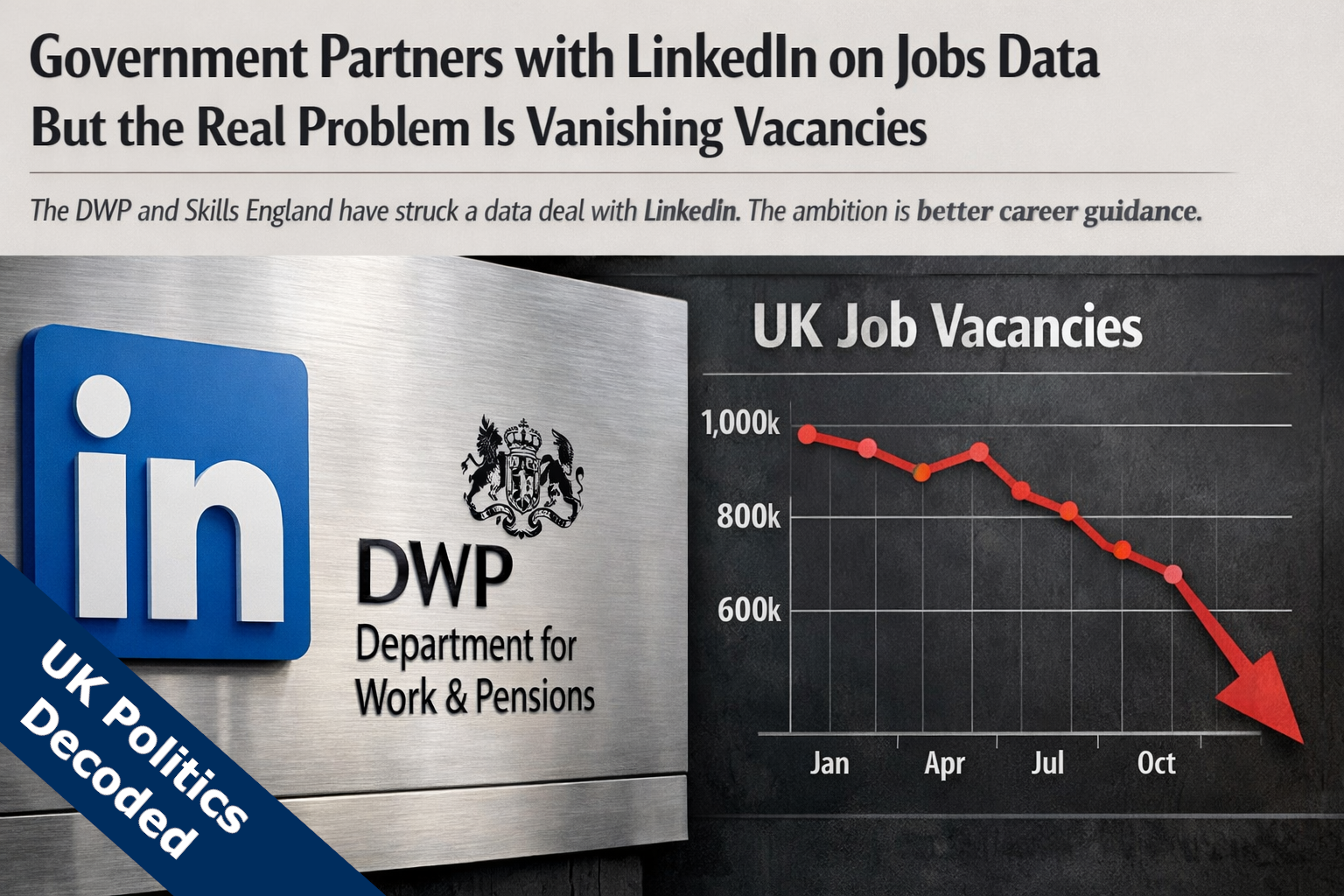
The Office for National Statistics publishes monthly vacancy estimates through its Vacancy Survey. The most recent figures, June 2026 put total estimated vacancies at 707,000. That is down 54,000 or 7.1% compared with the same period a year ago. It is the lowest reading since February to April 2021 and, outside the pandemic period, the lowest since September to November 2014.
This is not a short term dip. Vacancies peaked at approximately 1.3 million in the three months to May 2022, as the economy reopened and employers competed intensely for workers. Since then, the number has fallen in almost every quarter. The latest ONS bulletin records a decline across 13 of the 18 industry sectors tracked, with the largest quarterly falls in arts and entertainment, real estate, wholesale and retail, and accommodation and food service, the kinds of entry level and community facing roles that the Jobs and Careers Service is partly aimed at.
What Better Labour Market Data Could Help With
- Identifying where skills shortages are preventing available vacancies from being filled, even in a low vacancy environment.
- Mapping career transition routes so that people stuck in declining sectors can see credible paths into growing ones.
- Targeting training investment at the specific skills local employers are actually advertising for, rather than national averages.
- Helping young people understand realistic career trajectories, not just entry level roles.
What Better Data Cannot Change
- The overall number of vacancies available in the economy currently at a five year low of 705,000 according to ONS.
- The ratio of unemployed people to vacancies, which now stands at 2.5 to 1, up from 2.1 a year ago.
- The structural pressures on SMEs, including higher employer National Insurance contributions introduced in 2025, which ONS feedback suggests are dampening hiring appetite.
- The scale of health related benefit dependency, which the OBR projects will continue growing through 2030 regardless of the jobs market.
The Claimant Count, which measures people receiving unemployment related benefits, including Universal Credit claimants in the searching for work conditionality group stood at approximately 1.699 million in April 2026, according to ONS figures published in May. That figure increased on the month, though it remains lower than the same point a year ago.
The government's employment reform agenda, including the LinkedIn partnership, the Connect to Work scheme, the Pathways to Work reforms, and the Keep Britain Working review, all proceed from the assumption that the primary barrier is a mismatch, people who could work, but lack the right skills, guidance, or support to connect with available roles.
That is a genuine issue. But ONS vacancy data points to a second problem running alongside it, there are fewer roles to connect people to. When vacancies fall in 13 of 18 sectors, and when the ONS's own Vacancy Survey feedback records that firms are choosing not to recruit because of "economic and geopolitical uncertainty," the constraint is not primarily a skills or information gap. It is a demand gap.
As the Office for Budget Responsibility noted in its March 2026 fiscal outlook, current labour market weakness is being driven "primarily by entrants into the labour force struggling to find work amid subdued hiring demand." Schemes that improve matching however well designed operate on the supply side of that equation. They cannot, on their own, expand the pool of jobs that employers are actively trying to fill.
Key Takeaways
- The DWP and Skills England will receive anonymised labour market data from LinkedIn's 40 million UK accounts, focusing initially on local skills mismatches. No individual data will be shared.
- The partnership is intended to support the forthcoming Jobs and Careers Service and sits alongside a £2.5 billion youth employment package.
- UK job vacancies stood at 705,000 for February to April 2026, according to ONS down 7.1% year on year, the lowest since early 2021, and now 10.6% below prepandemic levels.
- Vacancies have fallen in 13 of the 18 industry sectors tracked by ONS. ONS survey feedback cites economic and geopolitical uncertainty as a reason some firms are not recruiting.
- The OBR has attributed current labour market weakness primarily to subdued hiring demand, not skills mismatches alone, a structural problem that data sharing partnerships are not designed to solve.
Sources & Further Reading
-
GOV.UK - LinkedIn and government join forces to help jobseekers build their careers (15 June 2026)
Archived copy (OGL): archived page -
ONS - Vacancies and jobs in the UK: May 2026 (covering February to April 2026)
Archived copy: archived page -
ONS - UK Labour Market Overview, May 2026 (Claimant Count and vacancies)
Archived internally for verification (19 June 2026) -
OBR - Economic and Fiscal Outlook, March 2026
Archived copy (OGL): archived page