AI Use: AI tools were used to support source discovery and to structure the article for clarity. All research, verification, drafting, and final editorial decisions are fully human led. Learn about our AI policy.
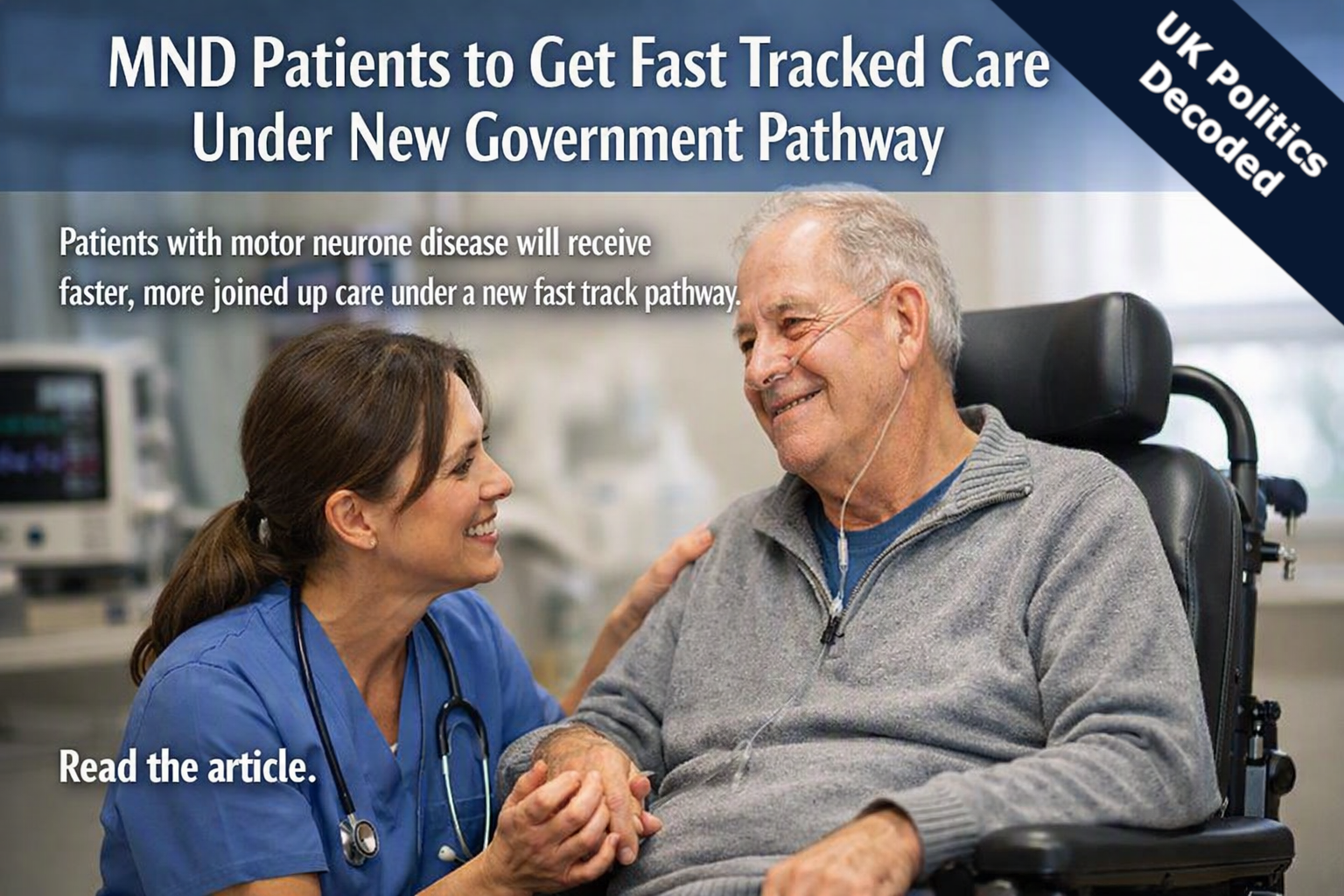
People living with motor neurone disease in England are set to receive faster access to care and support under a new fast track pathway. Health and Social Care Secretary Yvette Cooper made the announcement on 5 August 2026 during a visit to the Rob Burrow Centre for Motor Neurone Disease in Leeds, a facility that brings together specialist MND services under one roof and which the government says will inform the national approach.
MND is a rapidly progressing, terminal condition affecting the nerves that control movement. Currently, patients and their families often have to navigate separate health, social care, and housing services at a time when delays can significantly affect quality of life. The government says the new pathway is designed to address that fragmentation.
Key Announcements at a Glance
- Fast track care pathway: A new national pathway will be developed to speed up access to coordinated care and support for MND patients across England
- Joined up services: The pathway will draw on the Rob Burrow Centre model, bringing health, social care, and housing services together around the patient
- Disabled Facilities Grant changes: Local authorities have been asked to fast track Disabled Facilities Grant applications for MND patients and waive the means test
- Immediate local authority guidance: The government has already written to councils setting out steps to improve services for people with MND now, ahead of the full pathway being finalised
- Part of wider social care reform: The MND announcement sits within the first phase of the government's broader programme to build a National Care Service
The new pathway is still in development and will be shaped through close working with the MND Association, people living with the condition, and partners across health, social care, and housing. But the government has set out what it expects the pathway to deliver.
The pathway will be built around the following principles:
- Proactive care: Services will support people more proactively rather than waiting for a crisis before acting
- Coordinated assessment: Health and social care services will work together to assess and meet people's needs rather than operating in silos
- Advance planning: Care planning will include forward planning as the condition progresses, reducing the need to restart assessments at each stage
- Faster housing adaptations: Local authorities have been asked to speed up Disabled Facilities Grant processes for MND patients and to waive the means test entirely
- Reduced navigation burden: Families will not be expected to manage referrals between multiple services at a time of extreme stress
The announcement draws explicitly on the experience of the Rob Burrow Centre for Motor Neurone Disease, which opened in Leeds earlier in 2026:
Rob Burrow Centre for Motor Neurone Disease
- Location: Leeds Teaching Hospitals, named in honour of the rugby league player Rob Burrow who died from MND in 2024
- Model: Brings specialist MND clinical care, family support, research, and outreach together under one roof
- Status: Six months since opening, the centre's holistic support sessions, research programme, and family outreach are described as taking shape
- National ambition: The government intends to use the centre's approach as a blueprint for how coordinated MND care can be delivered more consistently across England
Ahead of the full pathway being finalised, the government has already written to local authorities in England setting out immediate steps they should take to improve support for MND patients. These are not new legislative duties but represent government guidance on best practice and expectations.
The guidance to local authorities covers five specific areas:
Guidance to Local Authorities
- Fast track access: Councils should expedite care and support access for people with MND without requiring them to wait through standard assessment timelines
- Joined up assessment: Health and social care services should work together when assessing and meeting the needs of MND patients
- Advance care planning: Plans should be made ahead of anticipated changes in the patient's condition, not just in response to deterioration
- Speed up Disabled Facilities Grants: Councils have been asked to accelerate the grant process which funds home adaptations such as ramps, hoists, and accessible bathrooms
- Waive the DFG means test: The means test for Disabled Facilities Grants is to be waived entirely for people with MND, removing a financial barrier to home adaptations
The MND Association welcomed the announcement and will be involved in developing the new pathway alongside the government. Tanya Curry, Chief Executive of the MND Association, described the announcement as "heartening" but called for the commitment to be translated into "real solutions implemented nationally and locally, in health and social care."
- MND Association: Will be closely involved in developing the pathway and has welcomed the announcement as a step in the right direction
- People living with MND: The government has committed to involving patients and carers in shaping the pathway
- Department of Health and Social Care: Leading the pathway development, with Yvette Cooper making the announcement personally at the Rob Burrow Centre
- Local authorities: Expected to implement the immediate guidance now, with the full pathway setting further expectations in due course
Motor neurone disease progresses quickly and unpredictably. For those living with the condition and their families, navigating multiple services, often while managing significant physical and emotional strain, is a well known problem in the UK. The government's announcement acknowledges this directly.
The challenges the new pathway is intended to solve include:
What Should Improve
- Speed of access: Care and support should be arranged more quickly after diagnosis
- Coordination: Health, social care, and housing services working together rather than separately
- Home adaptations: Faster and means test free access to Disabled Facilities Grants for necessary home modifications
- Forward planning: Services planning ahead for how needs will change, rather than reacting each time the condition progresses
What Remains to Be Confirmed
- National rollout timeline: The full fast track pathway is still being developed, no implementation date has been given
- Funding: No specific funding commitment was attached to this announcement
- Consistency: Whether councils will apply the guidance uniformly is not guaranteed without a statutory requirement
- Scope: The precise eligibility criteria and the point at which the fast track is triggered have not yet been published
In March 2026, Baroness Casey's Independent Commission into Adult Social Care highlighted the need for urgent action on MND specifically. That recommendation prompted the government to write to local authorities with immediate guidance on improving services. The 5 August announcement builds on that, framing the fast track pathway as a concrete delivery mechanism.
- Casey Commission timing: Baroness Casey's commission flagged MND in March 2026, the government says it responded to local authorities immediately
- First phase of reform: The MND pathway is explicitly described as part of the "first phase" of fixing social care under the National Care Service programme
- Research commitment: The government separately confirmed it remains committed to supporting research into better treatments and, ultimately, a cure for MND
- Dementia Tsar context: This announcement sits alongside other social care reform actions including the appointment of a Dementia Tsar and new workforce reforms
- 10 Year Health Plan: The MND pathway aligns with the NHS's Medium Term Planning Framework, which emphasises integrated, community based care and reducing fragmented service journeys
The fast track MND pathway does not stand alone. It is part of a wider package of social care reform that the government announced in late July 2026, which includes the broader National Care Service ambitions and a set of immediate improvements being made while longer term legislation is prepared.
The key elements of the wider context are:
National Care Service Reform Timeline
- 29 July 2026: Prime Minister Andy Burnham set out a new approach to social care reform, bringing Baroness Casey's commission deadline forward to summer 2027
- 5 August 2026: Yvette Cooper announced the MND fast track pathway at the Rob Burrow Centre, describing it as part of the first phase of social care reform
- Workforce reforms: Running alongside this, the government has announced measures to strengthen the social care workforce and improve safeguarding arrangements
- Dementia Tsar: An appointment expected before the end of summer 2026 to drive improvements in dementia care
- Commission deadline: Baroness Casey is now expected to report by summer 2027, a year ahead of the original timeline
More than 5,000 adults in the UK are living with MND at any one time, according to the MND Association. On average, six people are diagnosed every day. The condition progresses at different speeds but is always terminal, which is why delays in accessing care and support carry particular weight.
- Prevalence: More than 5,000 adults in the UK living with MND at any given time, according to the MND Association
- Progression: The condition is always terminal and in most cases progresses relatively quickly, making care delays particularly harmful
- Current gaps: Patients and families regularly report having to manage complex, multi agency support arrangements without adequate coordination
- Housing needs: Home adaptations are frequently needed as mobility deteriorates, making the Disabled Facilities Grant changes directly relevant
- Carer impact: Family members and unpaid carers shoulder significant responsibilities, often without formal support
The 5 August announcement marks a genuine commitment to improving care for one of the most demanding patient groups in England. For families living with MND, the immediate guidance to local authorities on Disabled Facilities Grants and fast tracked assessments represents a practical change that, if consistently applied, could reduce some of the day to day stress of navigating the system.
The longer term fast track pathway is still being developed. Until it is finalised and backed by clear expectations for local commissioners, how far the improvements reach in practice will depend on individual council and health trust responses. The MND Association has welcomed the direction while making clear that action, not intent, is what matters.
This announcement is one thread in a much larger tapestry. The government's social care reform programme is at an early stage, with the key decisions on funding, eligibility, and legislation still ahead. What the MND pathway signals is a willingness to act on specific, urgent needs now rather than waiting for the full commission to report.
Key Takeaways
- A new national fast track care pathway for MND patients is being developed, modelled on the approach at the Rob Burrow Centre in Leeds
- Local authorities have already been written to asking them to fast track MND care assessments and waive the Disabled Facilities Grant means test
- The announcement is part of the first phase of wider social care reform linked to the National Care Service programme
- No funding figure or national implementation date for the full pathway has been confirmed
- The MND Association has welcomed the commitment but called for it to be turned into concrete national and local action
Sources & Further Reading
- GOV.UK: Patients with motor neurone disease set for fast tracked care - 5 August 2026 Archived copy (OGL): archived page
- Fit for the Future: 10 Year Health Plan for England - GOV.UK Archived copy (OGL): archived page
- NHS England - Medium Term Planning Framework 2026/27 to 2028/29 Archived copy (OGL): archived page
- GOV.UK: PM sets out new path to fix social care together - 29 July 2026 Archived copy (OGL): archived page
- MND Association: What is Motor Neurone Disease?