AI Use: AI tools were used to support source discovery and to structure the article for clarity. All research, verification, drafting, and final editorial decisions are fully human led. Learn about our AI policy.
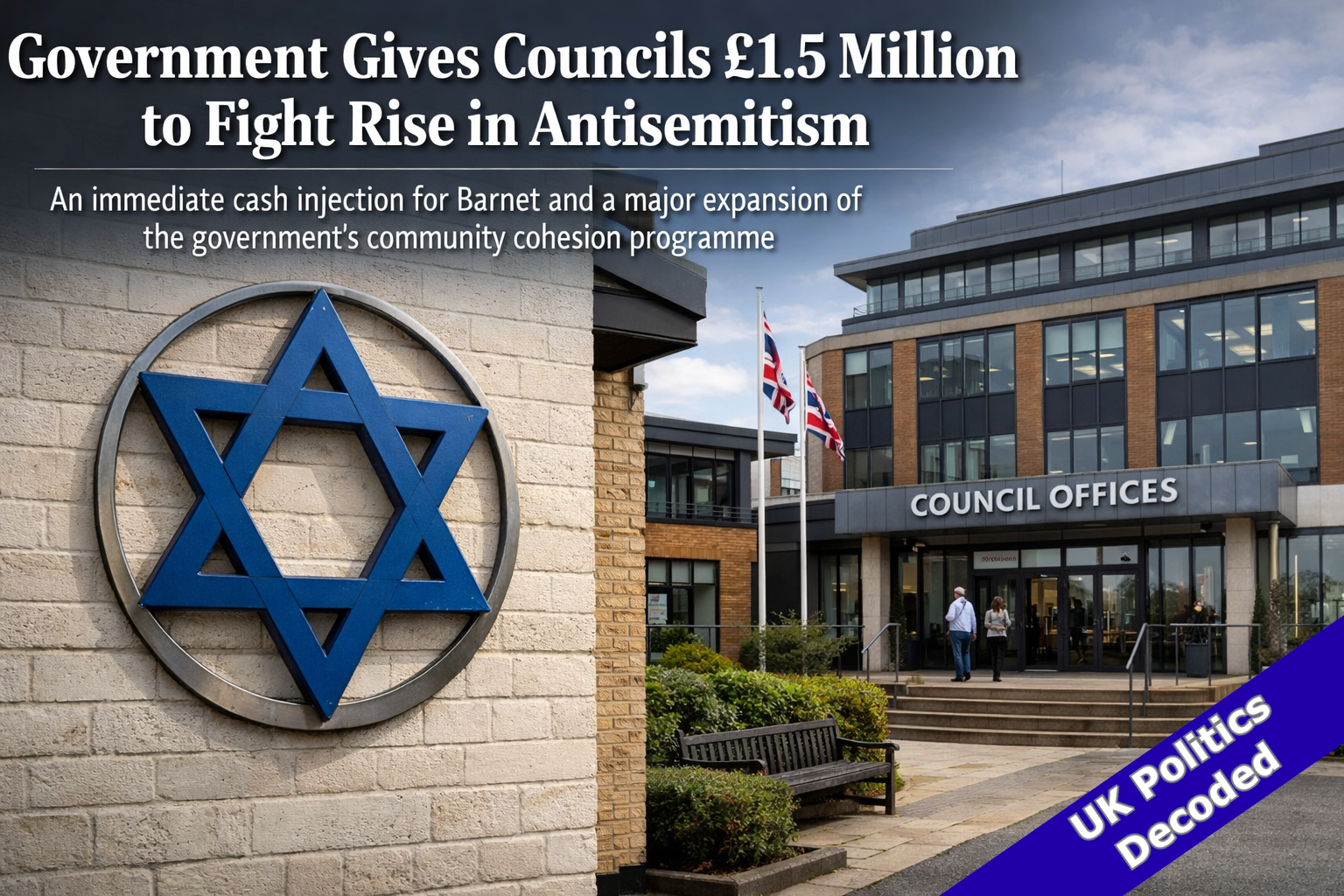
The government has announced £1.5 million in new funding to help councils and communities tackle a sharp rise in antisemitism. The Ministry of Housing, Communities and Local Government (MHCLG) confirmed on 5 May 2026 that £1 million will expand its existing Common Ground programme across England, while a further £500,000 will be paid immediately and directly to Barnet Council in North London, which has seen a serious spike in antisemitic incidents in recent weeks.
The announcement came on the same day the Prime Minister convened senior figures from across politics, business, faith communities, and civil society to call for a collective effort to stamp out anti Jewish hatred. It forms part of a broader package of government measures that now totals over £58 million committed to protecting Jewish communities, following a £25 million police and security funding announcement the previous week.
What Was Announced on 5 May 2026
- £1 million Common Ground expansion: additional funding for MHCLG's existing community cohesion programme, targeted at areas facing the greatest risk of antisemitism today
- £500,000 to Barnet Council: an immediate, ring fenced allocation responding to the concentration of serious antisemitic incidents and the large Jewish population in the borough
- Total government commitment: this funding builds on an existing £4 million already deployed through the Common Ground programme and a £25 million police and security package announced the week prior
- Scope of projects: money will fund community safety work, youth and schools initiatives, interfaith projects, and programmes to challenge antisemitic narratives and hate crime
- Wider strategy: the funding sits alongside the government's Protecting What Matters strategy, which sets out a longer term plan to tackle extremism and antisemitism across all parts of society
Why Is the Government Acting Now?
The government's announcement cited what it described as an alarming rise in antisemitism both in the UK and internationally. The press release referenced the antisemitic terrorist attacks at Heaton Park and Bondi Beach in 2025, as well as a recent spate of antisemitic incidents in North West London. Barnet, which has one of the largest Jewish populations of any local authority in England, was specifically identified as requiring immediate targeted support.
The Scale of the Problem
The backdrop to this funding is a documented increase in anti Jewish hate crime and community tension:
- Rising incidents: the government described the current picture as an "alarming rise" in antisemitism, both in the UK and globally, with Barnet experiencing a recent concentration of serious cases
- International context: the announcement explicitly referenced the Heaton Park and Bondi Beach antisemitic terrorist attacks in 2025 as part of the wider pattern the government is responding to
- Barnet's specific situation: the £500,000 direct allocation was made following Barnet Council's own request to central government for support, reflecting the scale and seriousness of incidents in the borough
- Community fear: the government's press release acknowledged that Jewish communities in certain towns and cities are "most fearful and concerned", which is why funding is being channelled to the highest risk areas rather than spread uniformly
- Prime Ministerial involvement: the level of attention, including a summit convened by the Prime Minister on the same day, signals that the government regards this as a priority issue requiring a cross societal response, not just a policing matter
What Is the Common Ground Programme?
The Common Ground programme is the government's existing mechanism for funding local community cohesion work:
How the Common Ground Programme Works
- Purpose: the programme funds local efforts to strengthen community relations, reduce tensions, and counter hate crime and extremism at a neighbourhood level
- Existing scale: prior to this announcement, the programme had already allocated over £4 million to communities across England
- Who delivers it: funding flows to councils, faith organisations, schools, voluntary groups, and community partnerships rather than being managed centrally by government
- New expansion: the additional £1 million announced on 5 May specifically targets areas facing the greatest current risk of antisemitism, with local partners deciding how to deploy it based on their own circumstances
What Will the Money Actually Fund?
The government has been deliberately broad in describing what the funding can support, giving local partners flexibility to design responses that fit their specific situation. The press release outlined several categories of activity that the money is intended to cover.
Types of Projects That Can Be Funded
The funding is intended to support a range of practical, on the ground interventions:
Eligible Activities Under the Funding
- Community safety work: projects that increase visible safety measures, improve reporting mechanisms, or provide reassurance to Jewish residents and organisations in affected areas
- Youth and schools initiatives: targeted programmes in schools and youth settings to challenge antisemitic attitudes, educate young people about the history and impact of anti Jewish hatred, and promote mutual understanding
- Interfaith projects: work that brings together Jewish communities with other faith and community groups to build relationships and reduce the risk of tension escalating into conflict or hatred
- Challenging antisemitic narratives: local projects aimed at countering the spread of antisemitic conspiracy theories, misinformation, and extremist content, including online
- Rapid visible action: the government emphasised it wants funding to enable quick, practical, and visible responses rather than slow administrative processes, reflecting the urgency of the current situation
Who Gets to Decide How the Money Is Spent?
A notable feature of this funding model is the emphasis on local decision making. The government has said it wants Jewish communities and Jewish organisations, the people most directly affected, to play a central role in designing and delivering the projects that the money funds. This reflects a stated commitment to ensuring that actions work for the communities they are meant to protect, rather than being imposed from Whitehall.
- Local partnerships: councils, faith groups, schools, police, voluntary organisations, and residents are all expected to work together under the programme, with no single body in sole charge
- Jewish community voice: the government specifically said Jewish communities and organisations should be central to developing and delivering the local responses, not just consulted as an afterthought
- Barnet's direct allocation: the £500,000 for Barnet is being paid directly to the council, giving it immediate operational flexibility to deploy resources where they are most needed
- Flexible design: the broad eligibility criteria are intentional, allowing each area to develop a tailored response rather than following a single national template
- Speed of deployment: the language of "rapid, visible action" throughout the announcement suggests the government wants the money spent quickly, not held in reserve or tied up in lengthy procurement processes
How Does This Fit Into the Bigger Picture?
The £1.5 million announced on 5 May is significant in its own right, but it represents one part of a much larger set of commitments the government has made in relation to antisemitism and the safety of Jewish communities. Understanding where this money fits helps to make sense of the scale of the government's overall response.
The Full Package of Government Measures
The funding announced on 5 May sits within a wider strategy:
Funding Already in Place
- £4 million+: already deployed through the Common Ground programme to communities across England before this announcement
- £25 million: announced the previous week to boost police patrols, fund specialist officers, and provide protective security for Jewish communities and sites
- £7 million: specifically allocated to tackle antisemitism in schools, colleges, and universities
- Total commitment: the government states total funding for Jewish community security and safety now stands at £58 million when all strands are combined
New Money Announced 5 May 2026
- £1 million: expansion of the Common Ground programme for areas at greatest risk of antisemitism
- £500,000: immediate direct payment to Barnet Council in response to recent serious incidents in the borough
- Protecting What Matters: this funding is described as part of the government's broader strategy document on tackling extremism and antisemitism across all sectors
- Prime Minister's summit: held on the same day, calling on leaders from across society to act, signalling political priority beyond just financial commitment
What Is the Protecting What Matters Strategy?
The government referenced its Protecting What Matters strategy as the framework within which this funding sits. The strategy sets out the government's wider approach to tackling extremism and antisemitism, covering not just funding but also plans for how different parts of government, the police, schools, and other institutions are expected to respond to rising hatred. The strategy is intended to provide a coordinated, cross government plan rather than leaving individual departments to act in isolation.
- Cross government approach: the strategy spans multiple departments, ensuring that responses to antisemitism are not limited to policing or housing policy alone
- Schools and universities: the £7 million schools funding sits within this strategy, reflecting a view that long term change requires educational as well as enforcement responses
- Community led action: the strategy emphasises local ownership, which explains why the Common Ground programme gives communities significant freedom in how they use funding
- Security and visibility: the police and protective security funding addresses the immediate safety needs of Jewish institutions such as synagogues, schools, and community centres
- Narrative challenge: the strategy also covers countering the spread of antisemitic ideas and conspiracy theories, which the government regards as a driver of real world hatred and violence
What Happens Next?
The announcement on 5 May set out the funding allocations and the broad categories of activity they will support. But there are still a number of steps that will follow before the money translates into projects on the ground, and some aspects of the government's longer term response are still being developed.
Immediate Next Steps
The practical stages that follow this announcement include:
What Can Happen Quickly
- Barnet deployment: the £500,000 direct payment to Barnet Council can be deployed immediately, with the council having flexibility to act without a lengthy bidding process
- Common Ground applications: areas already engaged with the programme or in high risk locations can move quickly to access the additional £1 million
- Police measures: the £25 million security package announced the previous week will already be flowing into increased patrols and specialist staffing
- Community partnerships: local councils and faith groups that already have working relationships can begin commissioning or expanding projects relatively quickly
What Will Take Longer
- Protecting What Matters implementation: the full strategy will take time to embed across all government departments, schools, universities, and other institutions
- Schools programme: the £7 million for schools, colleges, and universities will require programme design, procurement, and rollout before it reaches classrooms
- Measuring impact: the government has not yet set out specific targets or timelines for what the funding is expected to achieve or how success will be defined
- Community trust: building confidence within Jewish communities that government action will make a lasting difference will depend on consistent follow through rather than one off announcements
Why Does the Government's Response Use Local Councils?
It is worth pausing on why the government has chosen to channel much of this funding through local councils and community organisations rather than, for example, directly funding national Jewish community bodies or expanding a purely policing based response. This approach reflects a particular theory of how to tackle community tensions effectively.
The Rationale for Local Delivery
There are practical and policy reasons why local delivery is seen as more effective for community cohesion work:
Why Local Government and Communities Are Central
- Proximity: local councils and community organisations know their areas, their populations, and the specific tensions at play far better than central government departments operating from Whitehall
- Trust: community members are more likely to engage with, report to, and be supported by organisations they already have a relationship with, making local delivery more effective than national programmes
- Flexibility: what works in a borough like Barnet with a large, established Jewish community may be very different from what is needed in a city with a smaller or more dispersed Jewish population, making a one size fits all national approach less appropriate
- Speed: routing funding through existing local structures and partnerships, rather than building new national infrastructure, allows money to reach communities faster
- Complementarity: local community work sits alongside, rather than replacing, the policing and security funding, allowing different tools to address different aspects of the problem simultaneously
Conclusion: A Serious Response to a Serious Problem, but Sustained Action Will Be the Test
The government's announcement of £1.5 million in new antisemitism funding, alongside a Prime Ministerial summit and the broader £58 million security and community safety package, represents a significant escalation in the public response to rising anti Jewish hatred.
The immediate £500,000 to Barnet is a direct and practical response to a specific local crisis. The expansion of the Common Ground programme signals an intent to spread support to other high risk areas, giving local councils and communities the resources and flexibility to act quickly. The framing of Jewish communities as central to designing and delivering the funded work, rather than merely being recipients of it, is also worth noting as a meaningful commitment to genuine co-production.
What the announcement does not yet provide is a clear picture of how impact will be measured, whether this funding level will be sustained beyond the immediate emergency, or how the government intends to tackle the online amplification of antisemitic content that so often precedes real world violence. Those will be the questions that matter most in the months and years ahead.
Key Takeaways
- On 5 May 2026, the government announced £1.5 million in new antisemitism funding: £1 million to expand the Common Ground programme and £500,000 paid immediately to Barnet Council
- The money will fund community safety work, youth and schools projects, interfaith initiatives, and programmes to counter antisemitic narratives at a local level
- Jewish communities and Jewish organisations are explicitly expected to help design and deliver the funded projects, not just receive them
- This funding sits alongside a £25 million police and security package announced the previous week, and £7 million for schools, colleges, and universities, bringing the government's total commitment to £58 million
- The Protecting What Matters strategy provides the overarching framework for the government's approach to tackling extremism and antisemitism across all sectors