AI Use: AI tools were used to support source discovery and to structure the article for clarity. All research, verification, drafting, and final editorial decisions are fully human led. Learn about our AI policy.
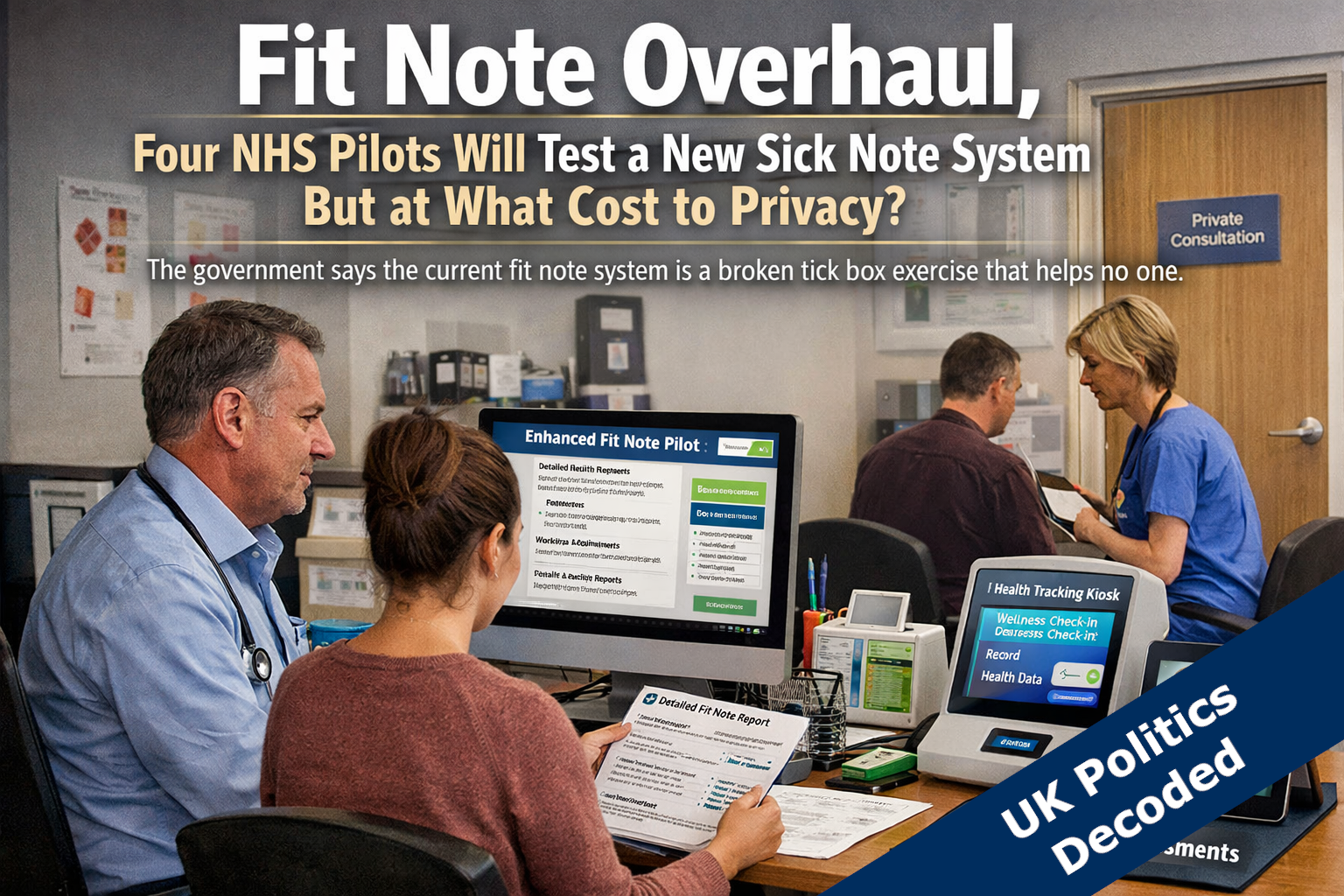
The government announced on 20 May 2026 that it will launch four NHS pilots to overhaul the fit note system, the mechanism through which GPs certify that a patient is unfit, or may be fit, for work. Around 11 million fit notes are issued every year in the UK, and more than nine in ten declare the person "not fit for work." The government describes this as a "tick box exercise" that does not offer patients any real support or guidance.
The announcement came from the Department for Work and Pensions and the Department of Health and Social Care jointly. The pilots, launching in July, will run for up to a year and cover up to 100,000 appointments. They will test whether replacing or supplementing the GP fit note with personalised "stay in work" and "return to work" plans involving employers, clinical staff, and non-clinical practitioners produces better outcomes for patients and reduces workload on GPs.
At a Glance
- 11 million fit notes issued annually in the UK, more than nine in ten marking someone "not fit for work"
- Four pilots launching July 2026 across Birmingham and Solihull, Coventry and Warwickshire, Cornwall and the Isles of Scilly, and Lancashire and South Cumbria
- Up to 100,000 appointments covered across the pilots over up to one year
- £3 million in first year funding for the NHS based pilots through WorkWell sites
- 29% of primary care staff say issuing fit notes is a good use of GP time, according to the government's own Call for Evidence findings
- 60% of employers think the current process is ineffective at supporting their employees' work and health needs
What the Government Is Proposing
The pilots will trial two broad models. In some areas, GPs will issue an initial fit note and refer patients to a new support service. In others, GPs will refer patients directly to that service without issuing a fit note at all. The support service will be staffed by a mix of clinical and non-clinical practitioners including social prescribers and work and health coaches depending on the pilot area.
A key feature of the proposed new approach is a three way conversation between the patient, their employer, and a trained professional, from the first day of absence. The aim is to keep people connected to their workplace, discuss reasonable adjustments, and prevent long term sickness absence from becoming entrenched.
The four pilot areas and their models
- Birmingham and Solihull: GPs issue an initial fit note where needed, all patients referred to a new support service led primarily by non-clinical staff including social prescribers and work and health coaches
- Coventry and Warwickshire: GPs issue the first fit note, patients can be referred to a service staffed by both clinical and non-clinical staff
- Cornwall and the Isles of Scilly: GPs refer patients directly to a non-clinical support service without issuing a fit note
- Lancashire and South Cumbria: GPs refer patients to a service staffed by both clinical and non-clinical staff, without issuing a fit note
The pilots sit within the existing WorkWell programme, a health led, locally delivered service designed to help people with a disability or health condition stay in or return to work. WorkWell is expanding nationally and has been allocated up to £235.4 million across seven NHS regions, with London receiving the largest allocation at £40.3 million.
The Case for Reform
There is genuine, broad based support for changing the current system. The BMA's GP Committee contributed to the pilot design and described the current fit note system as "not working for GPs or patients." The Royal College of GPs acknowledged that fit note administration "takes time away from patient care." The Confederation of British Industry called the system "broken" and said it "fails employers, workers, and the economy."
The pilots were recommended by Sir Charlie Mayfield, former chairman of John Lewis, in his Keep Britain Working Review into economic inactivity. His review found the fit note system was "not working as intended" and had become a barrier to contact between patients and employers, rather than a bridge.
The government's own Call for Evidence, based on the previous government's April 2024 consultation, found that just 29% of primary care staff consider issuing fit notes a good use of GP time. The current system, in its most common form, produces a binary outcome fit for work, or not fit for work with little guidance, no treatment plan integration, and no structured conversation between the people most directly affected.
The Questions the Pilots Do Not Yet Answer
The argument for reform is coherent. What is less clear is whether the proposed solution addresses the right problems and what new ones it might introduce.
Medical privacy and the employer's role
The current fit note system is rooted in the clinical relationship between a patient and their GP. When a GP issues a fit note, it reflects a medical assessment. Referrals to other services, physio, mental health, specialist care are typically made at the same point, through established NHS pathways, without the employer being part of that clinical conversation.
The new model proposes three way conversations involving the employer from the first day of absence. That raises a legitimate question, at what point does an employer's involvement in a patient's work and health plan begin to mean access to that patient's medical situation? The government's announcement does not detail what information will be shared with employers, what consent mechanisms will govern that sharing, or how patients will be protected if their employer uses that information in ways that disadvantage them.
Patients with sensitive conditions, mental health diagnoses, HIV, chronic conditions affecting capacity have a reasonable interest in controlling what their employer knows. The current system offers a degree of protection precisely because the GP acts as a clinical gatekeeper and the fit note contains limited information. A system designed around employer participation risks eroding that boundary, even if unintentionally.
Cybersecurity and data risk
Any expansion of the people and systems that hold or access health adjacent data increases the attack surface for bad actors. The NHS has been subject to serious cyberattacks in recent years, including the 2024 Synnovis ransomware attack which disrupted blood transfusion services across London NHS trusts. Adding employer facing systems or portals that connect employment data to health and work plans creates new data sets that are valuable precisely because they combine medical status with employment information.
The government's announcement does not address what data architecture will underpin the new system, who will hold the records produced by three way consultations, how long they will be retained, or what security standards will govern employer access. These are not hypothetical concerns, they are standard questions for any new health adjacent data system, and they deserve answers before a national rollout.
The reform case
- GP workload: 11 million fit notes a year, only 29% of primary care staff see it as good use of their time
- Patient outcomes: the current system offers no personalised support or structured return to work pathway
- Employer engagement: early, supported contact can prevent short term absence becoming long term
- Evidence base: the Keep Britain Working Review specifically recommended piloting new approaches
The unanswered questions
- Privacy: what medical information will employers access, and under what consent framework?
- Data security: who holds three way consultation records, and to what standard?
- Admin burden: a more complex, multi party process may not reduce workload, it may relocate it
- Employer bias: involving employers from day one risks prioritising return to work over patient recovery
Administration and the GP workload question
One of the stated aims of the reform is to reduce the administrative burden on GPs. That is a reasonable goal. But it is worth asking whether a system that involves coordinating between a patient, an employer, a work and health coach, clinical staff, and potentially a social prescriber is inherently simpler than a GP issuing a fit note and making a referral through existing NHS channels.
GPs already routinely make referrals at the point of issuing a fit note. The current pathway, assessment, fit note, referral to physiotherapy, mental health, or occupational health is familiar, documented, and governed by established clinical protocols. The new system adds parties to that process. Whether that reduces net administration or simply moves some of it out of general practice and into a new coordination layer is something the pilots will need to measure carefully.
The BMA welcomed the pilots but was explicit that "appropriate training, clinical oversight and clear governance" must underpin them, and that the process must "not inadvertently increase pressure on general practice." That caveat matters. If the new service requires GPs to brief, coordinate with, or oversee non-clinical practitioners handling their patients' work and health plans, the administrative saving may be smaller than assumed.
Is the new system needed, or does the current one need resourcing?
The government frames the problem as a system failure. An alternative reading is that it is, at least partly, a capacity failure. GPs issue fit notes quickly and without detailed support plans not because the system is fundamentally wrong, but because many practices do not have the time or the allied health resource to do more. Occupational health services are patchy. Social prescribers are unevenly distributed. Mental health waiting lists are long.
A system that routes patients to a support service staffed by social prescribers and work and health coaches is only as good as the availability of those practitioners. The pilots are funded at £3 million in year one across four sites. A national rollout of a system that requires dedicated multi disciplinary support teams at scale is a substantially larger commitment, one the government has not yet costed publicly.
Key Takeaways
- Four NHS pilots launching in July 2026 will test whether personalised work and health plans involving employers, clinical and non-clinical practitioners can replace or supplement the GP fit note
- The government's own evidence shows 29% of primary care staff consider fit notes a good use of GP time and 60% of employers say the current system fails their staff
- The pilots will cover up to 100,000 appointments over up to a year, backed by £3 million in first year NHS funding through WorkWell sites
- The proposed three way conversations between patients, employers, and practitioners raise unresolved questions about what medical information employers will access and under what safeguards
- Any new system holding health adjacent employment data creates additional cybersecurity exposure, the government has not yet published details of the data architecture or security standards that will govern it
- Adding parties to the consultation process may relocate administrative burden rather than reduce it, the pilots will need to measure that carefully before any national rollout
Sources & Further Reading
-
GOV.UK - Broken fit note system to be overhauled (DWP & DHSC, 20 May 2026)
Archived copy (OGL): archived page - GOV.UK - Keep Britain Working Review (Sir Charlie Mayfield, 2025) Archived copy (OGL): archived page
- GOV.UK - Fit Note Call for Evidence findings (DWP, published May 2026) Archived copy (OGL): archived page