AI Use: AI tools were used to support source discovery and to structure the article for clarity. All research, verification, drafting, and final editorial decisions are fully human led. Learn about our AI policy.
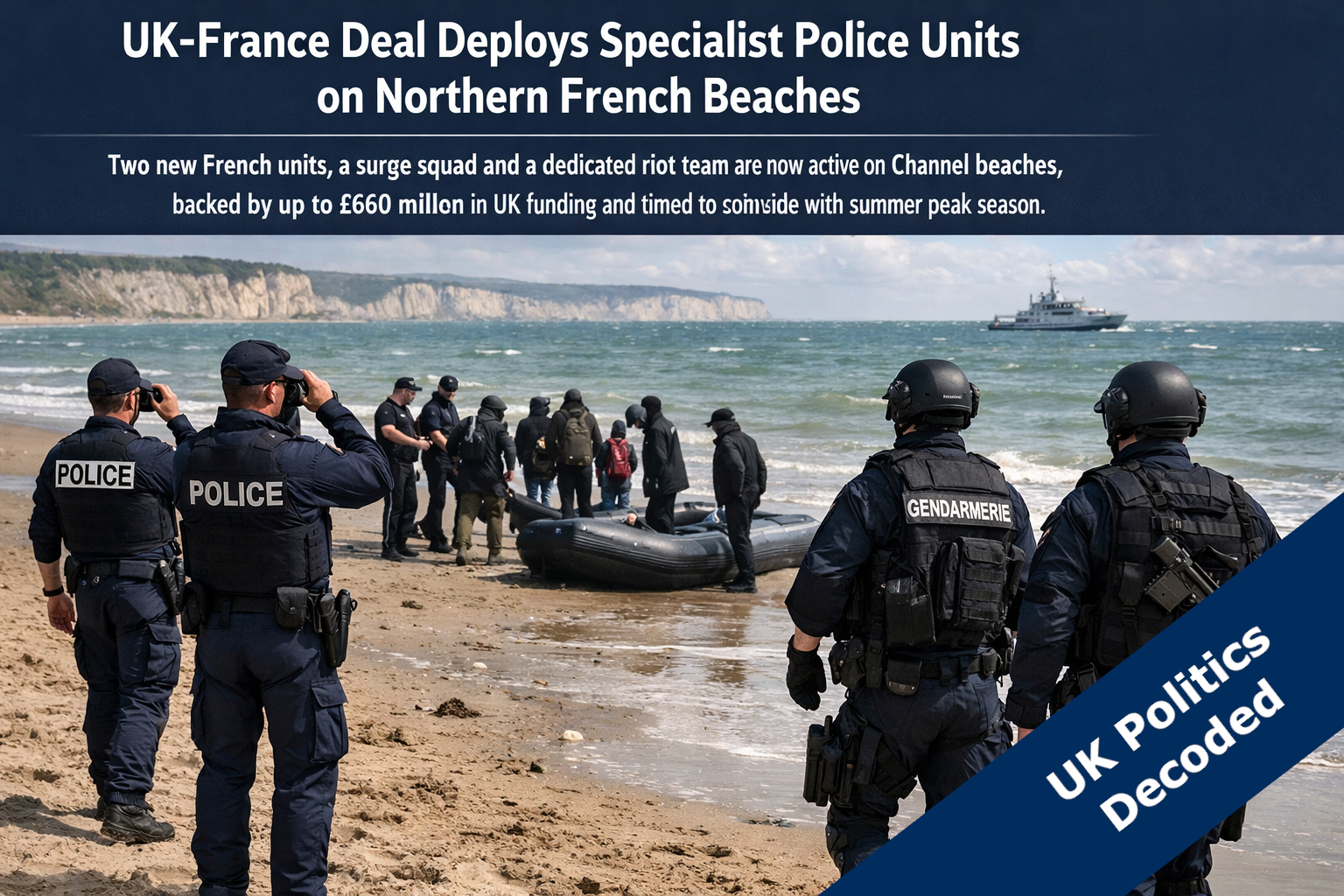
Two specialist French police units are now deployed on Northern France's beaches, the government announced on 17 June 2026. The move marks the first major operational step under the landmark UK-France immigration deal signed earlier this year by Home Secretary Shabana Mahmood and her French counterpart.
The deployment brings 125 officers and reservists to the French coastline, covering two distinct units with different powers and tactics and comes deliberately ahead of summer, when crossing attempts historically rise.
What the Government Has Announced
- Compagnie de Marche: 75 specialist officers deployed on a surge basis, focused on breaking up launch attempts, seizing equipment and disrupting crossings before migrants reach the water.
- CRS riot unit: A brand new 50 officer Compagnie républicaine de sécurité unit, France's first dedicated Channel riot team trained in crowd control and equipped to respond to hostile or evolving smuggler tactics.
- Combined strength: 125 officers and reservists in total, with the Compagnie de Marche surging numbers through summer months on intelligence led deployment.
- Funding commitment: £500 million committed upfront, with a further £160 million available conditional on results, totalling up to £660 million.
- Performance linked: For the first time, the funding is explicitly tied to outcomes if new tactics are not effective, funding stops after one year and is reallocated.
The two units have different remits. The Compagnie de Marche is an existing crack squad with a proven track record, the government says it was linked to 20% of all small boat event preventions in 2025. Under the new deal, it will be backed by drones, helicopters, planes and cameras, giving officers real time intelligence on where and when to deploy. The unit has public order powers allowing it to break up launch attempts and pursue criminal smugglers directly on the beach.
The CRS unit is newly created specifically for this purpose. Riot trained officers are designed to handle more hostile scenarios, violent crowds, organised launch attempts, or situations where standard enforcement units would be outmatched. The government says this team addresses a gap in France's previous enforcement capacity along the coast.
The beach deployments sit within a broader bilateral agreement that goes beyond officer numbers. The deal also involves joint cross border intelligence work, with recent operations extending into Germany, a raid led by French authorities, involving the UK's National Crime Agency and German Federal Police, seized dozens of boats and engines that the government says could have carried more than 2,000 people to the UK.
What Else the Agreement Covers
The full scope of the deal, as stated by the government:
Deal Components
- Officer boost: More than 40% increase in law enforcement officer numbers on Northern French beaches under the agreement.
- Surveillance technology: Enhanced drone, helicopter, plane and camera systems to support the Compagnie de Marche's operations.
- Conditional funding: The £160 million top up is explicitly performance linked, if targets are not met, it stops after one year.
- International enforcement: Coordinated operations across Western Balkans, Germany, France and the UK targeting supply chains used by people smuggling gangs.
Ministers point to a series of figures to frame the new deployments in context. In May, a surge in joint enforcement operations stopped what the government describes as almost half, 40% of all small boat crossing attempts from Northern France. Since the last general election, the government says 44,000 small boat crossing attempts have been prevented and nearly 70,000 people have been removed from the UK having entered illegally.
Separately, UK investigators last week secured the first sentences under the Border Security Act. Two men, Mohammad Tajik, an Afghan national, and Alnour Mohamed Ali, a Sudanese national, were sentenced at Canterbury Crown Court to two years and two years and three months respectively, for endangering others during a sea crossing and entering the UK illegally.
Prime Minister Keir Starmer said almost half of all attempted crossings were halted by the French last month, adding: "We're boosting them further to continue to drive down crossings." Home Secretary Shabana Mahmood said the pressure was being placed "exactly where it needs to be, on French beaches, targeting the criminal gangs and stopping launches before they can happen."
The announcement covers enforcement on French soil only. It does not change UK domestic asylum law, the processing of claims, or the legal framework for removals. The Border Security Act, under which the first smuggling convictions have now been brought, is a separate piece of domestic legislation. The UK-France deal also sits alongside, rather than replacing, other international arrangements the government has pursued including a new treaty with Germany, returns deals with France and Iraq, and tighter law enforcement cooperation across the Western Balkans.
Key Takeaways
- 125 specialist French officers and reservists are now active on Northern French beaches under the UK-France deal, announced 17 June 2026.
- The Compagnie de Marche (75 officers) focuses on disrupting launches, the new CRS riot unit (50 officers) handles hostile crowd scenarios.
- Up to £660 million in UK funding underpins the deal, £500 million committed, £160 million performance linked.
- The funding is explicitly conditional, if new tactics fail to deliver results, the additional £160 million stops after one year.
- The first convictions under the Border Security Act were secured the same week, with two small boat pilots sentenced at Canterbury Crown Court.