AI Use: AI tools were used to support source discovery and to structure the article for clarity. All research, verification, drafting, and final editorial decisions are fully human led. Learn about our AI policy.
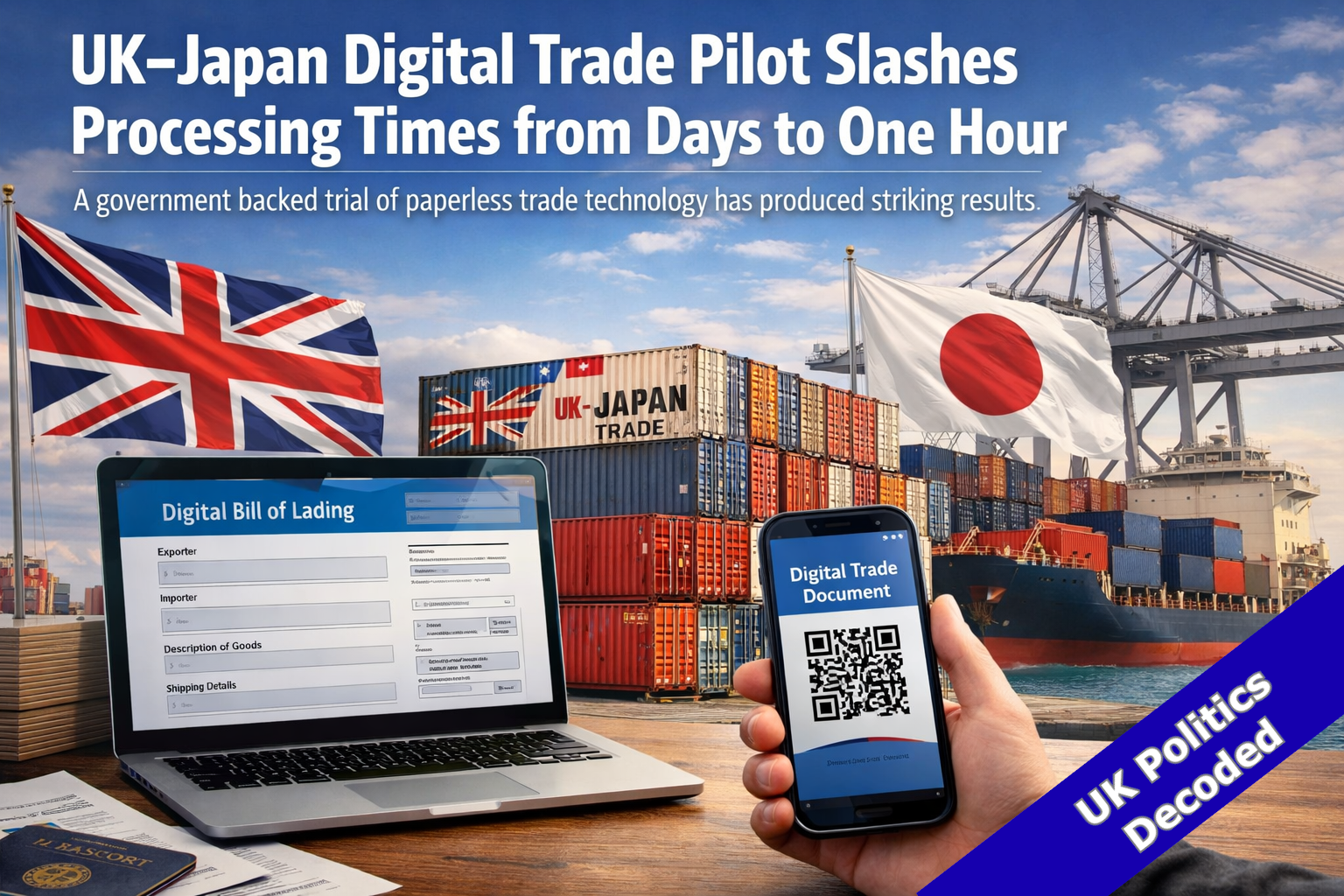
A pioneering UK-Japan digital trade pilot has demonstrated that documentary credit checks, a routine process in international trade finance that can take up to ten days can be completed in as little as one hour using digital technology. The results, published by the Department for Business and Trade (DBT) on 6 May 2026, mark a significant proof of concept for the government's ambition to make British exports faster, cheaper, and less reliant on paper based administration.
The pilot was conducted through the Digital Trade Testbed at Teesside University, in partnership with businesses trading between the UK and Japan, and coordinated with support from ICC United Kingdom. Three real world case studies underpinned its conclusions, cross platform data exchange between different digital trade systems, a simplified SME export journey into Japan, and a fully digitalised trade finance transaction between UK and Japanese banks. The findings were shared at an event in Tokyo hosted by the British Embassy and the Department for Business and Trade, attended by more than 50 Japanese industry leaders and government representatives.
Key Points at a Glance
- Ten days to one hour: Documentary credit checks that typically take up to ten days were completed in one hour under pilot conditions.
- Three pilot case studies: Cross platform data exchange, a simplified SME export journey, and a fully digital trade finance transaction were all tested successfully.
- Paperless processing: UK exporters saw lower costs, reduced administrative burdens, and greater supply chain efficiency from eliminating paper documents.
- Tech barriers largely cleared: The report concludes the main barriers to scale are now awareness and capability, not the underlying technology.
- Wider programme: The UK-Japan pilot complements active digital trade corridor programmes with France and Germany.
What the Pilot Tested and What It Found
The Digital Trade Testbed brought together businesses, banks and trade intermediaries to run a series of live pilot exercises. The aim was not just to test whether digital trade documentation could work in theory, but whether it could deliver measurable gains in real commercial conditions across a major trade corridor.
The Three Pilot Case Studies
The programme centred on three distinct exercises, each targeting a different part of the export process:
- Cross platform data exchange: Different digital trade systems were tested for their ability to share data securely with each other, a critical requirement for any interoperable global digital trade framework.
- SME export journey: A simplified pathway was designed and tested to support smaller British businesses entering the Japanese market, reducing the complexity of documentation requirements.
- Digital trade finance: A fully digitalised documentary credit transaction was completed between UK and Japanese banks, demonstrating that the financial settlement layer of international trade can function entirely without paper.
- Speed gains: Under pilot conditions, documentary credit checks completed in one hour a process that routinely takes up to ten days in conventional paper based trade.
- Cost reductions: Businesses taking part reported direct cost savings from eliminating paper shipping documents and reducing administrative handling at multiple points in the supply chain.
What the Technology Proved
The published reports are notably clear in their conclusion about where the challenge now lies:
Key Findings from the Pilot Reports
- Technical foundations in place: Secure cross platform data sharing and electronic trade documents have been shown to work in practice, not just in theory.
- Main barrier is not technology: The evidence points to awareness, capability gaps, and practical support for businesses and trade intermediaries as the primary obstacles to wider adoption.
- Interoperability achieved: Systems from different providers exchanged data successfully, a prerequisite for scaling digital trade beyond individual pilot corridors.
- Businesses of all sizes can benefit: The SME export pathway demonstrated that digital trade is not exclusively accessible to large corporations with dedicated trade compliance teams.
What This Means for UK Exporters
For British businesses that trade internationally, the administrative burden of paper based documentation has long been a friction point. Documentary letters of credit, bills of lading, certificates of origin and inspection certificates all typically exist as physical documents that must be physically verified, couriered and checked by banks, customs authorities and freight forwarders, a process that adds time and cost at every stage.
The Practical Case for Going Paperless
The pilot results indicate that digitisation of this process could deliver tangible benefits across the export cycle:
Benefits Demonstrated in the Pilot
- Speed: Transactions that typically span days or weeks can be processed in hours, accelerating cash flow and reducing time to market for exporters.
- Cost: Eliminating paper documents, courier fees and manual checking reduces direct administrative costs for businesses.
- Accuracy: Automated digital processes reduce the risk of errors in documentation that can cause costly delays at border or during financing.
- Access: The SME pilot pathway suggests smaller businesses which often lack the administrative resource to manage complex trade documentation stand to gain disproportionately from simplified digital systems.
- Supply chain transparency: Digital documentation enables real time tracking and verification of goods at each stage, reducing fraud risk and improving supply chain visibility.
The Obstacles That Remain
The pilot reports are candid that demonstrating the technology works is not the same as getting businesses to use it at scale. The ICC United Kingdom report identifies several practical challenges that will need to be addressed before digital trade becomes routine:
- Awareness: Many businesses particularly SMEs remain unfamiliar with digital trade documentation systems and the legal frameworks that underpin them.
- Capability gaps: Trade intermediaries such as freight forwarders, customs brokers and smaller banks may need training and onboarding support to adopt new systems.
- Common standards: The report calls for the development of shared digital corridor profiles that allow different systems to interoperate reliably across borders.
- Government and industry coordination: Scaling beyond pilots requires structured coordination between government departments, financial institutions and industry bodies.
- Routine adoption: Moving from successful demonstrations to repeatable, day to day processes that businesses can depend on remains the central challenge.
The Government's Digital Trade Ambition
The UK-Japan pilot does not sit in isolation. It is part of a broader government push to position Britain as a global leader in digital trade, a programme that spans multiple international corridors and involves legislative, as well as technological, reform.
The UK's Wider Digital Trade Corridor Programme
The UK-Japan results complement active programmes already under way with other major trading partners:
Active Digital Trade Corridors
- France: A digital trade corridor programme is under active development, targeting paperless processing for goods exported between the two countries.
- Germany: A parallel programme is under way with Germany, one of the UK's largest European trading partners.
- Japan: The newly published pilot results demonstrate live cross border digital trade finance and document exchange between UK and Japanese counterparts.
- LogChain relocation: Global digital trade firm LogChain has relocated its headquarters from Singapore to Liverpool, reflecting growing industry confidence in the UK as a hub for trade digitalisation.
Legislative and Regulatory Backdrop
- Electronic Trade Documents Act: The UK passed legislation in 2023 giving electronic trade documents the same legal standing as paper equivalents, a prerequisite for the technology to function in commercial and legal practice.
- ICC framework: The pilot was developed in alignment with ICC United Kingdom's commitment to interoperable, inclusive and scalable digital trade systems.
- Teesside University: The Digital Trade Testbed at Teesside University has served as the operational hub for the UK-Japan pilot exercises.
- Tokyo event: More than 50 Japanese industry leaders and government representatives attended the British Embassy Tokyo launch event in April 2026.
What Ministers Said
Minister for the Digital Economy Baroness Liz Lloyd said the trial showed how digital trade can deliver tangible benefits for UK exporters beyond theoretical gains:
"This pilot shows how digital trade can deliver real, tangible benefits for UK exporters, helping businesses move goods faster and with greater confidence. By working closely with partners in Japan, and complementing our promising digital trade corridors with France and Germany, the UK is demonstrating global leadership in making trade cheaper, faster and more secure through innovation."
Professor David Hughes, Coordinator of the Digital Trade Testbed at Teesside University, described the pace of progress as encouraging, while acknowledging the work that remains:
"It's exciting to see how quickly these foundational building blocks are coming together. What matters now is turning successful demonstrations into repeatable, day to day processes so businesses of all sizes can scale, trade with confidence, and realise the benefits of digital trade across the UK–Japan corridor."
Conclusion: A Significant Result, With the Hard Work Ahead
The UK-Japan digital trade pilot has produced results that are genuinely striking. Reducing a ten day banking process to one hour is not a marginal improvement, it is the kind of efficiency gain that, if replicated at scale, could meaningfully reduce the cost and complexity of exporting for British businesses.
The published reports are careful, however, to distinguish between proving the technology works and embedding it into daily practice. The main barriers to scale are now commercial and organisational, not technical a challenge that requires sustained coordination between governments, banks, freight intermediaries and the businesses that actually move goods around the world. The UK has legislation in place, a network of corridor programmes under development, and an early mover advantage in this space. But turning that into routine, repeatable digital trade will take time.
For UK exporters particularly the smaller businesses that stand to gain most from reduced administrative complexity, the practical takeaway is that these tools are becoming real, but adoption is not yet mainstream. Businesses considering their export processes in 2026 and beyond would be well served by monitoring the development of the corridor programmes and engaging with industry bodies as the training and onboarding frameworks the reports call for begin to take shape.
Key Takeaways
- A UK-Japan digital trade pilot has demonstrated that documentary credit checks can be reduced from up to ten days to just one hour using digital systems.
- The pilot tested cross platform data exchange, an SME export pathway, and a fully digital trade finance transaction, all successfully.
- The technology works, the main obstacles to scale are now awareness, capability and coordination across the supply chain.
- The UK-Japan programme complements active digital trade corridor work already under way with France and Germany.
- ICC United Kingdom's report calls for targeted training, common digital corridor standards, and sustained government and industry coordination to move from pilot to routine practice.
Sources & Further Reading
- GOV.UK – Businesses see processing times slashed in groundbreaking trial (6 May 2026, Department for Business and Trade) Archived copy (OGL): archived page
- ICC United Kingdom – Digital trade that delivers: scaling the UK–Japan corridor (2026)
- ICC United Kingdom – UK-Japan Trade Corridor Evidence Report (PDF, April 2026) Archived internally for verification (8 May 2026)