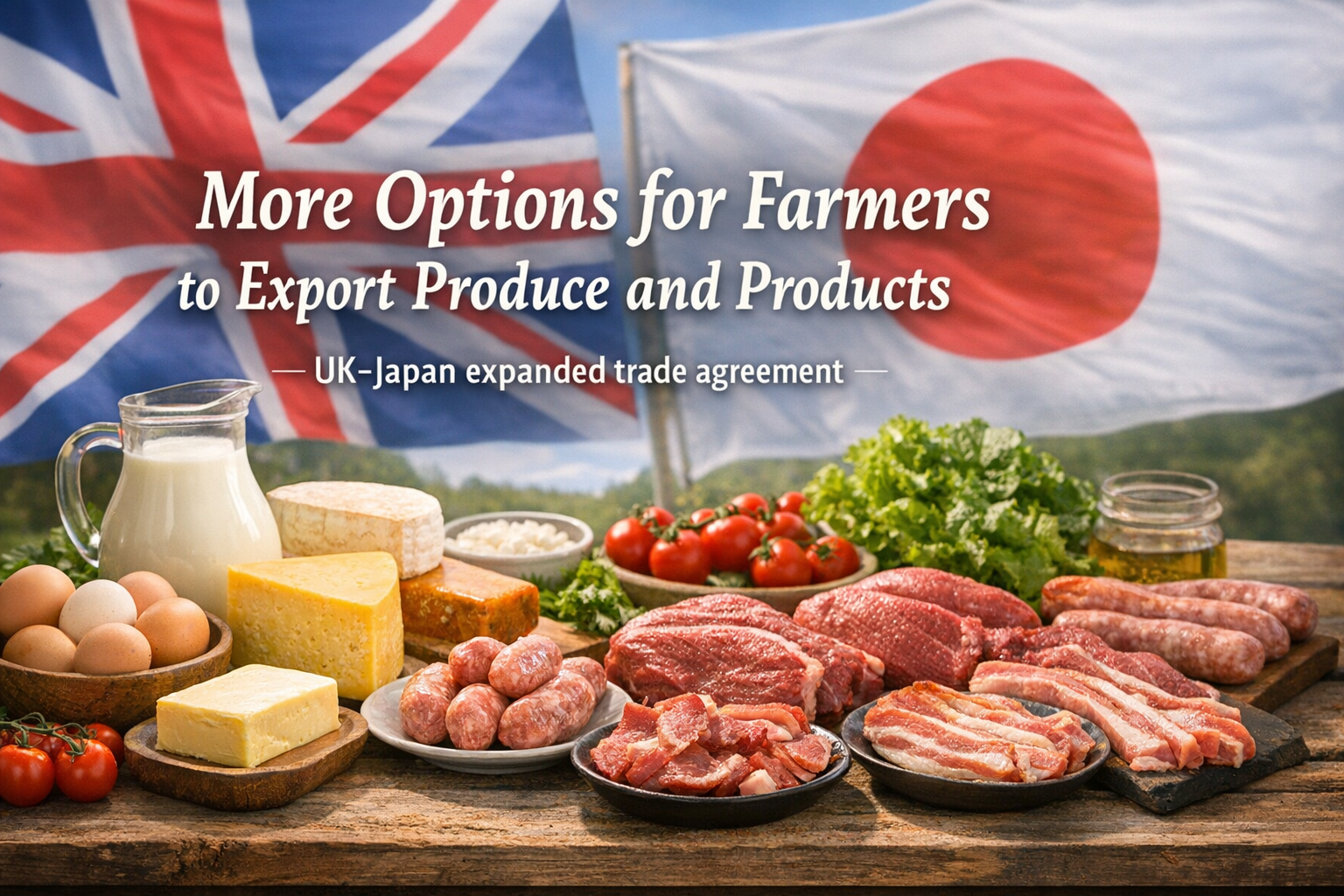
The UK and Japan have expanded their organic trade arrangement to include organic livestock products for the first time. From 1 April 2026, British producers can export organic meat, dairy and processed animal based foods to Japan using a single UK organic certification removing duplicated checks and cutting costs for exporters.
The change was announced by Food Security Minister Dame Angela Eagle and comes into effect immediately, opening up one of Asia's fastest growing food markets to a wider range of British organic goods.
Key Points at a Glance
- In effect from 1 April 2026 - organic livestock products are now covered by the UK-Japan equivalence arrangement for the first time.
- Single UK certification now valid for both the UK and Japanese markets, removing duplicate paperwork.
- Japan's organic market was valued at around £1.4bn in 2023 and is one of the fastest growing in Asia.
- Products covered include all UK certified organic meat, dairy, processed meats and processed foods containing animal ingredients.
- UK organic sector reached £3.9bn in 2025, continuing 13 years of steady growth.
What Changed?
The UK and Japan already had an organic equivalence arrangement in place, but until now it only applied to plant based organic products. This expansion adds organic livestock products to that framework for the first time, meaning the two countries formally recognise each other's organic livestock standards as equivalent.
In practice, this means a British producer holding a standard UK organic certification can now sell their livestock products in Japan without needing a separate Japanese certification, a step the government had identified as a priority trade barrier to remove.
The arrangement also builds on an earlier agreement reached in September 2025 that extended the existing equivalence to cover organic alcoholic drinks.
What Does This Mean for Exporters?
Before this change, British organic meat and dairy businesses wanting to sell into Japan faced the burden of obtaining separate certifications for the Japanese market. The new arrangement removes that requirement. British producers can now:
- use one UK organic certificate for both the UK and Japanese markets
- avoid duplicated inspections and paperwork
- reduce compliance costs and administrative delays
- access Japanese organic tenders and retail channels that were previously out of reach
The government estimates this will generate millions of pounds in additional annual trade, based on industry forecasts, though it has not published a specific figure.
Why Japan Matters
Japan is the second largest organic market in Asia after China, valued at approximately £1.4bn in 2023. Growth is being driven by Japanese government initiatives to promote organic consumption domestically, rising consumer interest in premium and traceable food, and expanding organic retail channels in major cities.
British organic products already perform well in Japan. Tea, fruit and vegetable juices, cereals, sauces and syrups have established a presence in the Japanese market. The new arrangement extends this to livestock products, a category not previously covered.
What Products Are Now Covered?
The expanded equivalence covers all UK certified organic livestock goods. According to the government, this includes:
- Meat: beef, lamb, pork and chicken
- Processed meats: sausages, bacon, hams and cured meats
- Dairy: cheese, butter, yoghurt, milk powders and processed eggs
- Processed foods containing animal ingredients: including organic pet food
This is the first time organic livestock products have been included in the UK-Japan equivalence framework.
Government Position
Food Security Minister Dame Angela Eagle said:
"From Welsh organic cheese to world class organic British beef, our farmers and producers set the gold standard for quality. This arrangement tears down barriers and gives them access to Japanese consumers who are increasingly seeking out the very best organic products the world has to offer."
The government had identified the removal of this trade barrier as one of its market access priorities and expects the change to generate millions of pounds in additional trade each year based on industry estimates.
Industry Reaction
Welsh organic dairy co-operative Calon Wen welcomed the announcement. The co-operative has been expanding its exports of organic cheese across Asian markets and is now looking to establish a presence in Japan.
Stuart McNally, Business Development and Sales Manager for Calon Wen, said:
"This is a very welcome breakthrough for Calon Wen, a farmer owned organic dairy co-operative, and for the wider UK organic sector. This equivalency with Japan allows us to pursue opportunities previously out of reach. This includes organic business tenders worth substantial trade annually. It's a positive step that supports our family farms and strengthens the reputation of Welsh organic dairy in premium export markets such as Japan."
How This Fits Into the Wider Organic Sector
The UK organic sector has been on a sustained growth path. It reached £3.9bn in retail value in 2025, growing 4.2% in that year and continuing a trend of steady expansion that has held since 2012.
Major export destinations for British organic products already include the EU, Switzerland, the United States and South Korea. The Japan deal adds a significant new opportunity, particularly for the livestock sector which had not previously benefited from equivalence with Japan.
Wider Trade Context
The announcement follows several recent market access developments for the UK livestock sector, including a beef tariff rate quota worth up to £70m a year if fully used, and new genetics market access in Asia, Africa and Latin America.
This comes as the government continues its post Brexit trade programme, which accelerated through 2025 and into 2026. Analysts note that businesses typically require around one to two years to adjust supply chains, certification processes and commercial relationships after new agreements come into force, a pattern seen in previous UK and international trade deals. Exporters considering the Japanese market will need to factor in that lead time when planning their approach.
Key Takeaways
- The UK-Japan organic equivalence arrangement now covers livestock products for the first time, in effect from 1 April 2026.
- British producers need only one UK organic certification to sell organic meat and dairy in both the UK and Japan.
- Japan's £1.4bn organic market is one of the fastest growing in Asia, driven by government policy and consumer demand.
- All UK certified organic meat, dairy, processed meats and processed foods containing animal ingredients are now covered.
- The UK organic sector hit £3.9bn in 2025, and Japan represents a new export opportunity for livestock producers.