AI Use: AI tools were used to support source discovery and to structure the article for clarity. All research, verification, drafting, and final editorial decisions are fully human led. Learn about our AI policy.
On 15 June 2026, the Department for Work and Pensions confirmed the locations of almost 180 new Youth Hubs across England, Scotland, and Wales. The hubs are to be embedded in community venues, football clubs, libraries and college campuses with the aim that no young person is more than an hour away from support by public transport. Work and Pensions Secretary Pat McFadden framed it as a once in a generation drive to tackle youth unemployment.
The announcement is part of a broader national expansion to over 360 hubs. Fifteen hubs opened in Year One, including locations in Tower Hamlets, Leicester, and South Lanarkshire. Almost 180 more are confirmed for Year Two. A final tranche covering areas such as St Albans, Cambridge, and the City of London is scheduled for Year Three.
What Was Announced
- Scale: Almost 180 new Youth Hub locations confirmed for Year Two of the rollout, bringing the total network toward 360 areas across Great Britain.
- Target group: 16 to 24 year olds, including those who are not in education, employment, or training (NEET).
- Services offered: Employment guidance, careers advice, mental health support, housing advice, skills training, and links to local employers with live job and apprenticeship vacancies.
- Funding: Youth Hubs form part of the government's £2.5 billion Youth Guarantee investment.
- Incentives: A Youth Jobs Grant of £3,000 is available for employers hiring an 18 to 24 year old who has been on Universal Credit for six months. A £2,000 apprenticeship incentive is available for small businesses hiring a 16 to 24 year old.
- International comparison: McFadden visited the Netherlands ahead of the announcement to study that country's youth point system, which has contributed to one of the world's lowest NEET rates.
The Tower Hamlets Youth Hub, opened at the Feldy Community Centre in Poplar in May 2026, was cited as an early example of the model in action. Tanzeem Ahmed of Poplar HARCA described a space offering CV writing, accredited training, and wellbeing advice alongside links to Jobcentre Plus. McFadden visited the site the day before the wider announcement.
The ambition is clear enough. Bringing employment services, mental health support, and careers guidance into accessible community settings rather than expecting young people to navigate formal jobcentre processes is a model with genuine evidence behind it. The Dutch system that McFadden studied achieves reach precisely because it meets people where they are. On that logic, the expansion is defensible.
But the programme rests on an assumption that the government has not fully addressed that there are enough jobs for young people to move into once they reach the hub's exit door.
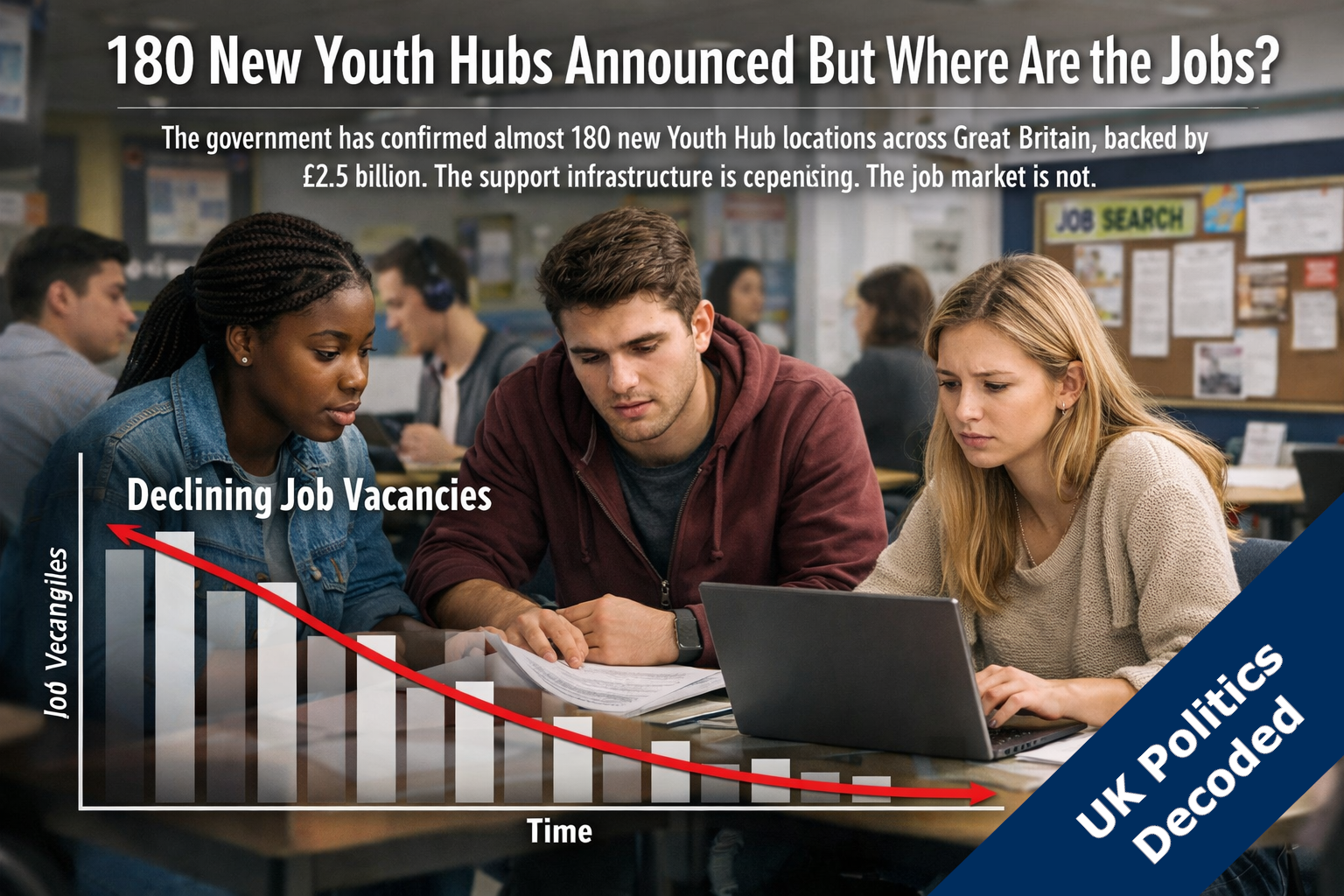
The latest ONS figures, published in June 2026, put total UK job vacancies at 707,000 for the three months to May. That is a fall of 19,000 quarter on quarter and the lowest reading since the three months to April 2021. On an annual basis, vacancies are down across 13 of the 18 industry sectors tracked by ONS. The sharpest falls are in wholesale and retail trade down 13,000 year on year and hospitality, which dropped 10,000.
These are not sectors at the periphery of youth employment. Retail and hospitality together represent a substantial share of the entry level roles that young people have historically relied on to get into work. When those sectors pull back on hiring, it is young and inexperienced workers who feel it first.
What Youth Hubs Can Help With
- Connecting young people with the vacancies that do exist more efficiently, through direct employer links.
- Providing the wraparound support, mental health, housing, financial guidance that prevents barriers from becoming permanent.
- Helping young people build credible paths into growing sectors, such as healthcare and green industries, rather than just chasing declining entry level roles.
- Reaching those furthest from the labour market who may never approach a formal jobcentre.
What Youth Hubs Cannot Change
- The overall level of hiring demand, which the ONS records at a five year low of 707,000 vacancies.
- Business decisions to pause permanent recruitment due to cost pressures and economic uncertainty.
- The shift by employers toward part time and temporary contracts to reduce exposure to fixed employment costs.
- The structural cost pressures, higher employer National Insurance, elevated energy costs that are constraining business expansion and headcount growth.
The ONS's own vacancy survey feedback is revealing. Firms across multiple sectors are reporting that they are putting recruitment on hold because of economic uncertainty and higher labour costs. The April 2025 increase in employer National Insurance contributions introduced in the Autumn Budget of November 2024 raised the cost of each hire. Combined with above inflation increases to the National Living Wage, the cost of taking on a new, inexperienced member of staff has risen sharply.
Energy costs compound the picture. Businesses, particularly smaller ones, continue to face electricity bills that remain significantly elevated against pre 2022 levels. For an SME weighing up whether to expand headcount or hold, that overhead is a genuine constraint. The KPMG/REC Report on Jobs for June 2026 confirmed that permanent placements fell at their fastest pace in ten months in May, with employers explicitly citing cost pressures and uncertainty about the business outlook as reasons for pulling back.
What is replacing permanent hiring is instructive. Employers who do need more staff are increasingly reaching for temporary and part time contracts. That gives businesses flexibility without locking them into the full cost of a permanent employee. It also tends to favour workers who already have experience, people who can be productive quickly, without requiring sustained training investment. For a 19 year old leaving a Youth Hub with a new CV and a handful of certifications, that is a harder market to break into than the one that existed three or four years ago.
ONS Vacancy Data: The Trend Since the Peak
- Peak (May 2022): Approximately 1.3 million vacancies as post pandemic reopening drove intense competition for workers.
- June 2026: 707,000 vacancies, a fall of nearly 600,000 from the peak, spread across more than four years of consistent decline.
- Annual change: Vacancies down across 13 of 18 industry sectors tracked by ONS. Largest falls in retail, hospitality, and professional services.
- ONS employer feedback: Firms citing economic and geopolitical uncertainty and higher employment costs as reasons for pausing recruitment.
- New hires: The number of people starting new jobs has fallen to a five year low, according to ONS payroll data for May 2026.
None of this means the Youth Hubs programme is wrong. Connecting young people to support rather than leaving them to navigate a fragmented system alone is worthwhile regardless of what the vacancy count is doing. Mental health services, housing advice, and face to face careers guidance have value that is not contingent on the jobs market being buoyant.
But the government's framing that the primary challenge is young people lacking the support and guidance to find available opportunities risks misdiagnosing where the constraint actually lies. The ONS data, and the OBR's March 2026 fiscal outlook, both point to subdued hiring demand as the primary driver of current labour market weakness. New entrants to the workforce are struggling to find work not primarily because they lack signposting, but because fewer employers are actively recruiting.
Building 360 hubs is a supply side response to what is increasingly a demand side problem. Until the conditions that are causing businesses to hold back on hiring cost pressures, uncertainty, energy costs, reduced consumer spending show signs of easing, the hubs will be doing valuable work against a structural headwind that £2.5 billion in support infrastructure cannot resolve on its own.
Key Takeaways
- Almost 180 new Youth Hub locations confirmed for Year Two of the national rollout, as part of a planned expansion to over 360 areas across Great Britain.
- Hubs offer integrated employment, mental health, housing, and skills support with financial incentives for employers who hire young people from Universal Credit.
- UK job vacancies stood at 707,000 for the three months to May 2026, the lowest level since April 2021 and down 19,000 quarter on quarter, according to ONS.
- Vacancies have fallen in 13 of 18 sectors tracked by ONS. The number of people starting new jobs has fallen to a five year low.
- Employers are increasingly using temporary and part time contracts rather than permanent hires, favouring experienced workers to limit training costs, a pattern that disadvantages new entrants to the labour market.
- ONS feedback and the KPMG/REC jobs survey both cite higher employment costs and economic uncertainty as the primary reasons businesses are pulling back on permanent recruitment.
Sources & Further Reading
-
GOV.UK - Almost 180 more Youth Hubs to help young people build skills and find jobs (15 June 2026)
Archived copy (OGL): archived page - ONS - Vacancies and Jobs in the UK: June 2026 (covering March to May 2026)
- The Independent - Unemployment in surprise fall but job vacancies hit lowest level in five years (June 2026)
- KPMG and REC - UK Report on Jobs, June 2026
-
OBR - Economic and Fiscal Outlook, March 2026
Archived copy (OGL): archived page