AI Use: AI tools were used to support source discovery and to structure the article for clarity. All research, verification, drafting, and final editorial decisions are fully human led. Learn about our AI policy.
UKPoliticsDecoded is an IMPRESS regulated public interest publisher. Read our editorial standards.
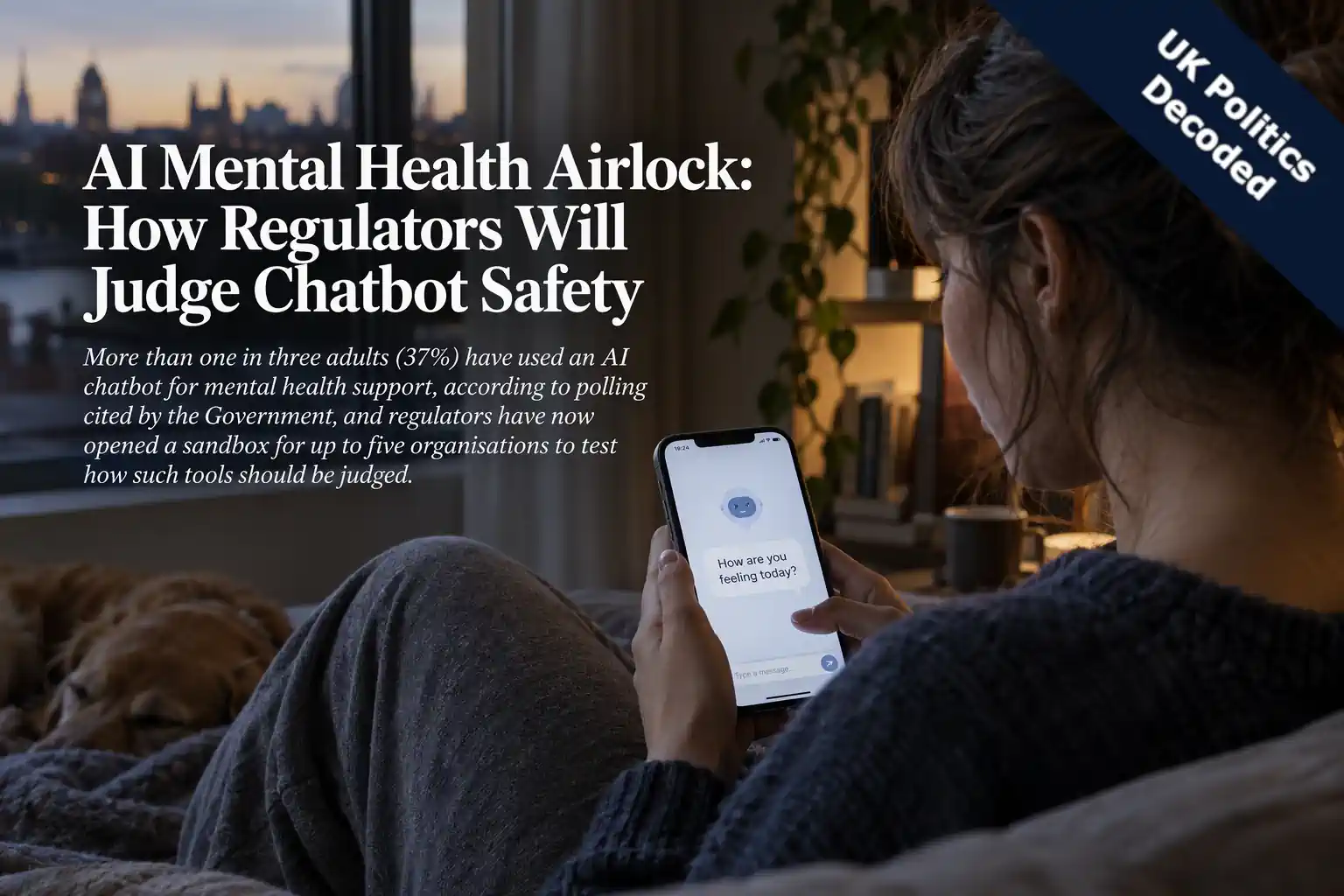
A new regulatory sandbox for AI mental health technology opened on 23 November 2026, run by the Medicines and Healthcare products Regulatory Agency (MHRA) and the National Institute for Health and Care Excellence (NICE). Called the AI in Mental Health Airlock, it will select up to five organisations to work alongside regulators, clinicians and people with lived experience.
The sandbox is unusual in what it leaves out. It will not test apps or chatbots themselves. It will test the methods, tools and frameworks used to judge whether those products are safe and effective, and applications are open now.
At a Glance
- The MHRA and NICE launched the AI in Mental Health Airlock on 23 November 2026 and will select up to five organisations to take part.
- The sandbox will test evaluation methods for AI mental health technology, such as benchmarking tools and assessment frameworks, rather than individual products.
- Applications close on 22 January 2027, and testing is expected to begin in April 2027.
- There is no fee to apply or take part, but participants receive no funding and must pay for their own studies, data and travel.
- The sandbox is strictly exploratory and is not a route to market or a form of regulatory approval for any product.
Why Regulators Are Building a Sandbox for AI Mental Health Tools
People are already turning to AI for help with their mental health. The Government's announcement cites Mental Health UK and Censuswide polling of 2,000 UK adults, carried out between 27 October and 3 November 2025, which suggests 37% of adults have used an AI chatbot to support their mental health or wellbeing.
Not all of those chatbots sit under the same rules. The announcement says some may have a medical purpose and fall under medical device regulation, while others may not. That patchwork is part of the problem the Airlock is designed to examine, alongside the range of products now in use, from therapeutic AI support to AI integrated virtual reality for therapy.
The Airlock expands the MHRA's existing AI Airlock programme and works with NICE's Health Technology Assessment Innovation Laboratory, known as the HTA Lab. NICE describes the lab as a safe space to test new evaluation approaches without affecting live NICE evaluations. The project also builds on recommendations from the National Commission on the Regulation of AI in Healthcare, which we covered in our report on the Commission's blueprint.
What the AI in Mental Health Airlock Will Actually Test
The application guidance is specific here. The focus is not on measuring how well a digital mental health technology performs. It is on the approaches used to evaluate and monitor those technologies, which the guidance says could include benchmarking tools, taxonomies and methodological assessment frameworks. Those approaches will be examined for how accurately and validly they detect AI related risks.
The risks listed are broad. They include hallucination, unsafe generated advice and clinical misinformation, as well as model drift and performance deviation. The guidance also names wider safety questions where AI may change how risk is spotted or managed, among them crisis detection and escalation, bias and performance across different populations, dependency and attachment risks linked to engagement design, and safeguards for minors and vulnerable users. The list is described as not exhaustive.
Activities may include workshops, virtual test environments and, where appropriate, real world testing. The sandbox may use hypothetical challenge scenarios or datasets, such as a chatbot failing to detect a crisis. Testing plans will be co-developed between each participant, the project team and experts, with participants leading on the approach.
The Government describes a sandbox as a regulator monitored virtual area where developers can generate robust evidence for their innovation. Here, the aim is practical learning that gives innovators greater clarity and supports proportionate regulation and evaluation.
How Applications and Selection Work
- Applications must be submitted through the MHRA's online portal, and Word versions of the form will not be accepted.
- The application guidance gives a deadline of 14:00 on Friday 22 January 2027, while the press release notes give 17:00 on the same day.
- Shortlisted applicants will be invited to interview and may be asked to take part in an interactive, scenario based session.
- Successful candidates must sign Terms of Engagement and Confidentiality Agreements before taking part.
Who Can Apply, and What Taking Part Costs
The call is open to charities, academic groups, commercial organisations, regulated professionals, educational bodies and NHS organisations, of any size. International applicants are welcome if their work is relevant to the UK digital mental health context, though the final cohort of up to five is to include a majority of UK based candidates. Where an application is presented as UK based, the lead applicant must be resident in the UK or employed by a UK organisation.
Applicants need to explain how their method or tool could assess AI related risks in digital mental health technologies, and show it can be tested through the Airlock. They must demonstrate a commitment to user safety or better mental health outcomes, including engagement with lived experience experts, and show relevance to UK health and care. Overseas participants are expected to commit to travel for key events where required.
Money is a significant consideration. There is no fee to apply or take part, but participants will not be funded. They are responsible for their own studies, delivery of testing activities, access to datasets and travel, and the guidance says the resource commitment depends heavily on each testing plan.
What the Airlock Will Do
- Test evaluation methods and safeguards for AI related risks in mental health technology.
- Produce a summary report for each participant on strengths, limitations and evidence gaps.
- Produce a NICE HTA Lab report on how AI related challenges could be handled in its evaluations.
- Produce an overall Airlock report to inform national and international regulation.
What the Airlock Will Not Do
- Test or approve individual digital mental health products.
- Act as a regulatory route to market for the MHRA.
- Signal any future position or decision by NICE or the MHRA.
- Publish company specific results without explicit agreement.
On confidentiality, the guidance says outputs may be used for research, methods development and learning, but that materials and findings will be treated and published on a confidential basis, so no company specific results with commercial implications are disclosed publicly without agreement.
When Does the AI Mental Health Airlock Start and Close?
The sandbox will run until October 2028, and participants can expect to design a testing plan lasting up to eight to twelve months. The anticipated, though changeable, timetable has sifting, interviews and shortlisting between January and March 2027, onboarding in February and March, and testing starting in April 2027. Regular hybrid or online meetings will be required during testing, along with reporting activities.
The Airlock sits within phase two of a Wellcome funded programme on digital mental health technology, which the MHRA and NICE have run since 2023. The MHRA's project page says phase two began in May 2026 and continues until autumn 2028. Earlier outputs include MHRA guidance on qualification and classification of such technologies, and a BSI standard on clinical studies for them, which is due to be published in early 2027 after a public consultation in June 2026.
Mind Warns of Harm if AI Mental Health Regulation Falls Short
Health Innovation Minister James Frith said AI could open up new ways to access mental health support, but that "innovation must go hand in hand with safety and public confidence." MHRA chief executive Lawrence Tallon said the Airlock will help the agency understand how AI mental health technologies can be practically assessed and managed. NICE's Chief Scientific Officer, Dr Nick Crabb, said the potential of such tools "can only be realised if we have robust ways of identifying and managing the risks they present."
Professor Alastair Denniston, who chaired the National Commission, said the message from that work was that patients and the public need to feel confident treatments are safe and effective. Miranda Wolpert, Director of Mental Health at Wellcome, said innovation must come with robust evidence and safeguards.
Mind took a more cautionary tone. Chief Executive Dr Sarah Hughes said the public are at risk of harm if AI regulation is not fit for purpose, noting that people increasingly use general purpose chatbots for support. She welcomed the convening of experts, said lived experience must be central, and pointed to Mind's own AI commission.
The MHRA also says it published free advice earlier this year to help the public, parents, carers and professionals choose digital mental health products. It lists five things to look for, what the product claims to do, who it is for, the evidence behind it, how personal data is used, and whether it is regulated as a medical device.
What Happens Next for AI Mental Health Regulation
Nothing changes immediately for people using AI chatbots or apps. The Airlock is a research and learning exercise, and the guidance is explicit that its outputs cannot be taken as indicating any future position. Any change to how such products are regulated or assessed would have to come from later decisions by the MHRA, NICE or the Government.
The first practical milestone is the application deadline on 22 January 2027, followed by selection of up to five organisations. Prospective applicants can email DMHT@mhra.gov.uk with questions. The press release notes and the application page give different closing times on the same day, so applicants should check the portal.
Key Takeaways
- The AI in Mental Health Airlock is a joint MHRA and NICE sandbox that will select up to five organisations, with a majority of the final cohort based in the UK.
- The sandbox examines the methods used to evaluate AI mental health technology, such as benchmarking tools and assessment frameworks, and does not test individual products.
- Applications close on 22 January 2027, with testing expected to start in April 2027 and the sandbox running until October 2028.
- Participation is free but unfunded, so organisations must cover their own studies, data access and travel.
- The Airlock is exploratory, and the MHRA and NICE say its outputs do not indicate any future regulatory or evaluation decision.
Sources & Further Reading
- AI in Mental Health Airlock to support safe innovation - GOV.UK Archived copy (OGL): archived page
- Apply for the AI in Mental Health Airlock - GOV.UK Archived copy (OGL): archived page
- Digital Mental Health Technology - GOV.UK Archived copy (OGL): archived page
- Medicines and Healthcare products Regulatory Agency - GOV.UK