AI Use: AI tools were used to support source discovery and to structure the article for clarity. All research, verification, drafting, and final editorial decisions are fully human led. Learn about our AI policy.
UKPoliticsDecoded is an IMPRESS regulated public interest publisher. Read our editorial standards.
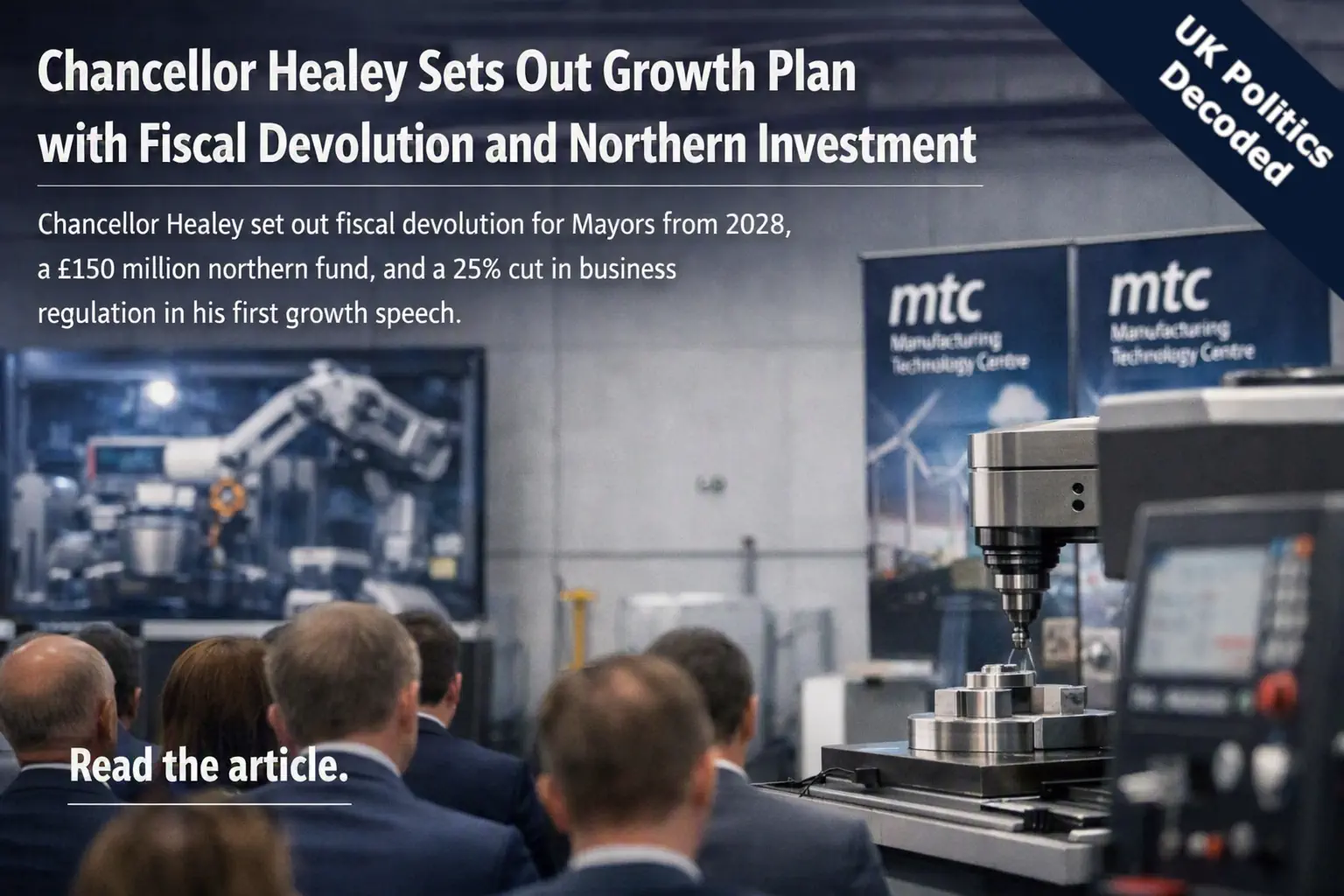
John Healey delivered his first major speech as Chancellor of the Exchequer on 7 September 2026, announcing plans to give Mayoral Strategic Authorities a share of local income tax from 2028, direct £150 million from the British Business Bank to northern scale ups, and cut business regulation by 25% by the end of Parliament. Four new areas, South Yorkshire, Liverpool City Region, North East England, and Cardiff Capital Region will also become Strategic Partners of the National Wealth Fund, gaining direct access to its investment pipeline and hands on support.
Speaking at the Manufacturing Technology Centre in the West Midlands, a facility he described as 1,000 people strong, with £35 million of government investment and turnover of nearly £130 million, Healey framed his agenda around three drivers, investment, innovation, and jobs. He acknowledged that UK growth remains "still fragile" despite being the fastest in the G7 in the first half of 2026, and that national debt has risen from 64% of GDP in 2009 to close to 100% today, with government borrowing costs at historic highs.
At a glance
- Mayoral Strategic Authorities will receive a share of local income tax from 2028, replacing central government grants, part of a fiscal devolution roadmap Healey will set out in full at the Budget.
- A £150 million British Business Bank allocation is earmarked for high growth scale up firms in the North, alongside a Northern 500 initiative grouping the region's most ambitious mid sized businesses into a single growth community led by the Great North partnership of Mayors.
- South Yorkshire, Liverpool City Region, North East England, and Cardiff Capital Region will become Strategic Partners of the National Wealth Fund, joining the West Midlands in a model designed to build local investment pipelines rather than distribute money at arm's length.
- The Treasury's Green Book discount rate falls from 3.5% to 3%, giving longer term and regionally focused projects a better chance of clearing investment appraisals, supported by a new economic potential analysis for all government spending decisions.
- Business regulation will be cut by 25% by the end of Parliament, judicial review reforms extended to all major infrastructure, and sandboxing powers for frontier technologies will be ready to deploy across the economy next year.
Mayors to Receive a Share of Local Income Tax from 2028 Under the Devolution Roadmap
The most structurally significant commitment in the speech was the fiscal devolution roadmap. At the forthcoming Budget, Healey said he would set out plans for local councils to retain more business rates and for central government grants to Mayoral Strategic Authorities to be replaced by a share of local income tax from 2028. He framed the case in economic rather than political terms, arguing that a transport bottleneck in South Yorkshire is invisible from Whitehall but has a measurable effect on business investment decisions. London remains what Healey called "our powerhouse," but he argued that if British city regions matched the performance of their equivalents in France and Germany, national growth would be transformed.
What regional authorities will gain
- A greater share of locally generated business rates retained within the area rather than redistributed centrally.
- A share of local income tax replacing central grants from 2028, providing more stable and predictable local revenue streams.
- Hands on support from the National Wealth Fund to build investment pipelines for the four new Strategic Partner areas rather than receiving funding at arm's length.
- Access to a Northern 500 growth community led by Mayors, backed by the private sector and central government, for the most ambitious mid sized northern businesses.
What changes at the centre
- Whitehall grants for Mayoral Strategic Authorities will be phased out from 2028, replaced by devolved income tax revenue streams.
- The Treasury's Green Book discount rate falls from 3.5% to 3%, changing how investment decisions are appraised at a national level.
- No10 North, led by the First Secretary of State, takes over coordination of growth delivery alongside the Treasury, replacing older schemes such as Levelling Up.
- A National Economic Council, a joint enterprise between central and regional government, will be convened to drive growth across every postcode.
To back northern growth specifically, the government is directing £150 million from the British Business Bank towards scale up firms in the North, targeting the most innovative and fast growing companies in the region. The Northern 500 initiative will bring together 500 of the North's most ambitious mid sized businesses in a single growth community, led by the Great North partnership of Mayors with support from the private sector and central government. Healey also confirmed that South Yorkshire, Liverpool City Region, North East England, and Cardiff Capital Region will become Strategic Partners of the National Wealth Fund, joining the West Midlands.
Green Book Discount Rate Drops to 3% as Treasury Sets 25% Target for Business Regulation Cut
The Treasury's Green Book, the framework that governs how government investment decisions are appraised will change immediately. The discount rate, which determines how much weight future benefits receive in a cost benefit calculation, falls from 3.5% to 3%. The practical effect is to make longer term projects and investments in regions outside established economic centres more likely to clear the investment hurdle. Alongside this, a new "economic potential analysis" will be introduced into government spending decisions, so that areas are assessed on what they could become rather than what they are today.
On regulation, Healey set out a package of reforms he described as taking "an axe to the thicket of consultation, litigation and administration" that he said has a stranglehold on private investment.
The government's regulatory reform commitments
- A 25% reduction in the overall burden of business regulation by the end of Parliament.
- Judicial review reforms extended from energy infrastructure to all major infrastructure, so that what Healey called "vexatious litigation" cannot block economic growth.
- Commitment to deliver the findings of the Fingleton Review, extended to other sectors, plus a new review of rail infrastructure costs.
- Major regulators to be convened by Healey and Business Secretary Johnny Reynolds later this autumn ahead of the Spending Review, to identify where rules are holding British business back.
- New Attorney General guidance that legal risk should not be the determining factor in ministerial decisions, ending what Healey described as a "consultation culture" at the Treasury.
Healey also said the government's public financial institutions which he described as already backed by £200 billion will be sharpened to align more closely with government priorities, and that public procurement will be used as a strategic tool to back British firms across a greater share of the public sector.
Nearly a Million Young People Not in Work and the Plan to Double British Unicorns
On innovation, Healey set an ambition to double the number of unicorn companies in the UK privately held companies valued at more than one billion dollars and said he and Business Secretary Reynolds would identify the next wave, with the state acting as an early customer to help them scale. New sandboxing powers are expected to be in place and ready to deploy across the economy next year. The powers would give businesses and inventors the ability to safely test frontier technologies from pavement robots and drones to medical treatments that are currently blocked by existing regulatory frameworks but have not yet caused the kind of harm that would justify permanent prohibition.
The jobs strand of the speech was anchored by a figure Healey described as a , close to one million people aged 16 to 24 are not in education, employment, or training, with two thirds having never held a job. He said tackling that was both a moral duty and a fiscal one, a person coming off benefits and into work reduces public expenditure and eventually generates tax revenue. The Chancellor confirmed that Alan Milburn will publish his full recommendations to government on how to address youth unemployment this autumn, and that the Global Talent Taskforce remains the government's mechanism for attracting skilled workers from overseas.
What Happens Next? No10 North, the National Economic Council, and the Upcoming Budget
Healey described two institutional pillars for delivering the growth agenda. No10 North a new strategic centre created by the Prime Minister and led by the First Secretary of State will work alongside the Treasury to remove obstacles, drive productivity, and give local leaders and businesses on the ground the conditions to grow. A National Economic Council, set up as a joint enterprise between central and regional government, will be convened to coordinate growth decisions across every postcode. Healey described it as a mechanism for greater public control and leadership over the essentials, transport, energy, housing, and utilities that create the predictability private investment needs.
The Budget, the Prime Minister's 10 Year Plan, and the Spending Review will follow the framework the Chancellor set out on 7 September. Healey acknowledged the government would not deliver everything immediately, but said the speech represented "the start of it today," with good growth in every postcode as the test the government has set for itself.
Key Takeaways
- From 2028, Mayoral Strategic Authorities will receive a share of local income tax rather than central government grants, and local councils will retain a greater proportion of business rates, a permanent fiscal devolution that Healey will detail at the Budget.
- The British Business Bank is directing £150 million to scale ups in the North, and a Northern 500 initiative will group the region's most ambitious mid sized businesses into a single growth community led by the Great North partnership of Mayors.
- The Treasury's Green Book discount rate falls from 3.5% to 3%, giving long term and regionally focused investment a better chance of clearing government appraisals, South Yorkshire, Liverpool, North East England, and Cardiff also join the National Wealth Fund as Strategic Partners.
- Business regulation will be cut by 25% by the end of Parliament, judicial review protections are extended from energy to all major infrastructure, and the Treasury will stop defaulting to consultation and legal caution when making ministerial decisions.
- Sandboxing powers for frontier technologies will be ready to deploy across the economy next year, and the government has set an ambition to double the number of British unicorn companies, with the state acting as an early customer for the next wave of high growth firms.