AI Use: AI tools were used to support source discovery and to structure the article for clarity. All research, verification, drafting, and final editorial decisions are fully human led. Learn about our AI policy.
UKPoliticsDecoded is an IMPRESS regulated public interest publisher. Read our editorial standards.
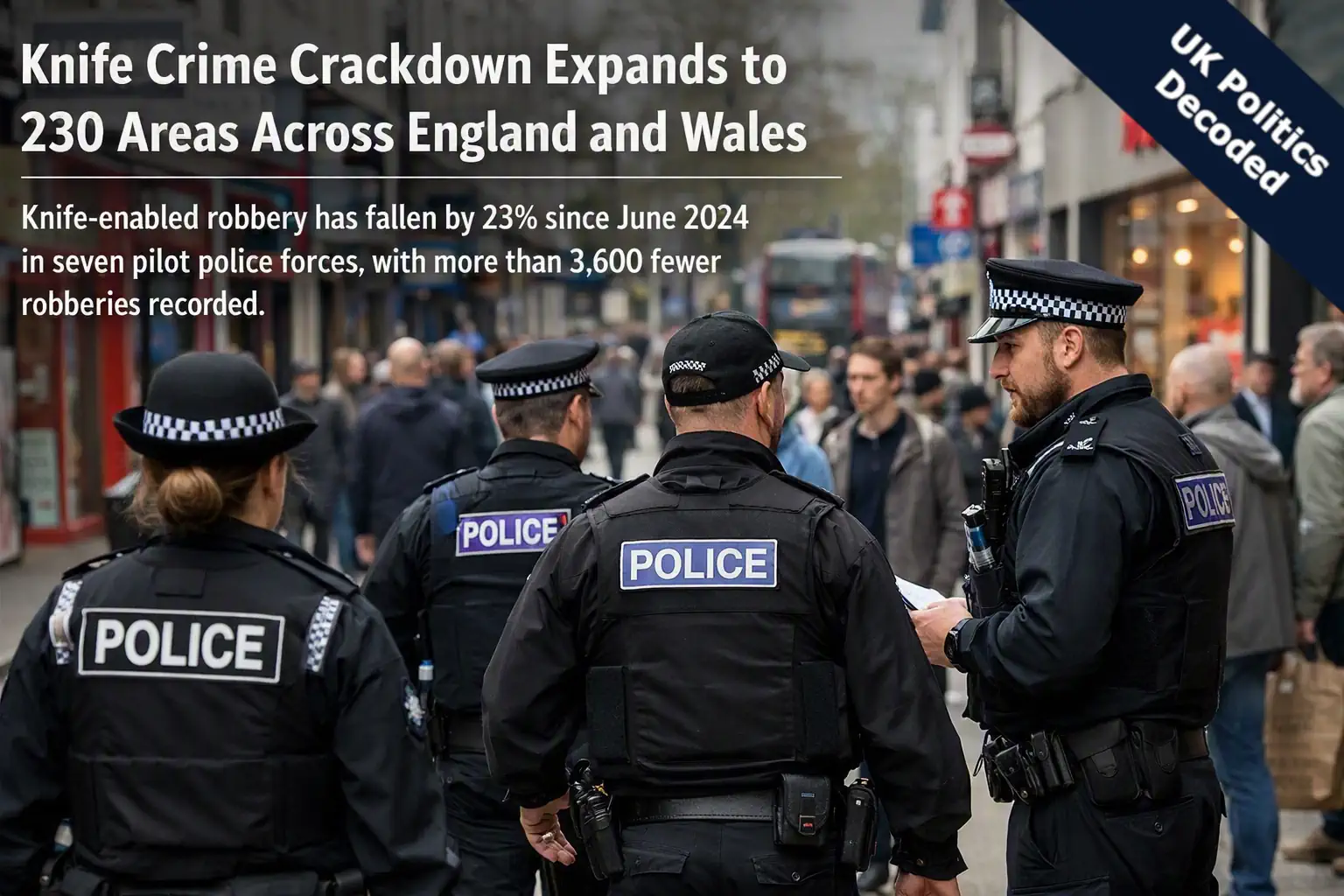
More than 230 areas across England and Wales will get extra police patrols, CCTV and prevention work as the Home Office widens its knife crime crackdown to 27 police forces, the government announced on 18 September 2026. Home Secretary Shabana Mahmood is backing local plans drawn up by police and councils, after new figures showed knife enabled robbery falling sharply in the areas that had already been targeted.
The expansion follows a pilot approach concentrated on the neighbourhoods worst affected by knife crime. Across seven forces running that pilot, knife enabled robbery has dropped by almost a quarter since the last general election, giving ministers the evidence they say justifies taking the same model nationwide.
At a glance
- More than 230 areas across 27 police forces in England and Wales will receive tailored local knife crime plans.
- Knife enabled robbery fell by 23% since June 2024 across seven pilot forces, with over 3,600 fewer robberies recorded.
- Overall knife crime is down 11% since the government took office, as it works towards halving it within a decade.
- Plans combine enhanced police patrols with prevention programmes aimed at young people most at risk.
- Home Secretary Shabana Mahmood visited a West Midlands boxing gym on 17 September as part of the announcement.
What's Actually Changing in the 230 Targeted Areas
Each of the more than 230 areas will get a plan tailored to its own patterns of knife crime, developed jointly by local police forces and councils. The Home Office says this will mean more visible policing, including enhanced patrols and CCTV, alongside programmes designed specifically for young people considered most at risk of becoming either a victim or a perpetrator of knife crime.
The plans also cover changes to the physical environment. The government says local areas will improve public spaces through better street lighting and redesigning locations where weapons could otherwise be hidden, alongside the policing and youth work elements of each plan.
According to the Home Office, growing evidence points to concerted, small area action as the most effective way to reduce knife crime, rather than a single blanket approach applied uniformly across the country. That is the rationale behind tailoring each of the 230 plus plans to its own local area rather than issuing one national template.
Why Knife Robberies Fell 23% in the Pilot Areas
The case for expanding the crackdown rests on results from seven forces that ran the targeted approach first, the Metropolitan Police, West Midlands Police, Greater Manchester Police, West Yorkshire Police, South Yorkshire Police, Avon and Somerset Police, and British Transport Police. Across those forces, knife enabled robbery has fallen by 23% since the 2024 general election, a reduction the Home Office says amounts to more than 3,600 fewer robberies being reported.
The government attributes some of that fall to better data sharing between forces, which it says has helped identify and arrest more suspects. Beyond the pilot forces specifically, knife crime overall is down 11% since the government came into office, a figure ministers are using to track progress against their broader target of halving knife crime within a decade.
Where the funding is going
- The Knife Crime Concentrations Fund is worth £26.25 million.
- Funding supports enforcement, prevention and community led intervention work.
- The West Midlands is among the regions receiving additional funding through the fund.
- Money can be used for education, early intervention and trauma informed prevention work with young people.
Shabana Mahmood's Knife Crime Visit, What She Said and Why
Shabana Mahmood visited the West Midlands the day before the announcement, calling in at a local boxing gym that supports vulnerable young people at risk of being drawn into crime. She was joined by three members of the government's Coalition to Tackle Knife Crime, Lynne Baird MBE, Pastor Lorraine Jones Burrell MBE, and Pooja Kanda OBE, each of whom has lost a child to knife crime and has campaigned since for stronger action.
"Targeted policing and prevention, focused on the areas where the need is greatest, is already cutting knife robberies by nearly a quarter," Mahmood said. "That means safer streets, and fewer lives lost. I am now taking this approach to more than 230 areas across the country."
Pooja Kanda OBE, founder of Justice for Ronan Kanda, welcomed the figures but stressed that enforcement needed to sit alongside prevention. "These reductions are encouraging, but I am even more encouraged by the Home Secretary's commitment to targeted action in areas experiencing the greatest harm," she said, adding that early intervention matters as much as policing itself.
Campaigners Cautiously Welcome the Crackdown, With One Big Caveat
Reaction from groups working directly with affected families and young people has been broadly welcoming, though several stressed that lasting change depends on sustained investment rather than a single funding announcement. Patrick Green, chief executive of the Ben Kinsella Trust, described the Knife Crime Concentrations Fund as "an important government investment in targeted prevention," while cautioning that lasting reductions come from combining enforcement with education and strong community partnerships.
Tracey Burley, chief executive of St Giles, struck a similar note, saying the figures show what sustained focus on the issue can achieve, but warning against complacency. "The real test will be whether we can sustain this progress and ensure that young people have the safety, support and opportunities they need before violence becomes part of their lives," she said.
Caroline Willgoose, mother of Harvey Willgoose and a knife crime campaigner, called the targeted funding "an extremely welcome step," saying she would continue working to prevent other parents from experiencing the same loss.
UK PoliticsDecoded’s Crime Tracker Dashboard lets readers examine our monthly analytics on crime statistics for every police force in England and Wales including violent offences, robbery rates, and stop and search outcomes. Built from open Police.uk and ONS datasets, it provides local comparisons so the public can see how enforcement and prevention policies are shaping real world results.
Key Takeaways
- More than 230 areas across 27 police forces will get tailored local plans combining enforcement, prevention and environmental changes.
- Knife enabled robbery fell 23% since June 2024 across seven pilot forces, with over 3,600 fewer robberies recorded.
- Overall knife crime is down 11% since the government took office, against a target of halving it within a decade.
- The £26.25 million Knife Crime Concentrations Fund backs the expansion, including funding for the West Midlands.
- Campaigners and charities have welcomed the announcement but say sustained investment in prevention will determine whether the gains last.