AI Use: AI tools were used to support source discovery and to structure the article for clarity. All research, verification, drafting, and final editorial decisions are fully human led. Learn about our AI policy.
UKPoliticsDecoded is an IMPRESS regulated public interest publisher. Read our editorial standards.
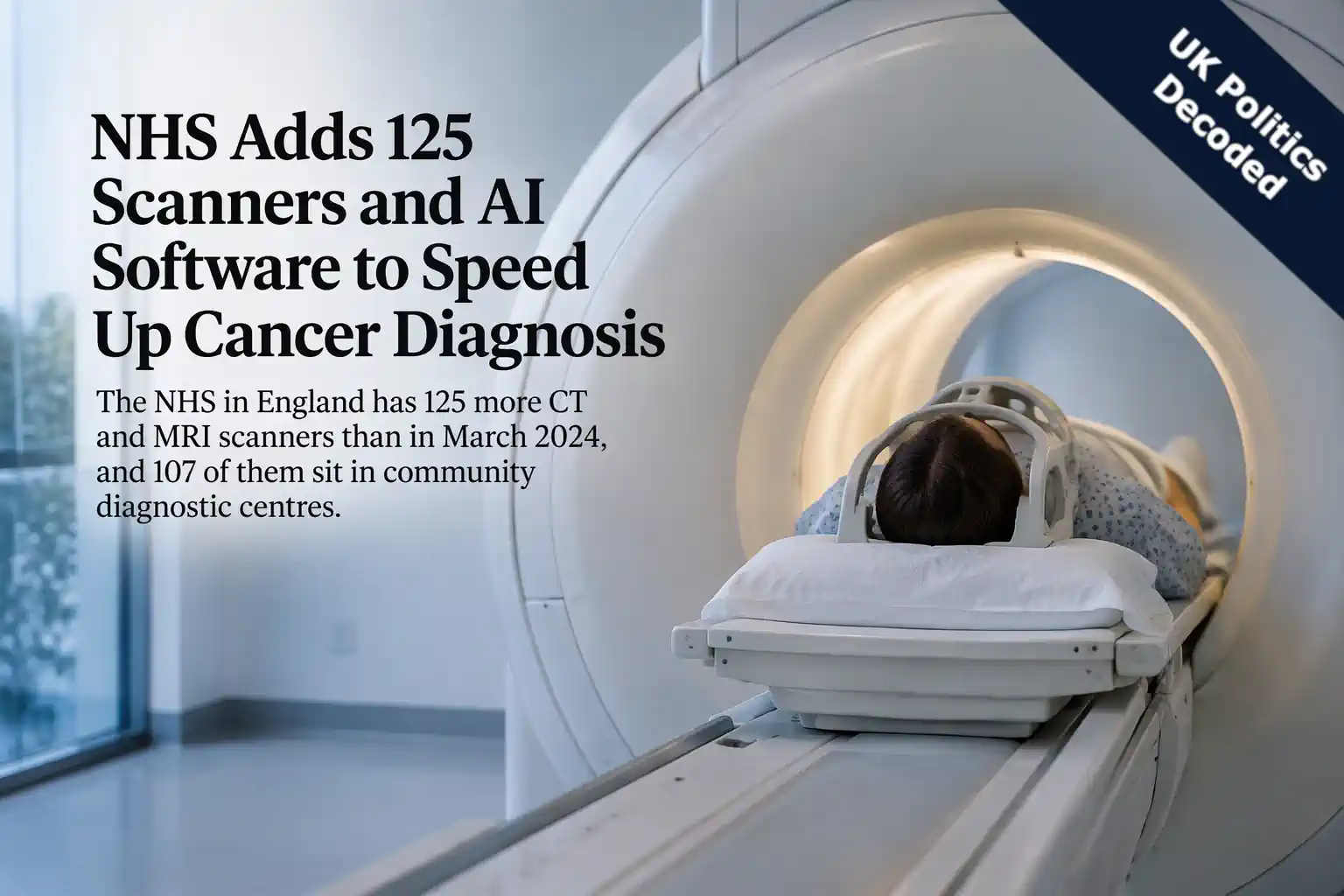
The NHS in England now has 125 more CT and MRI scanners than it did in March 2024, and the Department of Health and Social Care says they are helping deliver around a million extra scans every year. The figures come from NHS England data published on 3 November 2026, covering the two years to March 2026.
Faster scanning matters most for patients with suspected cancer, who often cannot be diagnosed or start treatment until imaging is done. Ministers also point to AI software that shortens MRI appointments, and to a new £19.2 million diagnostic centre in Greater Manchester.
At a Glance
- The number of CT and MRI scanners in the NHS rose by 125 between March 2024 and March 2026.
- Of those 125 new machines, 107 were installed in community diagnostic centres rather than hospitals.
- AI acceleration software is already installed on 54% of compatible NHS MRI scanners and helps services carry out on average 14% more scans.
- Every NHS trust will be able to upgrade compatible MRI scanners by 2029, which the government says could deliver up to 162,000 more checks a year.
- The new £19.2 million Manchester and Trafford Community Diagnostic Centre opened on Thursday 29 October 2026.
Where the extra million scans a year are coming from
The headline number is straightforward. According to the government, the NHS added 125 CT and MRI scanners between March 2024 and March 2026, which gives hospitals and diagnostic teams more capacity to spot cancer and other serious conditions earlier. CT and MRI are central to diagnosing lung, brain, breast and prostate cancer.
Most of that capacity is not sitting inside hospital buildings. Some 107 of the 125 new machines went into community diagnostic centres, which carried out nearly 2.2 million CT and MRI scans in the 12 months to March 2026. That is an extra million compared with the 12 months to March 2024, so the centres account for the gain the government is highlighting.
The scanner figures come from NHS England's 2025 to 2026 National Imaging Data Collection, which the government describes as showing continued growth in diagnostic scanner capacity.
How AI software is making MRI appointments shorter
New machines are only half of the story. The government says AI powered MRI software is now being rolled out across the NHS, and it has already been installed on more than half (54%) of compatible scanners. The software needs less data to produce a high quality image, which cuts the time each scan takes. Services using it have carried out on average 14% more scans while keeping image quality, according to the announcement.
For patients, the practical effect is shorter time in the scanner. The NHS website says an MRI scan usually takes between 15 minutes and one hour, depending on the part of the body being scanned. Time saved per patient can be used to book more appointments on the same machine in a day.
The government says every NHS trust will be offered the chance to upgrade compatible MRI scanners by 2029. A full rollout, it estimates, would allow existing equipment to deliver up to 162,000 more checks a year without buying a single extra machine.
New scanners
- 125 more CT and MRI machines than in March 2024
- 107 of them placed in community diagnostic centres
- Behind a rise to nearly 2.2 million scans a year at those centres
AI acceleration software
- Installed on 54% of compatible MRI scanners so far
- On average 14% more scans per service
- Full trust wide upgrade offer due by 2029
Inside the new £19.2m Manchester and Trafford diagnostic centre
The government used the announcement to showcase the Manchester and Trafford Community Diagnostic Centre, which cost £19.2 million and officially opened on Thursday 29 October. It is meant to let people in the area get tests and scans closer to home, rather than travelling to a large hospital site.
Karin Smyth, Minister of State for Health, said the 125 new scanners and the AI rollout are "helping deliver around a million extra scans every year", while the Manchester and Trafford centre would let people "get checked quickly and conveniently in the community".
Professor Peter Johnson, NHS England's National Clinical Director for Cancer, said waiting for test results can be an anxious time and that the earlier cancer is diagnosed, the more treatment options there are. Dr Stephen Harden, President of the Royal College of Radiologists, welcomed the new equipment but added that demand for scans is rising, so the workforce and equipment both have to keep pace.
Are NHS diagnostic waiting lists actually falling?
The government sets the scanner expansion against a wider run of NHS performance data. It says each month of 2026 so far has set an NHS monthly record for diagnostic activity, and the diagnostic waiting list has fallen in three of the five months since April. It also says cancer waiting times are better than last year and that the overall elective care waiting list is down by more than 250,000 since July 2024.
Those claims come from the government's announcement, and the release does not give the underlying waiting list totals or the monthly figures. The diagnostic list fell in three of five months, which also means it did not fall in two. Readers wanting to judge the trend will need the monthly NHS England statistics rather than this press release.
The release is also silent on staffing. Scanners need radiographers to operate them and radiologists to report the images, and the Royal College of Radiologists' comment is the only reference to workforce in the announcement.
How long does an MRI take, and when do you get results?
For anyone referred for a scan, the NHS website says results usually take between one and two weeks, because a radiologist has to review the images and write to the referring doctor. Anyone who has heard nothing after a few weeks is advised to contact the doctor who referred them. The NHS advises people who feel anxious or claustrophobic to speak to the hospital before the appointment.
Neither source says how much the new capacity will shorten that wait for an individual patient. The government's case rests on volume, more machines, more appointments per machine, and more tests delivered near home.
Key Takeaways
- The government says 125 extra CT and MRI scanners since March 2024 are helping the NHS deliver around a million more scans a year.
- Community diagnostic centres received 107 of the 125 new machines and carried out nearly 2.2 million CT and MRI scans in the year to March 2026.
- AI acceleration software is on 54% of compatible MRI scanners and has helped services carry out on average 14% more scans.
- Every trust is due the chance to upgrade compatible MRI scanners by 2029, with up to 162,000 more checks a year possible from a full rollout.
- The announcement does not publish diagnostic waiting list totals or say how individual patient waits will change.
Sources & Further Reading
- One million more scans to help catch cancer sooner - GOV.UK Archived copy (OGL): archived page
- MRI scan - NHS Archived internally for verification (archived page, 4 November 2026)