AI Use: AI tools were used to support source discovery and to structure the article for clarity. All research, verification, drafting, and final editorial decisions are fully human led. Learn about our AI policy.
UKPoliticsDecoded is an IMPRESS regulated public interest publisher. Read our editorial standards.
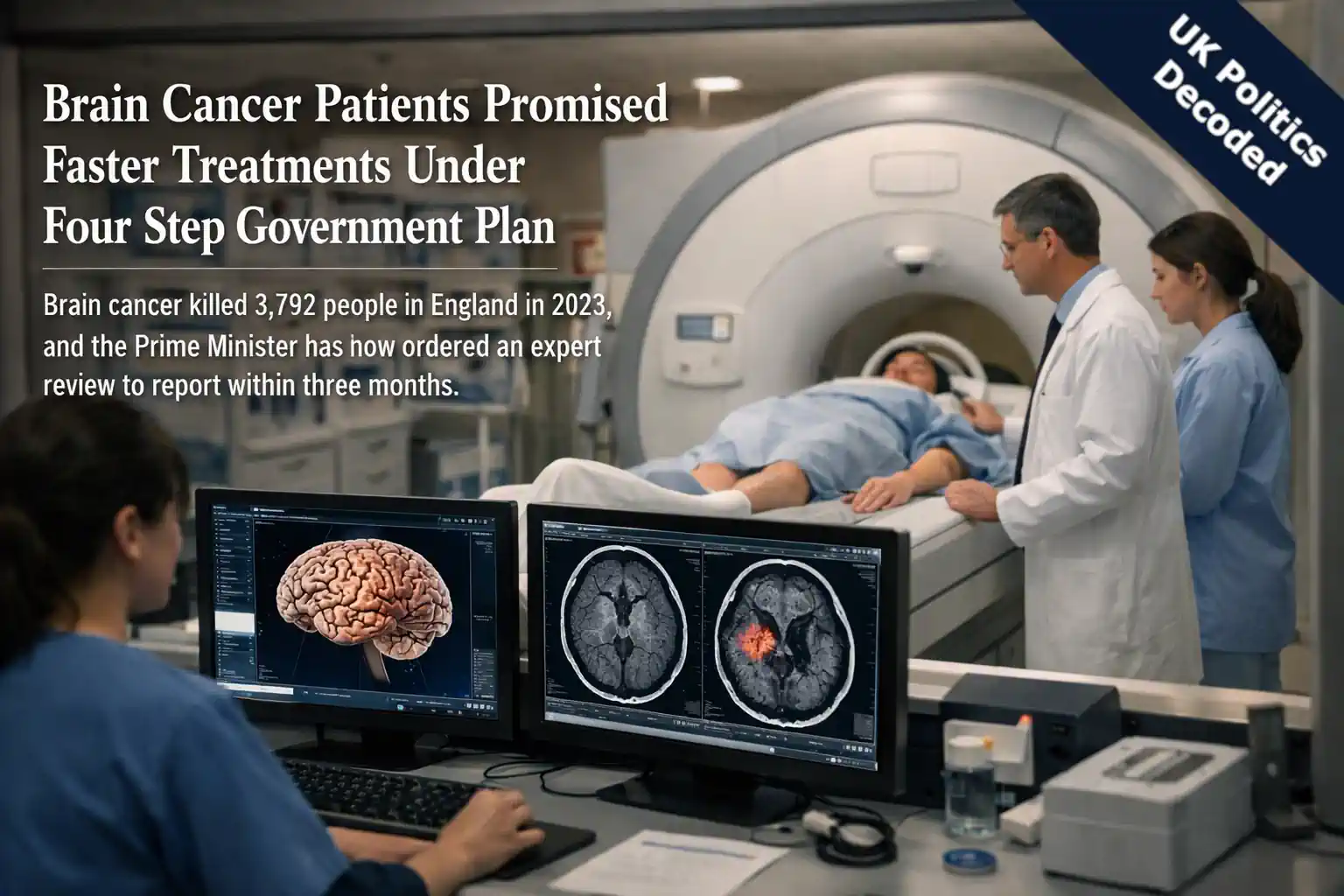
People with brain cancer are to get a faster route from research to treatment, under four steps set out by the Prime Minister on 14 October 2026. They include an expert review that must report within three months, a national action plan, a new national clinical lead and a quicker review of the rules for rare disease medicines.
The announcement followed a meeting in Downing Street between the Prime Minister, the Health Secretary and Archie Goodburn, a 25 year old swimmer with inoperable brain cancer who made an emotional plea for faster progress on BBC Breakfast.
At a Glance
- An expert review led by Professor Anthony Chalmers must report within three months on what has changed for brain cancer patients since a 2018 government review.
- A national action plan will follow the review and will aim to get new treatments out of the laboratory and to patients faster.
- The Department of Health and Social Care will appoint a new national brain cancer clinical lead, with the name to be announced in due course.
- The MHRA has been asked to finish its review of orphan drug rules in two years rather than three.
- The National Institute for Health and Care Research is currently supporting 59 brain tumour studies, including 35 clinical trials.
Brain cancer plan, what the Prime Minister has announced
The government has framed the package as four steps. The first is an immediate expert review, chaired by Professor Anthony Chalmers, who leads the Brain Tumour Group within the UK Collaborative for Cancer Clinical Research. Leading brain cancer experts will examine what has changed for patients since a 2018 government review of brain tumour research, and what is still holding progress back.
The review has three months to report. Its findings will then shape a national action plan, designed to get new treatments out of the lab and to patients more quickly. The government says the findings will be shared with the All Party Parliamentary Group on Brain Tumours and with brain cancer charities.
The third step is a new national brain cancer clinical lead, appointed by the Department of Health and Social Care to drive the work forward. No name has been given. The department says it will announce the appointment in due course.
The four steps announced on 14 October 2026
- An immediate expert review led by Professor Anthony Chalmers, reporting within three months.
- A national action plan shaped by the review's findings.
- A new national brain cancer clinical lead appointed by the Department of Health and Social Care.
- A request that the MHRA complete its review of orphan drug rules in two years rather than three.
What the orphan drugs review means for brain cancer treatment
The fourth step is the most technical. The Prime Minister has asked the Medicines and Healthcare products Regulatory Agency to finish its review of the rules for medicines that treat rare conditions, known as orphan drugs, in two years instead of three. The government says bringing forward any changes could help patients get promising new treatments sooner.
The review is required by the Rare Cancers Act 2026 and is led by the MHRA. The announcement does not say what changes the review might recommend, so it is too early to say how the rules could shift.
The MHRA also published a new five year strategy on the same day. According to the government, it sets out plans to position the UK as a leading place to develop, launch and use new medicines and technologies safely, with patients benefiting from quicker access.
How brain cancer patients could get onto more clinical trials
Alongside the four steps, the government wants more people with brain tumours to take part in clinical trials. Patients, families and charities will help design that drive. The Health and Social Care Secretary will host a roundtable with researchers, clinicians and charities to look for new ways to boost participation.
The starting point is not zero. The National Institute for Health and Care Research is supporting 59 brain tumour studies across the country, 35 of them clinical trials testing new treatments. Those studies need people with different types of brain tumour to take part. The government says charities and campaigners play a large role in recruitment, raising awareness and helping researchers find suitable participants.
Ministers also say they will work with researchers and industry to make the UK a better place to run clinical trials. Next year, the Department of Health and Social Care will partner with Cancer Research UK to bring together global experts and promote Britain as a leader in brain cancer research.
What the government has committed to
- A three month deadline for the expert review.
- A national action plan to follow it.
- A dedicated national clinical lead.
- A shorter two year timetable for the orphan drug rules review.
The announcement does not include a new spending figure for the package. The most recent funding referenced is the £25 million announced in January 2026 for the NIHR Brain Tumour Research Consortium, which has a strong focus on closing the gap between laboratory research and clinical practice.
How many people die from brain cancer in England?
The government published figures for deaths in England in 2023. There were 3,792 deaths from malignant brain cancer, out of 138,578 deaths from all malignant cancers, excluding non-melanoma skin cancer.
Age matters here. Of those brain cancer deaths, 278 were among people under 40, compared with 1,711 deaths from all malignant cancers in that age group. Among people aged 40 and over, brain cancer accounted for 3,514 deaths, against 136,867 from all cancers.
Cancer Research UK says it has invested more than £116 million in brain tumour research over the last decade. Its chief executive, Michelle Mitchell, said too many people, including young people, are losing their lives to brain tumours.
Archie Goodburn and brain cancer charities respond
Prime Minister Andy Burnham called Archie Goodburn an inspiration and said progress has not been good enough, in the UK or elsewhere. He said families facing the disease cannot afford to wait. Health and Social Care Secretary Yvette Cooper said Goodburn has shown extraordinary courage and that the government wants more trials under way and new treatments reaching patients faster.
>A joint statement came from Brainstrust, Brain Tumour Research, Brain Tumour Support, The Brain Tumour Charity and The Tessa Jowell Foundation, along with The Tessa Jowell Brain Cancer Mission. They thanked Goodburn and welcomed the commitment as a platform for significant improvements. They also said they remain committed to working with government to make sure the initiatives deliver meaningful change.
Cancer Research UK said it looks forward to delivering its 2027 Brain Tumour Conference and to supporting a new national brain tumour leadership group, alongside work involving people affected by cancer to improve clinical trial access.
What happens next? Brain cancer review and action plan timeline
The next fixed point is the expert review, which has three months to report from the announcement. Its conclusions will feed the national action plan, but the government has not published a date for the plan itself.
The clinical lead appointment, the Health Secretary's roundtable and the MHRA's orphan drug review all have further stages to come. Only the review's reporting window and the MHRA's two year timetable have been given a deadline so far.
Key Takeaways
- The Prime Minister announced four steps on 14 October 2026 to speed up brain cancer treatment, after meeting campaigner Archie Goodburn.
- An expert review led by Professor Anthony Chalmers will report within three months and inform a national action plan.
- The MHRA has been asked to complete its orphan drug rules review in two years rather than three, as required by the Rare Cancers Act 2026.
- There were 3,792 deaths from malignant brain cancer in England in 2023, according to figures published by the government.
- The clinical lead has not yet been named and no date has been given for the national action plan.