AI Use: AI tools were used to support source discovery and to structure the article for clarity. All research, verification, drafting, and final editorial decisions are fully human led. Learn about our AI policy.
UKPoliticsDecoded is an IMPRESS regulated public interest publisher. Read our editorial standards.
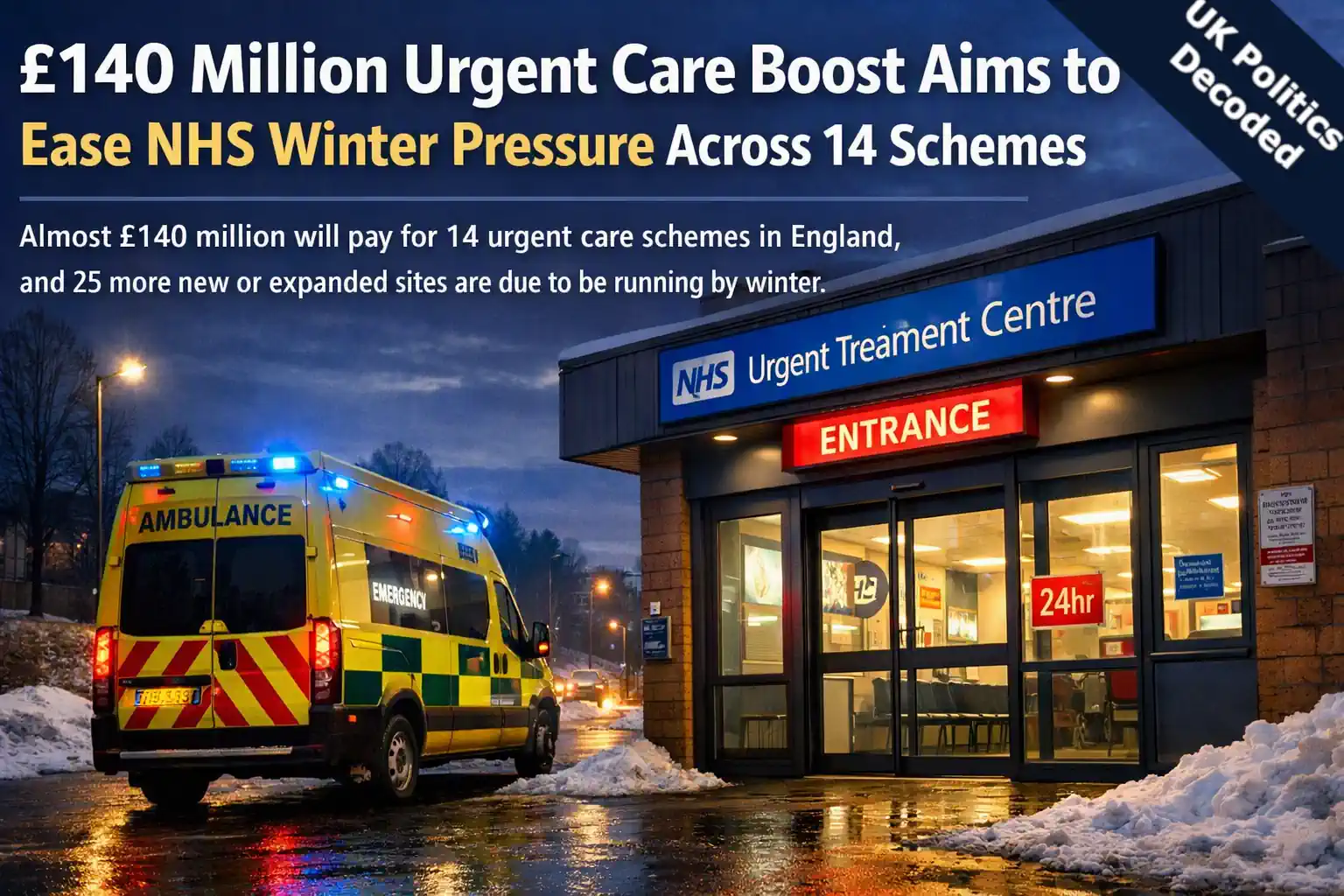
The government has committed almost £140 million to 14 urgent care schemes across England, as the NHS braces for what ministers describe as one of its most challenging winters. The projects, announced on 18 October 2026, cover new urgent treatment centres, same day emergency care units, ambulance fleets and emergency department upgrades.
A further 25 new or expanded urgent care sites, first announced in April, are meant to be open in time for winter. The package arrives after what the government calls the busiest summer in NHS history, and it comes with a message for the public, book your flu jab.
At a Glance
- The government is investing almost £140 million in 14 new urgent care schemes across England.
- A further 25 new or expanded urgent care sites announced in April are due to be open for winter.
- Queen's Hospital in Romford receives the largest single award, £42.1 million, to rebuild an A&E department designed for around 325 patients a day.
- More than 7.4 million flu vaccinations had been delivered in England by 11 October, and more children have been vaccinated so far than at the same point last year.
- The government says it is investing almost £2 billion in urgent care capital projects until 2030.
Where the £140 million for urgent care is going
The 14 schemes are spread across five regions of England. The East of England has the most, with six projects, followed by the Midlands with three, London with two, and North East and Yorkshire with two. The North West has one. The government has not listed any schemes in the South East or South West in this particular round, although both regions feature in the separate April list.
Money is not being handed out in one lump. Some awards run over several years, £7.7 million for Addenbrooke's Hospital in Cambridge is spread over four years, while Basildon Hospital's £6 million runs over two. London's emergency department digital transformation programme, at £18.4 million, is funded over three years.
The government says the schemes will provide a significant increase in frontline and urgent care capacity. Its pitch to patients is simple enough. Those with urgent but not life threatening problems should be seen in a dedicated setting, which leaves A&E teams free to concentrate on the sickest people.
Queen's Hospital Romford gets £42.1 million to rebuild an overstretched A&E
The headline project is at Queen's Hospital in Romford, which receives £42.1 million for a comprehensive transformation and reconfiguration of its A&E. According to the government, the department was built to see around 325 patients a day but now regularly treats more than twice that number.
The plan is for a modern emergency department with improved patient flow, dedicated waiting areas, better visibility for staff, a refurbished children's A&E and enhanced digital systems. The government says this should help reduce waiting times, corridor care and pressure on staff, while improving patient safety, dignity and experience. No completion date is given in the announcement.
London's other scheme is an £18.4 million programme over three years to bring digital check in and triage tools to emergency departments across the capital. These are intended to identify patients' needs earlier and steer them towards the right service.
What the 14 urgent care schemes will build, from UTCs to ambulances
Several of the schemes are aimed at splitting the workload away from the main emergency department. James Paget University Hospital in Gorleston gets £10 million for a new urgent treatment centre, while the Queen Elizabeth Hospital in King's Lynn receives £3.9 million to upgrade its existing one. Same day emergency care, which assesses and treats patients who can safely go home within a day, is the focus at the Queen's Medical Centre in Nottingham (£12.9 million), Airedale General Hospital (£6.76 million) and the Royal Albert Edward Infirmary in Wigan (£4.7 million).
Other projects tackle the flow of patients through hospitals. Lister Hospital in Stevenage gets £2 million for more escalation, general and acute beds, so patients can move out of A&E more quickly during busy periods. Addenbrooke's will use its money to build a digital coordination centre for beds, discharges and urgent admissions. Basildon is doubling its rapid assessment, triage and treatment area from three bays to eight. Norfolk and Norwich University Hospital has £4.86 million to refurbish its emergency department, and University Hospital of North Tees has £1 million to redo the entrance, reception and waiting areas.
Two schemes involve the ambulance service. East Midlands Ambulance Service receives £6.35 million for 40 additional double crewed ambulances, which the government says will increase its capacity to respond to 999 calls during periods of high demand. In Shropshire, £12 million will replace the ambulance operational hub in Shrewsbury with a modern base offering more space for vehicle preparation, maintenance and staff facilities.
The 25 urgent care sites promised for winter, what is open now?
The 25 sites announced in April are a mix of new and expanded urgent treatment centres and same day emergency care units. Going by the government's own status table, 17 are already open. They include new urgent treatment centres at the Queen Elizabeth Hospital Birmingham, Northampton General Hospital and the Royal Stoke University Hospital, and a new same day emergency care unit at Barnsley District General Hospital.
The other eight are not yet running. New urgent treatment centres at Southampton General Hospital are expected in November 2026, with those at Salisbury District Hospital, the Royal Hampshire County Hospital and North Middlesex Hospital expected in December 2026. Southampton's new same day emergency care unit is also due in November, and the William Harvey Hospital in Ashford is expected to complete its expansion this month. Two expansions, at Mid Yorkshire Hospitals NHS Trust and at Royal Devon, are not expected until January 2027.
That sits slightly awkwardly with the government's statement that all 25 sites will be open "for winter", since January is well inside the season. The announcement does not address the gap.
Pharmacy First, GP access and the flu jab push
Capacity is only one part of the winter plan. The government says it has expanded the Pharmacy First scheme, so people can get help with a wider range of common conditions at their local pharmacy, and enhanced GP access through evening, weekend and out of hours appointments during the colder months.
Prevention gets equal billing. More community pharmacies are offering the flu jab this year, and eligibility has been widened to include more vulnerable groups, including people experiencing homelessness. The NHS is also rolling out digital tools to simplify booking for parents, schools and vaccination teams. By 11 October, more than 7.4 million flu vaccinations had been delivered in England, and the government says more children have been vaccinated so far this year than last. Booking is open now.
Dr Emma Rowland, NHS Executive Director for Performance and Delivery, said investment in same day emergency care and urgent treatment centres will help more patients get the right care in the right place at the right time. She added that prevention is just as important and urged anyone eligible for a flu or other winter vaccination to come forward.
Yvette Cooper and NHS leaders on why this winter will be harder
Health and Social Care Secretary Yvette Cooper said winter will be more challenging for the NHS this year after such a heavy summer, which is why the government has been preparing early and investing in extra urgent care capacity. She said NHS staff worked incredibly hard to keep on top of the extra pressure this summer and that they now need support to deliver for patients through the winter.
Sir Ciarán Devane, Chief Executive of the NHS Alliance, called the investment welcome. He also set out where he thinks the priority lies, with demand remaining high, the focus needs to be on easing pressure on hospitals, improving patient flow and helping more people receive care closer to home or return home sooner.
The NHS has been preparing for winter since July, according to the government, with seasonal illnesses including flu and norovirus expected to add to an already heavy workload.
How the £140 million fits into £2 billion of urgent care spending
The £140 million sits inside a larger commitment. The government says it is investing almost £2 billion in urgent care capital projects until 2030, with the aim of improving facilities and helping people get care closer to home. That is on top of a £1.5 billion investment confirmed so far for projects addressing urgent maintenance problems across the NHS estate.
The announcement does not say how much of the £2 billion has already been allocated, and it does not set targets for A&E waiting times or ambulance response times linked to the new money. Whether the schemes change those figures will depend on how quickly they are built and staffed, details that the government has not yet published.
Key Takeaways
- Almost £140 million will fund 14 urgent care schemes across England, covering urgent treatment centres, same day emergency care, ambulances and emergency department upgrades.
- Queen's Hospital in Romford receives £42.1 million, the largest single award, to overhaul an A&E department that regularly treats more than twice the 325 patients a day it was built for.
- According to the government's status table, 17 of the 25 sites announced in April are open, with eight still to come between October 2026 and January 2027.
- The government has expanded Pharmacy First, enhanced GP access out of hours and widened flu jab eligibility, including to people experiencing homelessness.
- The government says it is investing almost £2 billion in urgent care capital projects until 2030, alongside £1.5 billion confirmed for NHS estate maintenance.