AI Use: AI tools were used to support source discovery and to structure the article for clarity. All research, verification, drafting, and final editorial decisions are fully human led. Learn about our AI policy.
UKPoliticsDecoded is an IMPRESS regulated public interest publisher. Read our editorial standards.
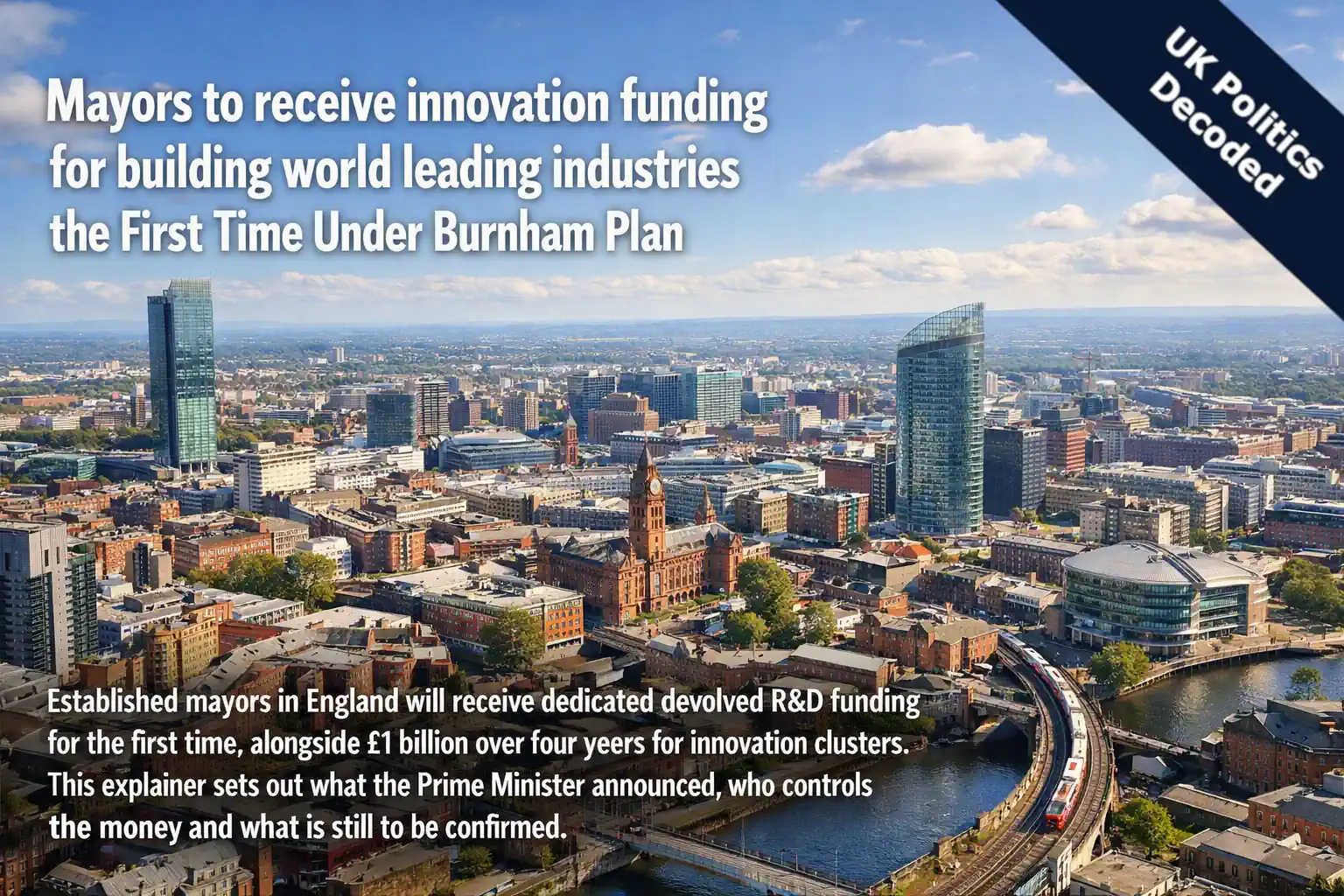
Local leaders in England are to be handed dedicated research and development (R&D) funding for the first time, under plans Prime Minister Andy Burnham set out at the Innovation Nation Summit in Manchester on 9 October. The government says some R&D funding will move out of Westminster, giving regions more freedom to back their own ideas and drive growth.
The package also includes £1 billion for industrial clusters over the next four years, and a new body, No.10 North, tasked with linking innovation clusters across the country. Mr Burnham described the aim as "good growth in every postcode."
At a glance
- Established mayoral strategic authorities in England will receive dedicated devolved later stage innovation funding for the first time.
- The existing Local Innovation Partnerships Fund will be devolved to established mayors from 2028.
- The government will commit £1 billion through UK Research and Innovation over the next four years to support innovation clusters in the Industrial Strategy's priority sectors.
- No.10 North will be tasked with building partnerships between innovation clusters, starting with the Northern and Oxford to Cambridge growth corridors.
- The devolved R&D money will sit alongside new Good Growth Funds, a single, flexible, long term growth budget for local leaders.
What Burnham Announced at the Innovation Nation Summit
Speaking at the summit, Mr Burnham said Britain has "the finest minds working at the most prestigious universities" and some of the most advanced companies and clusters. The government's argument is that the next wave of breakthroughs should not only be discovered in the UK, but developed, scaled and commercialised here too.
The speech was framed around a mission the Prime Minister has set for his government, good growth in every postcode. In practical terms, the announcement splits into three parts. Mayors get their own innovation money, UK Research and Innovation (UKRI) backs high growth clusters with £1 billion, and No.10 North works on connecting clusters to each other.
The speech also set out measures to tackle barriers to growth and a national mission to defeat dementia. The government's published announcement gives no further detail on either, so this article does not cover them.
How Control of R&D Money Is Moving Away From Whitehall
The change that matters most is who decides. The government describes the reforms as a shift away from a system where too many decisions about regional innovation are taken at a national level, and towards one that gives places greater control over their economic future.
Under the new approach, established mayoral strategic authorities will be able to back the most promising innovation opportunities in their own areas, building on local strengths. Rather than local areas applying into centrally designed schemes, the funding will be devolved to them to direct. The government says this will let Whitehall focus on the decisions only central government can take.
The first concrete step is the Local Innovation Partnerships Fund (LIPF), which will be devolved to established mayors from 2028. The government calls this a first step. It says it will devolve a "substantially increased share" of later stage innovation funding to local leaders, including in areas beyond the existing established mayoral authorities, as set out in the Rewiring the State Cabinet Statement.
The dedicated R&D money is meant to sit alongside the new Good Growth Funds. The government describes those as a single, flexible, long term growth budget that lets local leaders invest in opportunities to create jobs, attract investment and raise living standards. Between them, the two pots are intended to give mayors both research money and wider growth money to plan around together.
£1 Billion for Innovation Clusters and the Role of No.10 North
Separately from the devolved funding, the government will commit £1 billion through UKRI over the next four years to support high growth innovation clusters in the Industrial Strategy's priority sectors. The money is aimed at places with the research excellence, businesses and skilled workers needed to turn new ideas into successful companies.
No.10 North has a different job. It will bring forward partnerships between clusters in the Industrial Strategy's eight growth driving sectors, building on what the government calls the success of the Cambridge and Manchester collaboration. The first partnership will link the Northern Growth Corridor with the Oxford to Cambridge Growth Corridor, in sectors including life sciences, digital and technology, and advanced manufacturing.
The government says connecting universities, businesses and local leaders in different parts of the country should help ideas move more quickly from research into commercial products. It also argues that places combining their strengths can compete at the scale needed to attract international investment.
Confirmed in the announcement
- Dedicated devolved later stage innovation funding for established mayoral strategic authorities in England.
- LIPF devolved to established mayors from 2028.
- £1 billion through UKRI over four years for innovation clusters.
- A first No.10 North partnership between the Northern and Oxford to Cambridge growth corridors.
None of the figures in the government's announcement put a total on the devolved R&D funding itself. The only headline sum is the £1 billion for clusters, and that is delivered through UKRI rather than handed to mayors.
Does the Funding Apply to Scotland, Wales and Northern Ireland?
The LIPF announcement relates only to established mayoral strategic authorities in England. The government has said it will work with the devolved governments, and with local and regional stakeholders in Scotland, Wales and Northern Ireland, to explore how the benefits of local empowerment can be spread to all parts of the country. No timetable or funding for that work is given in the announcement.
The £1 billion for innovation clusters is described as supporting clusters across the UK, though how it will be split between places has not been published.
The reforms also sit within a broader aim of reindustrialising Britain. The government says too many discoveries from UK universities and researchers fail to become major companies, productive investment and well paid jobs in the communities where they began. It argues that successful innovation depends on more than research funding alone, pointing to skilled workers, affordable space, modern infrastructure, access to finance and links with universities. Putting more decisions in local hands, it says, will allow those elements to be brought together around a clear plan for each area.
When Will Mayors Get the Money? What Is Still Unconfirmed
Much of the detail is still to come. The 2028 date for devolving the LIPF means the first mayors to control that money are some way off, and the wider share of later stage innovation funding has not been quantified.
The government's own test, as it states it, is whether local leaders can use the new freedom to unlock new investment, grow businesses and create better paid jobs. Whether that happens will depend on how much money is eventually devolved and how quickly mayors can put it to work, neither of which the announcement settles.
The No.10 North partnerships and the UKRI cluster funding are the nearer term items to watch, since the first corridor link has already been named and the four year funding period is set.
Key Takeaways
- Established mayoral strategic authorities in England will receive dedicated devolved R&D funding for the first time, with the Local Innovation Partnerships Fund moving to them from 2028.
- The government says it will devolve a substantially increased share of later stage innovation funding in future, including to areas beyond existing established mayors.
- A separate £1 billion over four years will flow through UKRI to innovation clusters in the Industrial Strategy's priority sectors.
- No.10 North will build partnerships between clusters, beginning with the Northern and Oxford to Cambridge growth corridors.
- The announcement does not set out the total devolved R&D budget, the Good Growth Funds budget or a timetable for Scotland, Wales and Northern Ireland.