AI Use: AI tools were used to support source discovery and to structure the article for clarity. All research, verification, drafting, and final editorial decisions are fully human led. Learn about our AI policy.
UKPoliticsDecoded is an IMPRESS regulated public interest publisher. Read our editorial standards.
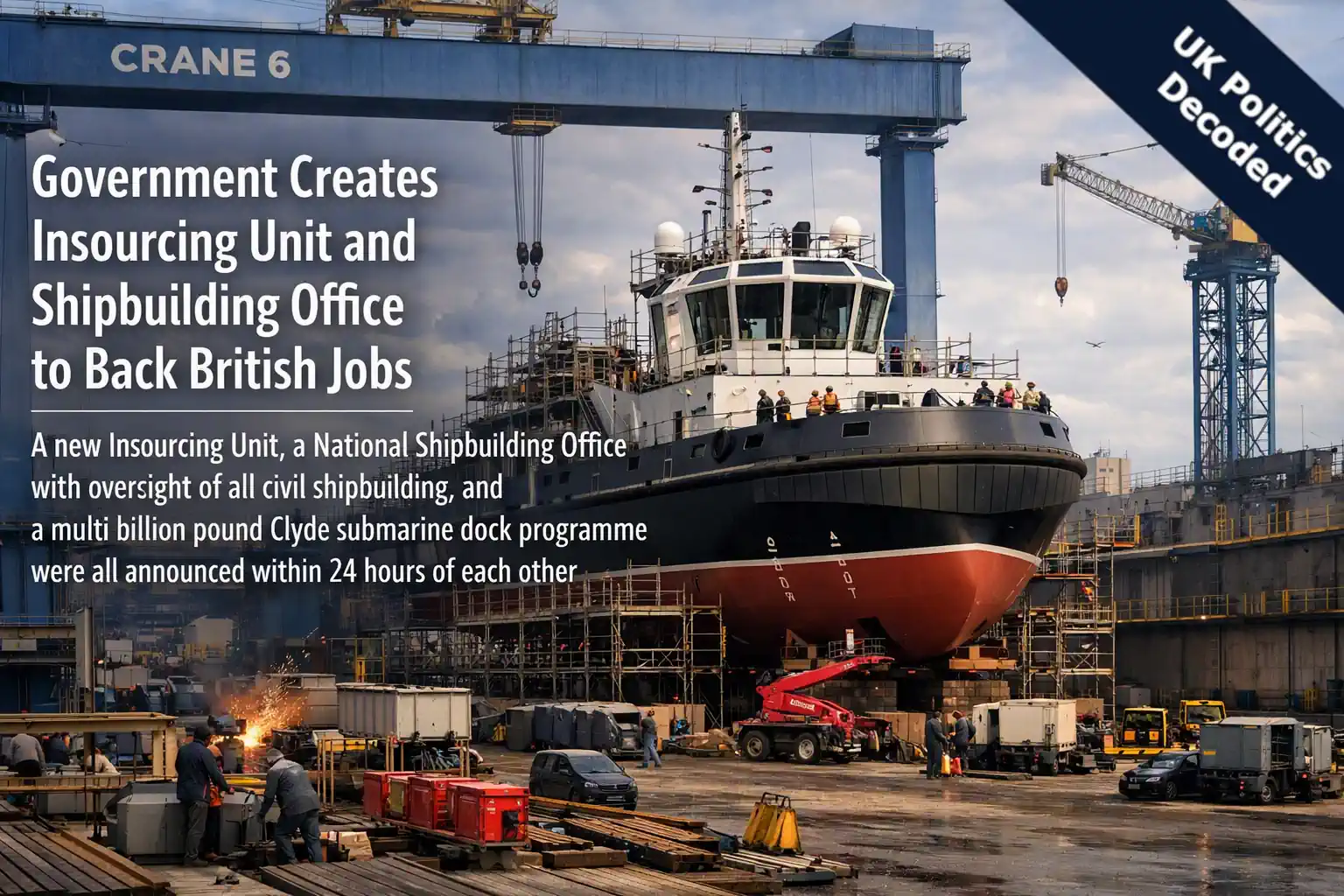
The Cabinet Office announced a package of measures on 27 September to "rewire the state," handing a new National Shipbuilding Office oversight of all civil shipbuilding decisions and creating an Insourcing Unit tasked with bringing outsourced government services back in house. A day later, the Treasury and Ministry of Defence confirmed the first big test of that shipbuilding oversight, a multi billion pound investment in British yards, including three new floating docks for the Royal Navy's submarine service at HM Naval Base Clyde.
The two announcements, coming within 24 hours of each other, are being presented by ministers as a single, connected push to put government spending to work for British jobs, rather than two separate stories. Utility companies are being told to follow the same principle, or face legislation forcing them to.
At a glance
- The Cabinet Office has created a new Insourcing Unit, based within the Office for the Prime Minister and Cabinet, to coordinate the "biggest wave of insourcing in a generation."
- A new National Shipbuilding Office will oversee every civil shipbuilding decision made by government, with a Shipbuilding and Maritime Technology Action Plan due later this year.
- Utility companies providing electricity, gas and water are being told to use their procurement to support British manufacturing jobs and apprenticeships, or face legislation if they do not.
- Chancellor John Healey confirmed three new floating docks for HM Naval Base Clyde's submarine service, procured through a UK only competition called Programme Euston.
- A new marine research vessel, replacing the ageing RV Cefas Endeavour, will be built exclusively in UK shipyards and is expected to be operational in the early 2030s.
Why Utility Companies Are Being Told to Buy British
The first strand of the 27 September package extends a principle the government says it already applies to its own spending. Earlier in 2026, ministers introduced guidance requiring central government spending to bring skills and jobs to communities across the country. The new measures push that expectation onto private utility companies for the first time.
Electricity, gas and water network operators will now be expected to use their own procurement decisions to support British manufacturing jobs and apprenticeships as they invest in infrastructure. The government has been explicit that this is a request rather than a legal requirement for now, but has left the door open to compulsion. Legislation will be brought forward "when parliamentary time allows" if utility companies do not follow the government's lead voluntarily.
That framing matters. It signals the government would rather utility firms change behaviour without new law, but it also puts those companies on notice that continued reliance on overseas suppliers could eventually carry a legislative cost, not just a reputational one.
What the New National Shipbuilding Office Actually Controls
The second strand hands one body, the National Shipbuilding Office, oversight of every civil shipbuilding decision taken across government. The stated aim is to give the UK shipbuilding industry a clearer, more predictable pipeline of demand, and a simpler route for ships to be procured, including through closer work with European allies.
The Ministry of Defence is due to publish more detail through the National Shipbuilding Office's Shipbuilding and Maritime Technology Action Plan later this year, which will set out how that oversight works in practice. Until that plan lands, the office's precise powers over individual contracts remain to be spelled out in full.
Inside the Insourcing Unit and Its £1 Million Test
The third strand of the 27 September package is the Insourcing Unit, based within the Office for the Prime Minister and Cabinet. Its job is to coordinate departmental insourcing activity, clear away barriers to bringing services back in house, and identify opportunities across government to get better value for money while restoring direct operational accountability.
What Changes
- Central government service contracts worth more than £1 million must now complete a Public Interest Test before renewal.
- The Cabinet Office plans to bring its own building management services, including cleaning and security staff, back in house once current contracts end.
- The unit is intended to reduce spending on consultancy and professional services by building up Civil Service capacity instead.
The unit will work alongside, rather than replace, the Public Interest Test that already applies to most central government service contracts valued above £1 million. That test is designed to check whether a contract genuinely serves the public interest before it is renewed or extended, and the Insourcing Unit is being framed as the mechanism that acts on the test's findings.
How the Clyde Submarine Dock Investment Fits the Same Push
Where the 27 September announcement set out the rules, the 28 September announcement supplied the first big example. Chancellor John Healey confirmed that British shipyards will deliver two major maritime projects worth billions of pounds, three new floating docks for the Royal Navy's submarine service at HM Naval Base Clyde, procured through a UK only competition known as Programme Euston, and a new marine research vessel to replace the ageing RV Cefas Endeavour.
The floating docks will provide the maintenance facilities needed to inspect, upgrade and repair the UK's current and future fleet of nuclear submarines. The government has justified restricting the competition to UK only bidders on the grounds of their importance to national security and to sovereign British industry, echoing the same "national interest" language used to describe the new National Shipbuilding Office's remit.
Chancellor Healey said the investment was "backing British jobs on the Clyde and businesses across the UK, supporting growth in every postcode," and argued it would help secure "resilience in the industries that will drive growth today while building the capabilities the country needs for the future." Defence Secretary Wes Streeting went further, describing the Clyde programme as evidence that "defence spending should make Britain stronger in every sense," adding that Programme Euston "will modernise it for decades to come, while backing British shipyards, workers and engineering."
Both announcements sit inside a broader shift in how this government talks about public spending, framing procurement not just as a way to buy goods and services, but as a tool for building domestic industrial capacity. The marine research vessel is a useful illustration of how the pieces connect. It replaces RV Cefas Endeavour, will run on clean fuels and use automation, robotics and artificial intelligence, and is expected to lead a new national system for monitoring UK seas, tracking fish stocks, pollution levels and the seabed. Defra has applied the national security exemption in the Procurement Act 2023 to that contract specifically to keep the build inside UK shipyards, tying a scientific and environmental commitment to the same industrial strategy driving the Clyde submarine dock work.
None of this is happening in isolation from the government's wider Modern Industrial Strategy, which has already underpinned other announcements this year, including automotive investment and critical minerals projects. What the 27 and 28 September announcements add is a more explicit statement that government procurement itself, not just industrial subsidy, is being treated as a lever for jobs and sovereign capability.
The test of both announcements will be delivery rather than intent. The Shipbuilding and Maritime Technology Action Plan, due later this year, should clarify exactly how much authority the National Shipbuilding Office has over individual departmental contracts, and whether "oversight" translates into a genuine veto or simply a coordinating role.
On insourcing, the clearest near term marker is the Cabinet Office's own building management contracts, which will not be brought in house until they expire in 2028, a reminder that even flagship examples of this policy take years to materialise. And on shipbuilding, Programme Euston's UK only competition and the Cefas vessel contract both still have to be run to completion before the jobs and capability promised on the Clyde and elsewhere actually show up.
For utility companies, the immediate pressure is reputational rather than legal. Whether that changes will depend on how quickly, or how reluctantly, gas, electricity and water firms adjust their procurement to match a government that has now said, twice in two days, that it expects public and quasi public money to build British capability first.
Key Takeaways
- The government has created a new Insourcing Unit and a National Shipbuilding Office as part of a package of measures published on 27 September to "rewire the state."
- Utility companies face possible future legislation if they do not voluntarily use procurement to support British manufacturing jobs and apprenticeships.
- A day later, the Treasury confirmed the National Shipbuilding Office's first major example, a multi billion pound investment including three new floating docks for HM Naval Base Clyde's submarine service, procured through the UK only Programme Euston competition.
- A new marine research vessel, replacing RV Cefas Endeavour, will be built exclusively in UK shipyards under a national security exemption in the Procurement Act 2023.
- Delivery will take years rather than months. The Cabinet Office's own insourcing of cleaning and security contracts will not begin until 2028, and the Shipbuilding and Maritime Technology Action Plan is not due until later this year.
Sources & Further Reading
- GOV.UK - Measures to rewire the state Archived copy (OGL): archived page
- GOV.UK - Healey pledges "new age of industrialisation" as Government backs British shipbuilding Archived copy (OGL): archived page