AI Use: AI tools were used to support source discovery and to structure the article for clarity. All research, verification, drafting, and final editorial decisions are fully human led. Learn about our AI policy.
UKPoliticsDecoded is an IMPRESS regulated public interest publisher. Read our editorial standards.
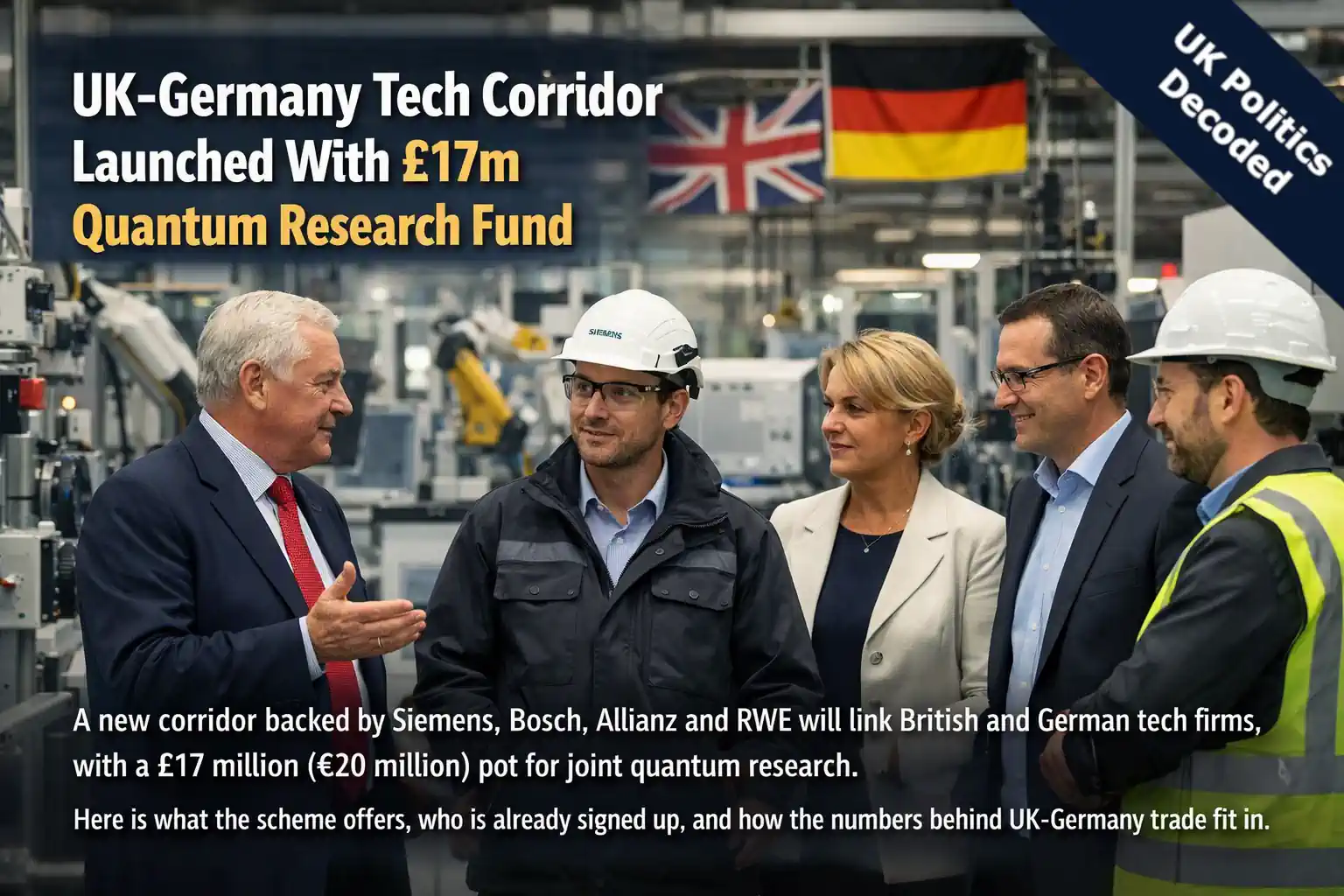
The UK and Germany have agreed to open an Industrial Tech Corridor, a structured route for British and German technology companies to find partners, investors and customers on each other's side of the North Sea. The government announced it on 8 October 2026, the day the Prime Minister travelled to Berlin.
Alongside the corridor, both countries will share a research pot of around €20 million (£17 million) for joint work on quantum technology. The Department for Business, Innovation, Science and Trade describes the package as a way to win investment, create skilled jobs and speed up the adoption of technologies such as AI.
At a Glance
- The UK and Germany have agreed an Industrial Tech Corridor to help technology firms and industrial companies in both countries form partnerships.
- A shared pot of around €20 million (£17 million) will fund joint quantum research, with the UK's share coming from the Office for Quantum's budget via Innovate UK.
- Allianz, Bosch, RWE and Siemens are backing the corridor, which the government calls a flagship initiative under the Kensington Treaty.
- MicroAGI plans 180 new London jobs and Proxima Fusion could quadruple its workforce at Culham by 2028, according to the government.
- UK-Germany trade in goods and services was worth £155.4 billion in the 12 months to the end of March 2026, making Germany the UK's second largest trading partner.
What Is the UK-Germany Industrial Tech Corridor?
At its simplest, the corridor is a matchmaking mechanism. The government says it will help companies on both sides of the North Sea strike partnerships with each other, with the stated aims of driving investment, creating jobs and spreading cutting edge technologies such as AI. When fully up and running, it is meant to connect high growth technology companies with major industrial partners and investors, helping the smaller firms win business and scale up.
The programme sits under the Kensington Treaty, the UK-German bilateral friendship agreement, which the government describes as the parent framework. It also builds on the two countries' Strategic Science and Technology Partnership. The official corridor website says the scheme gives companies and policymakers a structured channel to connect around shared technology and industrial priorities.
The website sets out what each side gets. Technology companies can engage with industrial leaders, explore partnerships, understand both markets and speed up commercial growth. Industrial firms get a route to discover new technology, build strategic relationships and turn their technology priorities into practical collaboration. Enquiries go to a Foreign, Commonwealth and Development Office email address listed on the site.
The release is candid that the corridor is not yet at full operating strength. The wording is "when fully up and running", and no start date for the full programme, budget for the corridor itself or application process has been published in the material we reviewed.
Which Companies Are Backing the Tech Corridor?
The government names Allianz, Bosch, RWE and Siemens as leading German firms supporting the initiative. The release carries supporting statements from a longer list of businesses, including Vodafone, Celonis, Codesphere, Nscale, Isembard, Quantexa, MicroAGI and Proxima Fusion.
The corridor's website sorts its participating scale ups into four groups, AI and data, cybersecurity and infrastructure, advanced engineering and manufacturing, and workforce and skills. The entries are described by activity rather than company name in the version we saw, covering things like AI-powered materials discovery, sovereign cloud platforms, precision CNC manufacturing, photonic processors and embodied AI for industrial robotics.
Three companies have already announced concrete moves, according to the government. Munich headquartered robotics research firm MicroAGI will expand in London, creating 180 new high paid jobs. Proxima Fusion will expand its base in Culham, with the potential to quadruple its workforce there by 2028. UK based AI software company Quantexa is committing to a dedicated sovereign unit in Germany to support deployment in both countries. These are company commitments reported by the government, and the announcement does not give timelines for the hiring or the new unit.
Business Secretary Jonathan Reynolds said the agreements "mean more jobs, more investment, and more innovations that will change lives". Germany's Federal Minister for Digital Transformation and Government Modernisation, Dr Karsten Wildberger, said the partnership would let scale ups enter "Europe's most advanced AI ecosystems" and described it as a step towards strengthening Germany's digital sovereignty.
£17m for Quantum Research, Where the Money Comes From
The headline funding is a joint pot of around €20 million, which the release converts to £17 million. It will back projects across quantum technology, from quantum computing itself through to uses in financial services. The release also points to quantum sensors, which it says are already helping to improve understanding of conditions such as epilepsy and dementia.
The UK's contribution comes from the Office for Quantum's budget, delivered through Innovate UK, according to the notes to editors. The release does not say how large each country's share will be, how the money will be split between projects, or when a call for proposals will open.
The government makes a large claim about why this matters. It says quantum computing has the potential to add more than £200 billion and some 100,000 jobs to the UK economy by 2045, and notes that the UK committed earlier this year to be the first country in the world to build large scale quantum computers on its own soil by the early 2030s. The release does not name the source of the £200 billion estimate.
Independent modelling points the same way, with caveats. Oxford Economics published research in February 2025 estimating that quantum computing could lift UK economy wide productivity by up to 7% by 2045, equivalent to as much as £212 billion of GDP. The same research warned that the UK's government funding for quantum hardware was more than ten times smaller than that of peer nations, and said greater state support would be crucial if the UK were to realise the benefits. Those are modelled projections that depend on quantum computing becoming commercially viable, not forecasts of what the €20 million will deliver.
There is a separate, smaller research stream too. Last month the UK and Germany launched a joint funding call worth £2.4 million for research and development in clean energy, life sciences and engineering biology. Research teams from both countries can partner to bid for up to £350,000 each.
How Big Is UK-Germany Trade? The Numbers Behind the Corridor
The release says Germany is the UK's second largest trading partner and contributes some £155 billion to the UK economy. The Department's own factsheet, published on 24 September 2026, gives a closely related but differently defined figure, total trade in goods and services of £155.4 billion in the 12 months to the end of March 2026, up 3.9% on the year before. That is 8.1% of all UK trade. Because the release does not explain how its £155 billion figure was calculated, the two numbers are best read as related rather than identical.
The balance is lopsided. The UK exported £63.8 billion to Germany and imported £91.7 billion from it over the period, leaving a total trade deficit of £27.9 billion. Goods account for the gap, the UK ran a £40.4 billion deficit in goods, partly offset by a £12.5 billion surplus in services.
Technology related trade matters here. The UK's largest services export to Germany is "other business services", which includes research and development, consulting and technical services, at £11.7 billion. Telecommunications, computer and information services come next at £5.2 billion, a figure that fell 0.7% on the previous year. On the goods side, the UK's biggest exports to Germany were mechanical power generators at £4.8 billion, aircraft at £3.4 billion and medicinal and pharmaceutical products at £2.5 billion.
Investment tells a mixed story. At the end of 2024, the stock of German investment in the UK stood at £50.2 billion, up 14.7% on the end of 2023. UK investment stock in Germany was £48.5 billion, down 21.1% over the same period. The factsheet also reports that the UK's share of the German import market was 4.3% in 2025, down 0.2 percentage points from 2024.
The factsheet estimates that exports to Germany supported around 642,400 jobs in the UK in 2022, using OECD modelling. The Department cautions that this measures employment supported by exports rather than jobs created by them, since the roles may previously have served the domestic market.
When Will the Tech Corridor Open? What the Government Hasn't Said
The announcement sets out a framework and some early commitments rather than a delivery timetable. Several practical questions are not answered in the published material, when the corridor will be fully operational, how a company applies to take part, what the corridor itself will cost, and when the quantum funding call opens. The corridor website currently lists a contact address for enquiries.
The government has also not set out how it will judge success. Job numbers from MicroAGI and Proxima Fusion are described as expansions or potential growth, and the quantum figures are long range economic estimates. Readers looking for firm outcomes will need to watch for follow up announcements from the Department and Innovate UK.
What is confirmed is the political agreement. A named corridor under the Kensington Treaty, a publicly stated quantum funding pot, and a group of major German and British firms prepared to put their names to it. The announcement came alongside a separate UK-Germany agreement on countering hybrid threats, covered in our related article below.
Key Takeaways
- The UK and Germany announced a new Industrial Tech Corridor on 8 October 2026 to help technology companies and industrial firms in both countries form partnerships.
- A shared research pot of around €20 million (£17 million) will support joint quantum projects, with the UK contribution coming from the Office for Quantum via Innovate UK.
- The government says quantum computing could add more than £200 billion to the UK economy by 2045, while Oxford Economics modelling gives a figure of up to £212 billion on the assumption of government support.
- UK-Germany trade reached £155.4 billion in the 12 months to the end of March 2026, with the UK running a £27.9 billion total trade deficit.
- No full launch date, application process or corridor budget has been published, so the scale of the scheme's impact is not yet known.
Sources & Further Reading
- GOV.UK - First ever UK-Germany tech corridor unlocks investment, jobs and opportunity for British business Archived copy (OGL): archived page
- GOV.UK - Germany trade and investment factsheet (24 September 2026) Archived copy (OGL): archived page
- The UK-Germany Industrial Tech Corridor Archived internally for verification (9 October 2026)
- Oxford Economics - Quantum Computing could boost UK productivity and GDP growth, but government support is crucial Archived internally for verification (9 October 2026)