AI Use: AI tools were used to support source discovery and to structure the article for clarity. All research, verification, drafting, and final editorial decisions are fully human led. Learn about our AI policy.
UKPoliticsDecoded is an IMPRESS regulated public interest publisher. Read our editorial standards.
More than 3,000 people sleeping rough in England have been offered a route off the streets since government funding reached local areas on 30 September, according to the first monthly figures from the new Rough Sleeping Programme. The Ministry of Housing, Communities and Local Government (MHCLG) published them on 27 November 2026.
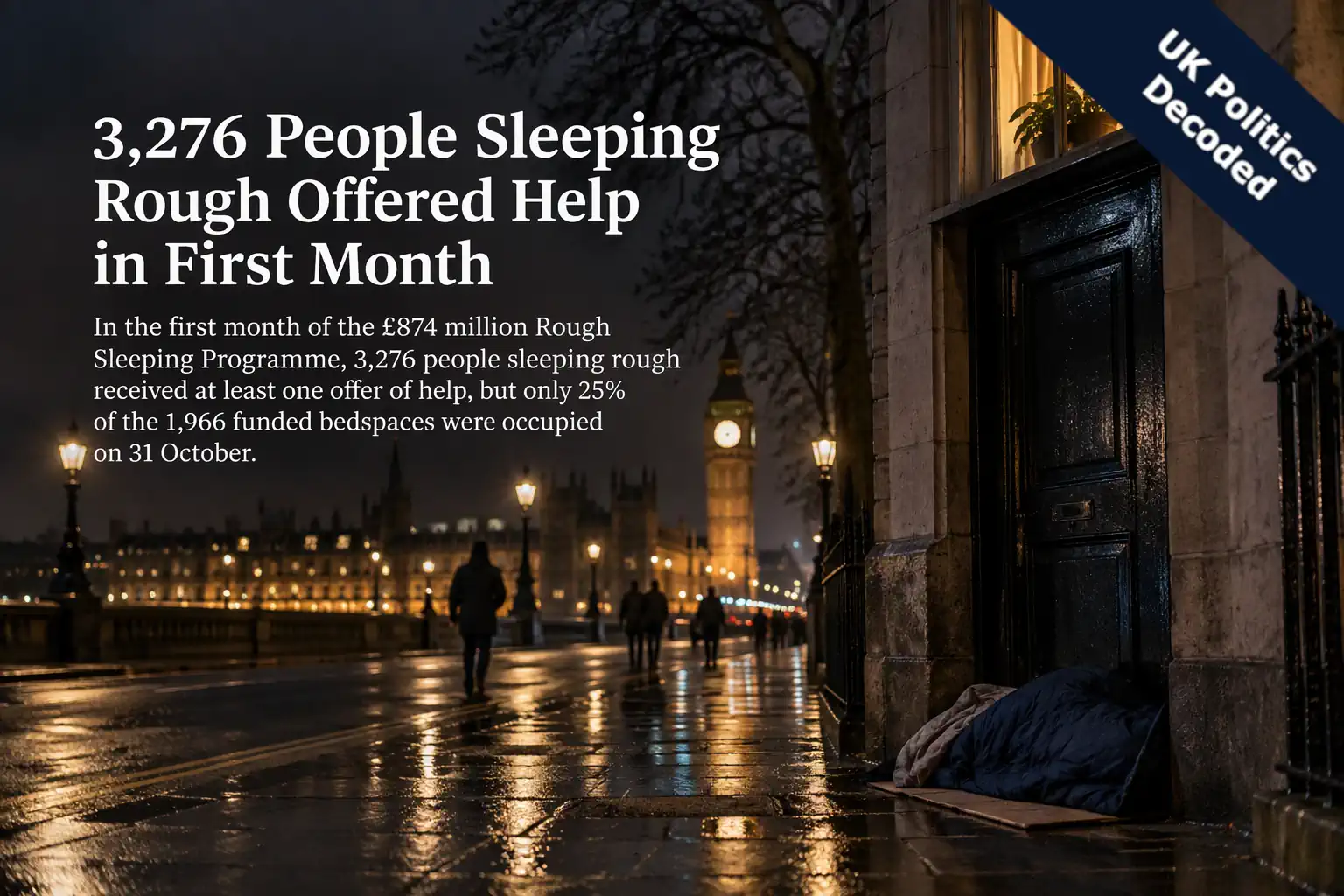
The headline number is 3,276 people who received at least one offer by the end of October. Behind it sit some important caveats about how the data was collected, which the department sets out in its own publication.
At a Glance
- By the end of October, 3,276 people sleeping rough had received at least one offer of a route off the street, out of 4,251 offers made in total.
- On 31 October there were 1,966 bedspaces funded by the Rough Sleeping Programme, and 25% of them were occupied.
- The Rough Sleeping Programme is worth £874 million over three years, led by mayoral strategic authorities and local authorities.
- 82% of areas that gave a suitable response said they were confident everyone sleeping rough would be offered a route off the street by 1 December.
- The government says the figures cannot show whether offers were accepted or how many people actually stopped sleeping rough.
How Many People Sleeping Rough Have Been Offered Help?
The government says 3,276 people sleeping rough received at least one offer of a route off the street by the end of October. That is one month after initial funding reached local areas.
The overall count of offers is higher. In total, 4,251 offers were recorded, and the department is clear that this figure includes repeat offers made to the same person, as well as offers to people who may not currently be sleeping rough. In its press release, MHCLG rounded that to "more than 4,250". Nearly 2,000 additional bed spaces have also been funded through the programme.
An "offer of a route off the street" has a specific meaning in the statistics. It is an offer of support or accommodation made to someone sleeping rough, or at risk of it, so that they have a clear and accessible way off the street. It is not the same as someone moving into a bed.
The release picks out two local examples. Areas in the East of England made 656 offers of a route off the street, while 253 newly funded bed spaces have been created in the North West.
Only a Quarter of Funded Beds Were Occupied in October
The bedspace figures tell a different story to the offers. On 31 October, 1,966 bedspaces were reported as funded by the programme, and 25% of those were occupied.
The department's data notes give some context. In some areas, programme funded accommodation was still being mobilised at the end of October and was not yet operational. Some authorities also buy in bed and breakfast, hotel or other temporary accommodation as needed rather than keeping a fixed number of dedicated bedspaces, so their reported numbers may not reflect everything they can offer. In some cases, zero was reported where a reliable figure was not available.
Response rates also varied. Around 90% of areas provided data on offers and bedspaces, but only around 78% gave their level of confidence about delivery, because borough level figures were not available for London. For the confidence question, London is treated as a single area.
Rough Sleeping Figures Explained, What the Data Can't Show
The figures are management information. They come from local authorities and strategic authorities that receive programme funding, submitted through the department's online data collection system, and they are subject to validation and quality assurance. The department says figures may be revised in the next publication if authorities provide corrected or more complete information.
It also lists what the data cannot answer. The publication says it cannot show how many people stopped sleeping rough because of the programme, whether an offer was accepted or led to someone moving into accommodation, or whether anyone stayed housed. It also cannot show the total accommodation available locally, since bedspace figures cover only programme funded provision.
What the figures do show
- How many offers of a route off the street were made.
- How many people sleeping rough received at least one offer.
- The number of programme funded bedspaces and how many were occupied on 31 October.
- How these measures change over time and vary between reporting areas.
What the figures do not show
- How many people stopped sleeping rough as a result of the programme.
- Whether an offer was accepted or resulted in someone moving into accommodation.
- Whether someone stayed in accommodation or reached a sustained housing outcome.
- Whether differences between areas reflect better or worse performance.
The department adds that areas differ in need, funding arrangements and delivery models, so comparisons between them should be made with care. It also stresses that missing data should not be read as zero activity. Several authorities told MHCLG they had difficulty with the new reporting rules. Some reported only accepted offers, some could not reliably record repeat offers to the same person, and others counted only offers tied to programme funding. The department says it is working with authorities to improve guidance and consistency.
Where the £874 Million Rough Sleeping Funding Is Going
The Rough Sleeping Programme provides £874 million over three years. It is led by mayoral strategic authorities and local authorities, who work with local partners on accommodation and support. The money is meant to fund a route off the streets this winter and in later years, alongside settled accommodation with intensive support for people with the most severe and long term experience of sleeping rough.
Alongside the figures, the government confirmed further allocations. It has set out allocations for councils and mayors from £382 million of the extra £432 million announced at the Budget, to continue their route off the streets offer. It has also confirmed allocations for the settled accommodation part of the programme over the next two years, which it says will fund more than 1,000 longer term settled accommodation units and the intensive support that goes with them.
The government says the allocations give councils and mayors greater certainty over the funding available to them until the end of Parliament.
Will Everyone Sleeping Rough Be Offered Help by Christmas?
Prime Minister Andy Burnham said his first instruction to government was to make sure everyone sleeping rough is offered a route off the street by Christmas. In the release he said the new figures show early progress, but acknowledged it was "a big task" and that not everyone will accept the first offer they are made.
Housing Secretary Angela Rayner described the progress as encouraging, and said there was "much more to do". She said the effort was not only about more bed spaces but about making sure people have the support they need to rebuild their lives.
On delivery, the government says more than four in five areas that responded expect to have offered everyone sleeping rough in their area a route off the street by 1 December. The programme's own data puts the figure at 82% of areas that gave a suitable response. The ambition itself is that everyone sleeping rough who needs it will be offered a route off the street by Christmas. Outreach teams will keep working with people into the new year, building trust and making further offers.
Whether those offers turn into stable accommodation is not something the first release can answer, and the department has said the figures may be revised as authorities submit corrected or more complete returns.
Key Takeaways
- The first Rough Sleeping Programme figures show 3,276 people sleeping rough received at least one offer of a route off the street by the end of October.
- A total of 4,251 offers were recorded, but that count includes repeat offers to the same person and offers to people who may not currently be sleeping rough.
- Of the 1,966 bedspaces funded by the programme on 31 October, 25% were occupied, and some funded accommodation was still being mobilised.
- The department says the data cannot show whether offers were accepted or whether anyone left the streets for good, and that figures may be revised.
- The government has confirmed allocations from £382 million of the extra £432 million announced at the Budget, plus funding for more than 1,000 settled accommodation units.
Sources & Further Reading
- GOV.UK: Thousands sleeping rough offered a route off the streets Archived copy (OGL): archived page
- GOV.UK: Rough Sleeping Programme management information, October 2026 Archived copy (OGL): archived page