AI Use & Transparency: AI tools were used to support source discovery and to structure the article for clarity. All research, verification, drafting, and final editorial decisions are fully human led. Learn about our AI policy.
UKPoliticsDecoded is an IMPRESS regulated publisher. Read our editorial standards.
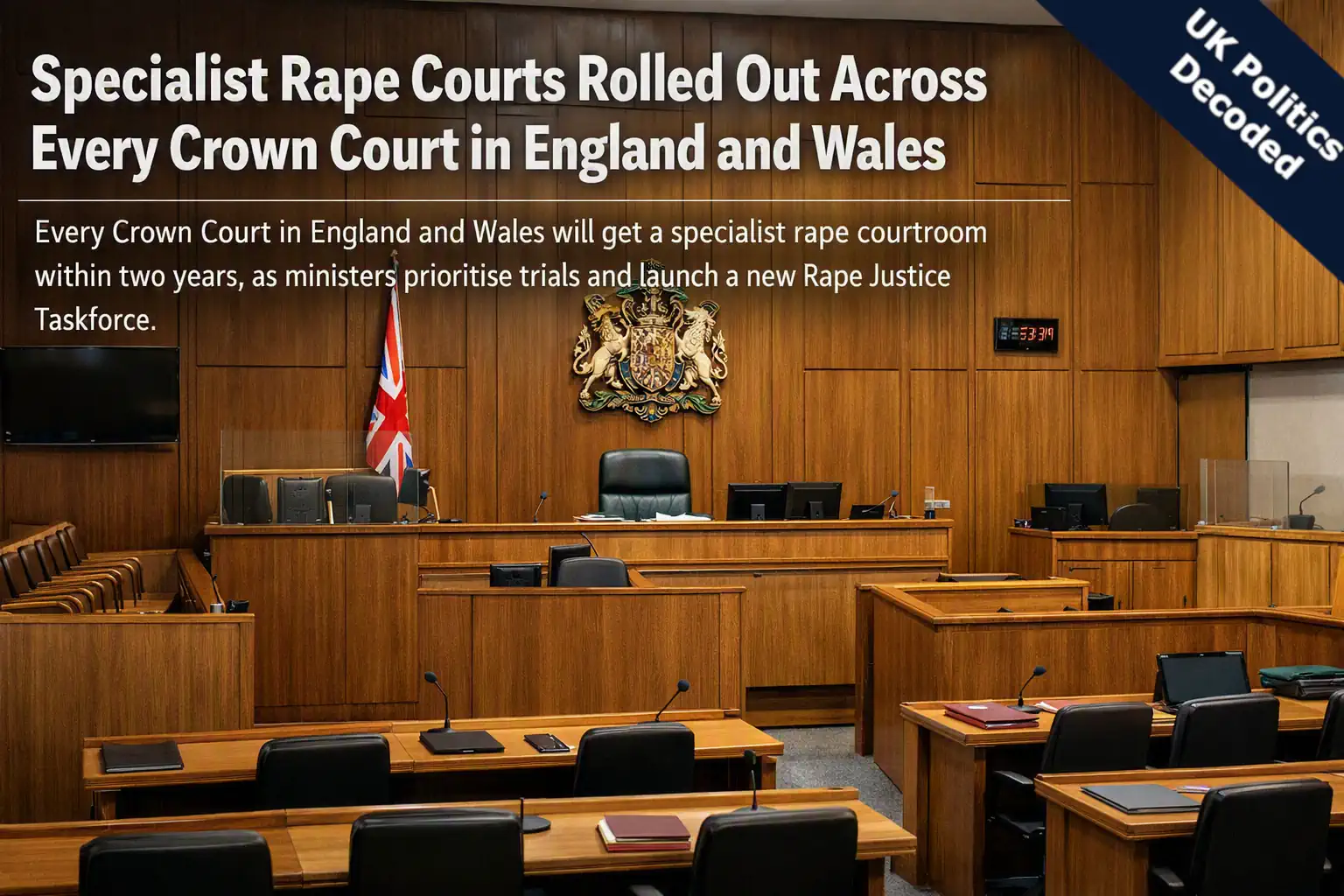
Every Crown Court in England and Wales will get at least one courtroom dedicated to rape and serious sexual offence cases within two years, under plans announced by the Ministry of Justice on 21 September 2026. The rollout, backed by a multi million pound cash injection, is designed to give trials priority, cut delays for survivors and encourage more victims to come forward rather than withdraw before their case is heard.
Rape and serious sexual offence trials will now be given a fixed date, rather than sitting on the "floating lists" that can see cases bumped and rescheduled with little warning. The courtrooms themselves will be upgraded with private waiting rooms and separate entrances, along with facilities to pre record evidence and to let victims observe sentencing remotely rather than sit through it in person.
At a glance
- Every Crown Court in England and Wales will get at least one specialist rape and serious sexual offence courtroom within two years, backed by a multi million pound investment.
- Rape and serious sexual offence trials will be given fixed dates instead of sitting on floating lists that can be delayed at short notice.
- Rape cases took an average of 424 days to complete once they reached the Crown Court in 2025, according to the Ministry of Justice.
- A new Rape Justice Taskforce will bring together criminal justice leaders to tackle rising rates of postponed rape trials and the reasons victims withdraw from cases.
- The changes follow Labour MP Charlotte Nichols speaking publicly about her own experience and calling for reform.
Why Rape Cases Take 424 Days to Reach Trial and How Ministers Plan to Cut That
The case for change rests on how long survivors have been waiting. According to the Ministry of Justice, rape cases took an average of 424 days to complete once they reached the Crown Court in 2025, with too many victims dropping out of the process before their case was ever heard. Ministers say that delay, combined with the stress of navigating an unfamiliar system, has left many feeling let down at every stage.
Prime Minister Andy Burnham said victims of rape and serious sexual offences "have felt let down by our justice system" for too long, pointing to persistently low prosecution rates and years long waits for justice. "This is not good enough," he said. "That's why we are making major changes to rebalance the scales of justice and put victims first." He added that prosecuting offenders alone "will not be enough" and that the government would also step up efforts to prevent the crimes happening in the first place.
Lord Chancellor Alex Norris framed the reform as a shift away from treating survivors as paperwork. "Victims of rape and serious sexual offences have felt they've been left alone facing the criminal justice system for too long," he said. "They have been treated as cases to process and not as people to support." The funding announced, he said, would deliver courtrooms "designed with victim needs in mind" and give staff specialist training to handle cases with care.
Private Entrances, Fixed Trial Dates, and What Actually Changes for Victims
Beyond the physical layout of the courtrooms, the announcement includes a package of measures aimed at how victims are treated once a case begins. All court staff will receive trauma informed training, and the Ministry of Justice will trial giving victims of sex offences a single point of contact to help them through the court process, rather than dealing with different officials at each stage.
The new Rape Justice Taskforce sits alongside these changes. It will draw together leaders from across the criminal justice system with a specific brief, tackling the rising rate of postponed rape trials and confronting the myths that the government says contribute to victims withdrawing from their own cases. Unlike the courtroom upgrades, which are physical and immediate, the taskforce is meant to work on the cultural and procedural reasons cases fall apart before they reach a jury.
Ciara Bergman, chief executive of Rape Crisis England & Wales, welcomed the package as "a significant step forward" that reflects reforms her organisation has called for over many years. She said the recognition that survivors need separate waiting areas, entrances and exits "to prevent survivors from being intimidated and distressed by the presence of perpetrators and their supporters" was "both necessary and long overdue," alongside the focus on trial efficiency and victims' ability to participate in and observe proceedings.
How Specialist Rape Courts Fit Labour's Pledge to Halve VAWG Within a Decade
The announcement follows Labour MP Charlotte Nichols speaking publicly about her own experience of the justice system, which the government says helped shape the case for these specific measures. It also builds directly on a separate commitment made earlier this month, when the Prime Minister said every police force in England and Wales would have a dedicated rape and sexual offence investigation team by the end of 2027, intended to help ensure more cases reach a prosecution in the first place.
The Ministry of Justice sets the rollout within a broader run of measures on violence against women and girls since Labour took office. It says it has pledged more than £1 billion to support victims, is placing domestic abuse specialists in 999 control rooms across every police force in England and Wales, and is expanding Domestic Abuse Protection Orders to give victims longer lasting protection. The government has also said it will use the Courts and Tribunals Bill, due back before Parliament in October 2026, to help reduce the wider backlog of cases still waiting to be heard.
Today's announcement forms part of the government's stated aim to halve violence against women and girls within a decade, a target that depends as much on how the justice system treats victims once a case is reported as on preventing the offences in the first place.
Key Takeaways
- Every Crown Court in England and Wales will get at least one specialist rape and serious sexual offence courtroom over the next two years, funded by a multi million pound investment.
- Rape trials will get fixed dates and victims will have access to private waiting rooms, separate entrances, and facilities to pre record evidence or watch sentencing remotely.
- Rape cases took an average of 424 days to complete once they reached the Crown Court in 2025, according to the Ministry of Justice.
- A new Rape Justice Taskforce will tackle postponed trials and the reasons victims withdraw, while all court staff will get trauma informed training.
- The reform follows a pledge that every police force will have a dedicated rape and sexual offence investigation team by the end of 2027, as part of the government's plan to halve violence against women and girls within a decade.
Sources & Further Reading
- GOV.UK - Specialist rape courts rolled out across the country Archived copy (OGL): archived page