AI Use & Transparency: AI tools were used to support source discovery and to structure the article for clarity. All research, verification, drafting, and final editorial decisions are fully human led. Learn about our AI policy.
UKPoliticsDecoded is an IMPRESS regulated public interest publisher. Read our editorial standards.
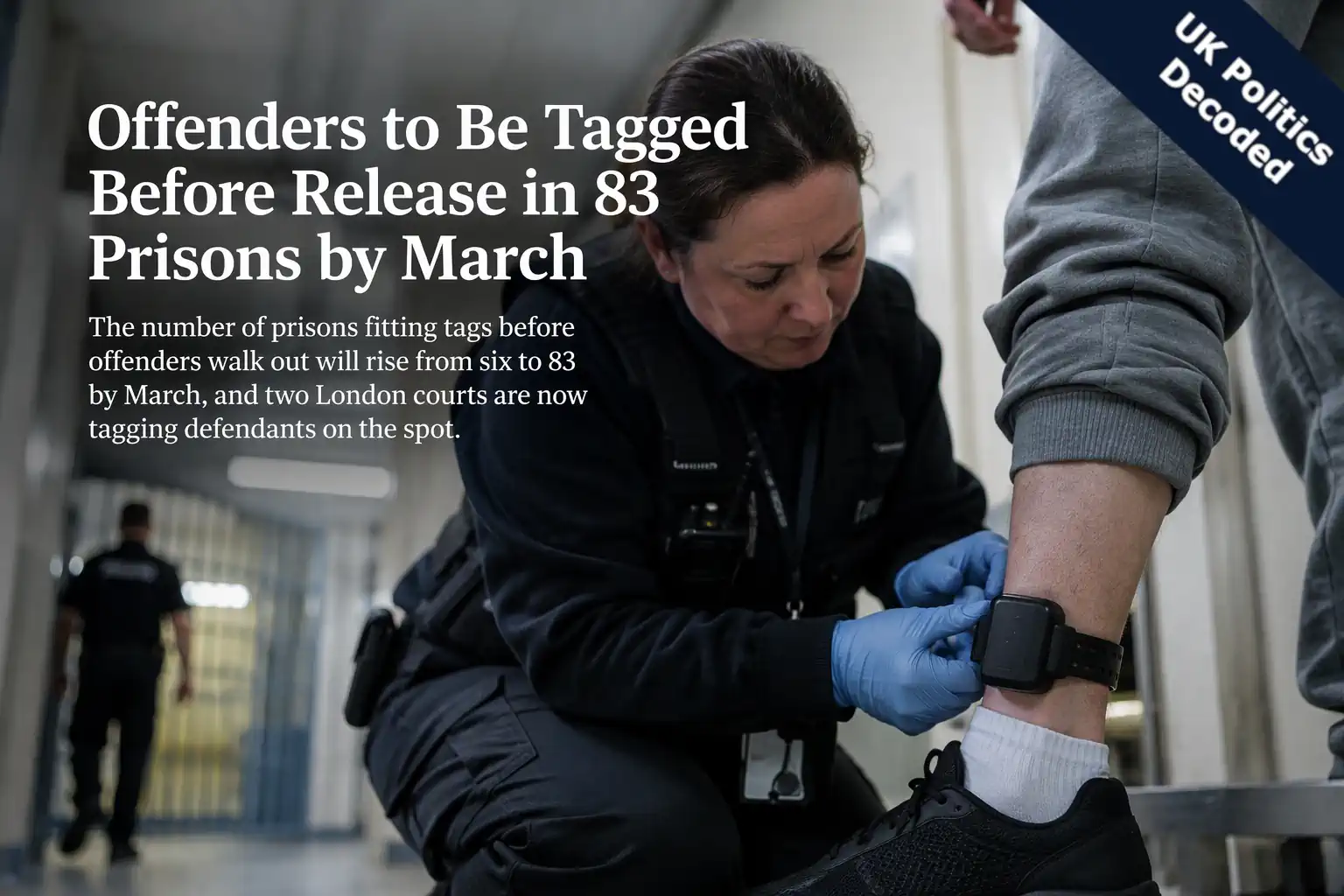
Thousands more offenders will be fitted with electronic tags before they leave prison, the Ministry of Justice announced on 25 November 2026, as a scheme that began in six prisons is extended to 83. Once the rollout is complete, the department says every prison in England and Wales that regularly releases offenders with a tagging order will be covered.
A separate three month pilot at two London magistrates' courts will also test fitting tags at court for people sentenced to electronic monitoring or given it as a bail condition. The government says both moves are meant to close the gap between an offender leaving custody and monitoring actually starting.
At a glance
- The Ministry of Justice says 83 prisons in England and Wales will be tagging offenders before they leave custody by the end of March.
- The rollout reaches 16 prisons from December 2026 and 50 from January, building on an October 2025 pilot at six prisons.
- A three month pilot at Croydon Magistrates' Court and Highbury Corner Magistrates' Court is fitting tags on offenders and bail defendants at court.
- The expansion is part of a £100 million investment in electronic monitoring, according to the government.
- The department cites studies showing GPS tags and curfew tags were each linked to offenders being around 20% less likely to reoffend.
How Tagging at Source Is Being Rolled Out Across 83 Prisons
Until now, the government says, offenders were not tagged before leaving the prison gate. The "tagging at source" scheme changed that. It started in October 2025 at six prisons, HMP Fosse Way, HMP Peterborough, HMP Cardiff, HMP Swansea, HMP Sudbury and HMP Ranby. Eligible offenders there were fitted with GPS, alcohol and curfew tags before they left custody.
The expansion is now moving quickly. According to the Ministry of Justice, the scheme will reach 16 prisons from December and 50 from January. Ten additional prisons begin tagging eligible offenders in December 2026, a further 34 follow in January, and another 33 are due by the end of March. That brings the total to 83.
The department describes this as an accelerated expansion and says it will put offenders under tighter supervision from the moment they enter the community. It also argues the change removes a potential surveillance gap before monitoring begins.
Which London Courts Are Now Tagging Offenders?
The second strand moves the fitting point earlier still. Under a new three month pilot, people who are sentenced to electronic monitoring, or who are given a tag as part of their bail conditions, will have it fitted before they leave court. The pilot is running at Croydon Magistrates' Court and Highbury Corner Magistrates' Court, and began in November 2026.
The ministry says the scheme has been made possible by the London Criminal Justice Taskforce, which was set up to tackle London's record Crown Court backlog. The taskforce brings criminal justice partners together under the joint leadership of the Courts Minister and the Deputy Mayor for Policing and Crime in London, and meets regularly.
The pathfinder is a test. The government says it will assess whether the approach works and, should it prove successful, the intention would be to roll it out further across the courts estate.
Rollout timetable for tagging before release
- October 2025: pilot launched at six prisons in England and Wales.
- December 2026: scheme expands to 16 prisons, with ten additional sites.
- January 2027: a further 34 prisons begin, taking the total to 50.
- By end of March: another 33 prisons join, giving 83 in total.
Does Electronic Tagging Reduce Reoffending? The Evidence Cited
Ministers lean heavily on the reoffending evidence. The government says a study published last year found thieves and burglars who were GPS tagged as part of an innovative pilot were around 20% less likely to reoffend. It adds that other evidence showed offenders fitted with curfew tags, which keep them at home during certain hours, were also 20% less likely to reoffend.
The announcement also states that more offenders are tagged in England and Wales than in any other country in Europe.
There is a practical argument too. The government says fitting tags in prisons and courts will let providers spend more time responding to possible breaches, rather than making installation visits to offenders' homes.
Justice Secretary and Probation Chief Back Tagging Expansion
Lord Chancellor and Justice Secretary Alex Norris said criminals and defendants "should be under no illusion that leaving prison or court means escaping the watchful eye of the authorities." He described tagging as one of many tools used to monitor offenders, and said that by fitting tags before offenders walk out of prison or court the government is "tightening the net around those who break the law."
His Majesty's Chief Inspector of Probation, Martin Jones, backed the direction of travel. Referring to a recent inspection of electronic monitoring in practice, he said tagging must happen at the earliest opportunity if it is to protect the public and support rehabilitation. He welcomed the plans to expand "tagging at source" and to prioritise the work.
The ministry is keen to stress that a tag is never used on its own. Offenders can also face approved premises, curfews, mandatory meetings with probation officers, no contact orders, requirements on where to live and the threat of immediate recall to prison if they break the rules.
How Much Is Being Spent on Prison Tagging?
The rollout forms part of a £100 million investment to expand tagging. Separately, the government says it is investing up to £700 million a year in the Probation Service and community services by 2028/29, to strengthen its ability to supervise offenders.
The announcement also points to wider reforms to electronic monitoring, including new restriction zones that will let probation officers confine serious sexual and violent offenders to designated areas. Breaches could result in a return to prison.
Key Takeaways
- The Ministry of Justice says tagging before release will cover 83 prisons in England and Wales by the end of March, up from six in the October 2025 pilot.
- A three month pilot at Croydon and Highbury Corner magistrates' courts will test fitting tags for offenders and bail defendants before they leave court.
- The department says GPS tagging and curfew tagging were each linked to around 20% lower reoffending in the studies it cites.
- The government says the expansion is backed by a £100 million investment, with up to £700 million a year going into probation and community services by 2028/29.
- The court pilot would only be extended across the courts estate if the Ministry of Justice judges it a success.
Sources & Further Reading
- GOV.UK - Thousands more tags to be fitted in prison in major expansion Archived copy (OGL): archived page