AI Use: AI tools were used to support source discovery and to structure the article for clarity. All research, verification, drafting, and final editorial decisions are fully human led. Learn about our AI policy.
UKPoliticsDecoded is an IMPRESS regulated public interest publisher. Read our editorial standards.
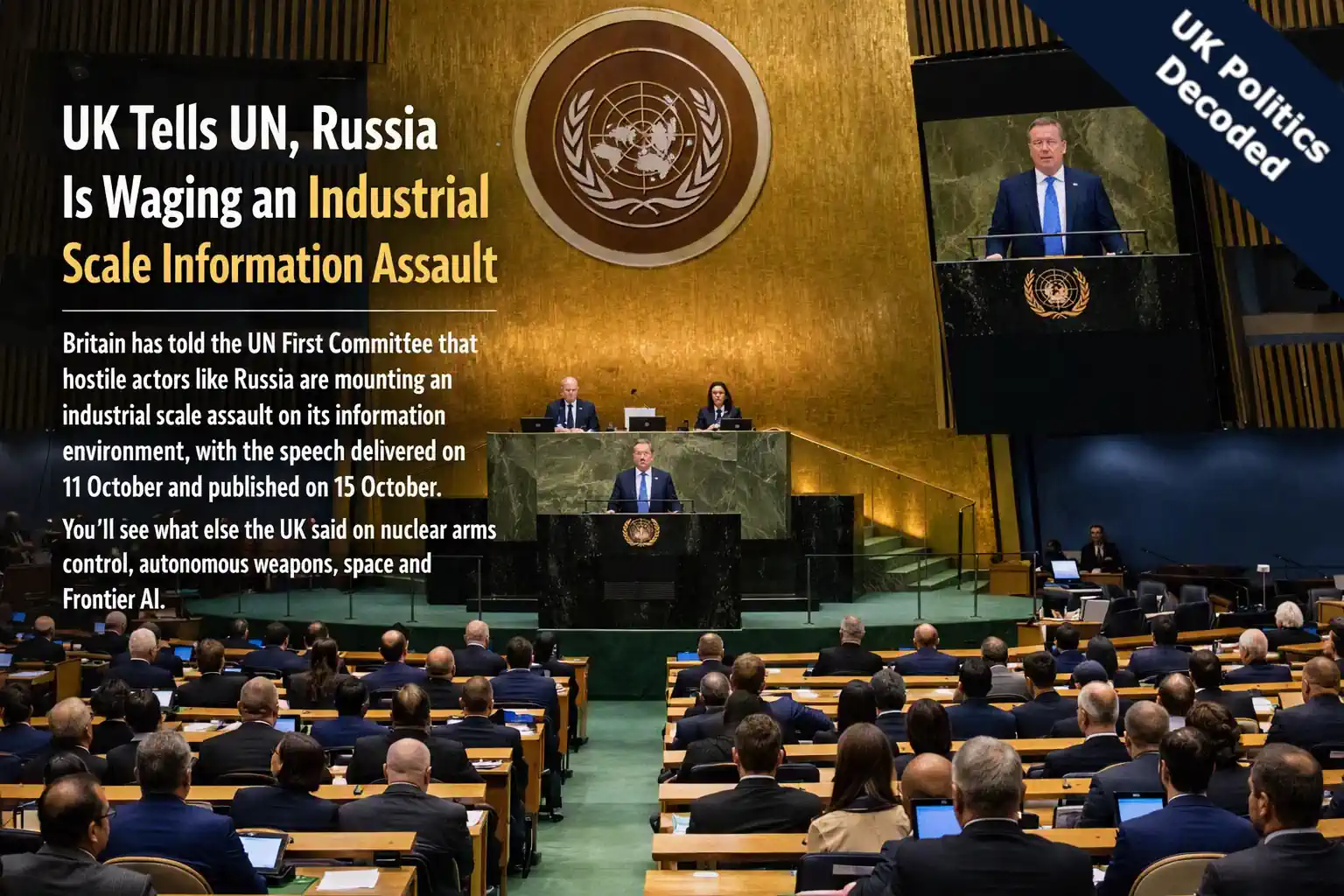
The UK has told the United Nations that it is "witnessing an industrial scale assault by hostile actors like Russia on the information environment in the UK and many of our allies." The words came in a statement to the UN First Committee, which deals with disarmament and international security, delivered on 11 October 2026 and published by the Foreign, Commonwealth & Development Office (FCDO) on 15 October.
The speech was given in New York by David Riley OBE, the UK's Ambassador and Permanent Representative to the Conference on Disarmament in Geneva. It ran well beyond disinformation, covering nuclear non-proliferation, autonomous weapons, chemical and biological weapons, outer space and artificial intelligence.
At a Glance
- The UK told the UN First Committee that hostile actors like Russia are carrying out an industrial scale assault on the information environment in Britain and among its allies.
- The statement was delivered on 11 October 2026 by David Riley OBE, the UK's Ambassador and Permanent Representative to the Conference on Disarmament in Geneva.
- The UK said it will keep investing in defence, meet its NATO commitments and strengthen European capabilities.
- The UK said it will put artificial intelligence at the heart of its G20 Presidency next year.
- The UK regretted that May's Non-Proliferation Treaty Review Conference failed to reach a consensus outcome.
What the UK Told the UN About Russia's Information Assault
Mr Riley opened by placing the statement in what he called a "dangerous, turbulent age". He noted that the UN is in its eighty first year and said the international security architecture, built over generations, "cannot be taken for granted". He also pointed to the Prime Minister's recent statement to the UN General Assembly, which had described strategic competition as intensifying.
The line on information warfare came early. The UK said hostile actors like Russia are mounting an industrial scale assault on the information environment in Britain and in many allied countries. The statement gave no examples, figures or named campaigns, so the speech itself does not set out how the UK measures that claim.
Alongside that, Mr Riley said rapid technological change is creating new security challenges. He said the UK would recommit to the principles that have underpinned peace and security for decades, naming respect for sovereignty and territorial integrity, and adherence to international law. He said the UK is working to raise the cost to Russia of its war against Ukraine, to challenge Iran's non-compliance with its nuclear safeguards obligations, and to confront the unlawful nuclear and ballistic missile programmes of the Democratic People's Republic of Korea.
Will the UK Keep Investing in Defence? What It Told the UN
On the UK's own posture, the statement was direct. Britain, Mr Riley said, will keep investing in defence, meet its NATO commitments and strengthen European capabilities. He framed that as defensive rather than aggressive, the UK does not seek confrontation, but must be "unflinching in defending our people and our allies" against hostile state threats.
The statement gave no new spending figures or timelines. It restated existing commitments rather than announcing fresh ones.
NPT Talks Failed, but the UK Sees Progress on Autonomous Weapons
Mr Riley used the speech to point to areas where he said progress remains possible. Last month, after more than a decade of debate over Lethal Autonomous Weapons Systems, the Group of Governmental Experts on LAWS agreed a set of elements for a possible future instrument. He credited the Chairmanship of Dutch Ambassador Robert in den Bosch.
On biological weapons, he said a set of recommendations for strengthening the Biological Weapons Convention is "within our reach". Those include mechanisms to strengthen international cooperation and assistance, and to improve states' ability to respond to the threats and opportunities of emerging technologies such as Frontier AI.
The picture on nuclear diplomacy was less positive. States Parties met in New York in May for the eleventh Non-Proliferation Treaty (NPT) Review Conference, and the UK regretted that the conference could not reach a consensus outcome. Mr Riley argued that the lack of a final document does not diminish the treaty's value. In his account, the conference showed significant common ground on transparency, risk reduction, safeguards, peaceful uses and preventing the spread of nuclear weapons.
He restated the UK's long term goal of a world without nuclear weapons, adding that progress must be practical, realistic and able to command broad international support. The UK also said it will continue backing the International Atomic Energy Agency (IAEA) and its safeguards system, and Nuclear Weapon Free Zones. During the UK's chairship of the P5 Process, he said, Britain worked to advance engagement on transparency, risk reduction and strategic stability.
UK Backs OPCW and Space Arms Control Talks at the UN
The UK said it will work to uphold and implement the Chemical and Biological Weapons Conventions and hold to account those who use such weapons. Mr Riley described the Organisation for the Prohibition of Chemical Weapons (OPCW) as playing a vital role, and commended its work supporting the Syrian Government's determination to eliminate the remaining elements of the Assad regime's chemical weapons programme.
On space, Britain said it will work to manage the risk of conflict through practical measures that strengthen transparency, build confidence and reduce risks. It restated support for the mandate of the Open Ended Working Group on the Prevention of an Arms Race in Outer Space (PAROS), even as, in Mr Riley's words, some states seek to reinterpret that mandate and risk a return to "the competing tracks of the past".
The UK also said it will defend the norms of humanitarian arms control as conflict grows across the world.
Frontier AI and the UK's G20 Presidency
Mr Riley called Frontier AI "one of the most significant challenges and opportunities of our age". He quoted King Charles, who at a recent meeting with leaders of the world's largest AI companies said the task is "not merely to advance technology, but to ensure that it remains firmly in the service of humanity."
The statement then made its one forward looking commitment on timing, the UK will put AI at the heart of its G20 Presidency next year, with the aim of delivering the potential of AI for good while dealing with the risks. The statement did not say what specific proposals the UK will bring to the G20.
Mr Riley closed by reaffirming the UK's commitment to the UN Charter, international law and effective multilateralism, and said Britain will work with all partners "in a spirit of pragmatism and dialogue".
What the Statement Does and Does Not Change
This was a policy statement rather than a legislative or funding announcement. It sets out the UK's stated priorities at the UN's main disarmament forum and does not create new rules, budgets or powers.
It does show where the UK is placing emphasis. Information manipulation by hostile states now sits in the opening lines of a speech otherwise devoted to arms control, which signals that the government treats it as a security question and not only a communications one. The speech does not say what action the UK plans to take in response.
The next concrete marker mentioned in the statement is the UK's G20 Presidency next year, where AI is due to feature prominently. Further detail on that agenda has not yet been published in the source material.
Key Takeaways
- The UK told the UN First Committee on 11 October 2026 that hostile actors like Russia are waging an industrial scale assault on its information environment, without citing figures or examples.
- The statement said the UK will keep investing in defence, meet its NATO commitments and strengthen European capabilities, but gave no new spending numbers.
- The UK said it regrets that May's eleventh NPT Review Conference ended without a consensus outcome, while arguing the treaty retains its value.
- The UK welcomed an agreement last month by the Group of Governmental Experts on LAWS on elements for a possible future instrument on autonomous weapons.
- The UK committed to put AI at the heart of its G20 Presidency next year, with no specific proposals set out yet.