AI Use: AI tools were used to support source discovery and to structure the article for clarity. All research, verification, drafting, and final editorial decisions are fully human led. Learn about our AI policy.
UKPoliticsDecoded is an IMPRESS regulated public interest publisher. Read our editorial standards.
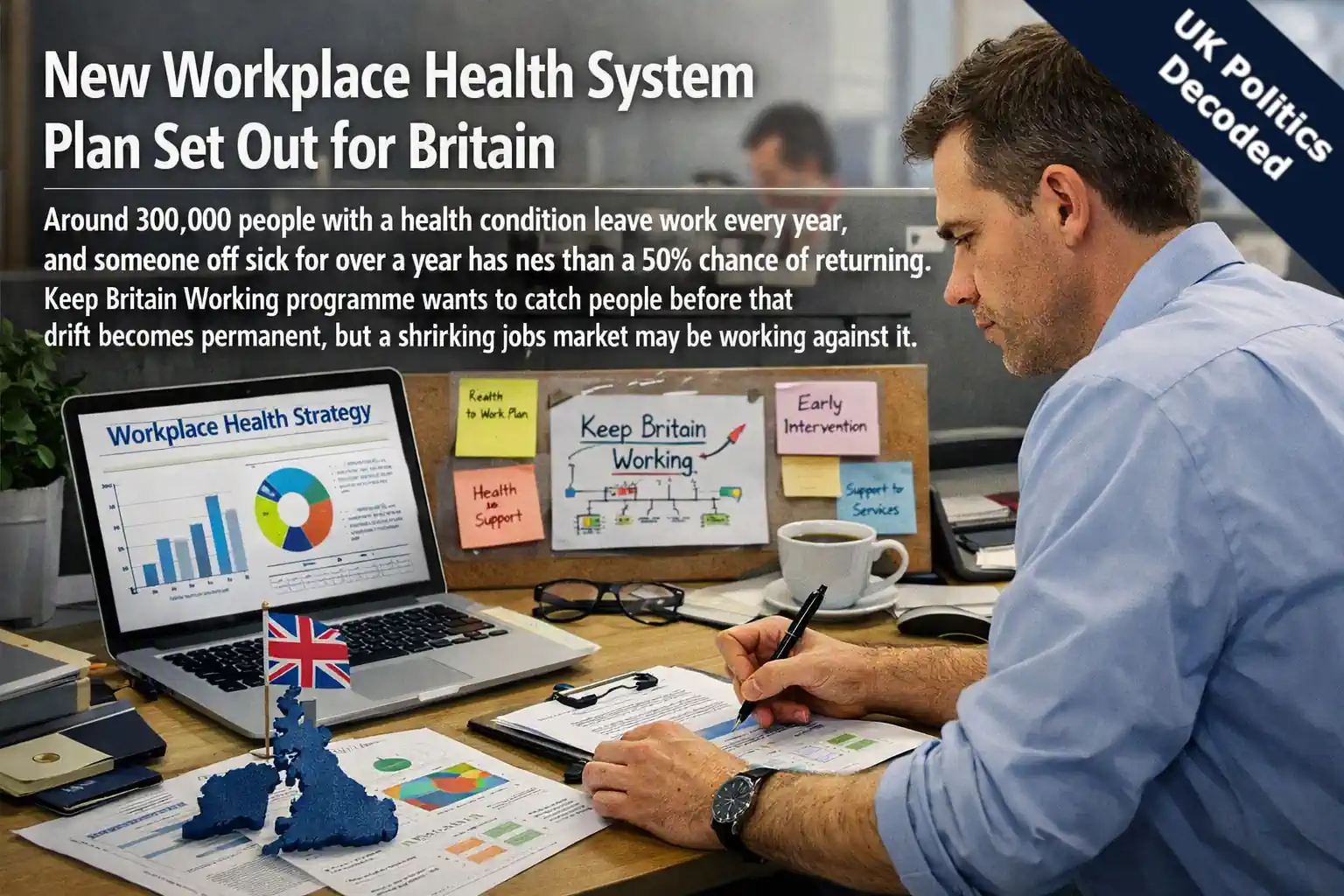
The government has set out fresh detail on plans for Britain's first Workplace Health System, as new figures show 300,000 people with a health condition leave work every year. The update, published on 23 September by the Department for Work and Pensions, comes from Sir Charlie Mayfield, co-chair of the Keep Britain Working programme, who has spent ten months testing the approach with employers, mayors and disabled people across the UK.
The case for acting quickly is stark. Someone who has been off work for four to six weeks still has a 96% chance of returning, according to the government's figures. Wait a year, and that chance falls to under half. Since 2019, the number of working age people out of work due to ill health has risen by 800,000, at an estimated cost to the economy of around £212 billion a year.
At a glance
- Around 300,000 people with a health condition leave work every year, and the government says much of this is preventable.
- Someone off sick for four to six weeks has a 96% chance of returning to work, but that falls to under 50% after a year off.
- Eleven regional Vanguards and more than 200 organisations are already testing the new Workplace Health System across all four UK nations.
- UK job vacancies fell to 702,000 in the three months to August 2026, their lowest level since early 2021, according to the ONS.
- There were 2.5 unemployed people for every vacancy in May to July 2026, a ratio that has barely moved since mid 2025.
What Is the Workplace Health System, and How Would It Work?
Sir Charlie Mayfield's argument is that Britain has spent decades treating economic inactivity as a welfare problem when it is really a growth opportunity going unused. The Keep Britain Working review, which he chairs alongside three Secretaries of State, wants to build what it calls the country's first Workplace Health System, a structure that brings together employers, the NHS, local authorities and other support services so people do not fall out of work unnecessarily.
The pitch rests on joining up services that currently operate in isolation. Mayfield's update notes that the same people often show up on the welfare bill, on NHS waiting lists and in the productivity statistics, without anyone able to connect the dots between them. Better data on workplace health and inclusion, the review argues, would let employers spot problems early rather than losing staff to long term sickness absence.
Eleven regional Vanguards, including nine Mayoral Strategic Authorities alongside Cornwall Council, Hull City Council and Worcestershire County Council, are already testing the model with more than 200 organisations. In Liverpool City Region, that has meant piloting draft return to work plans developed jointly with employers. In Hull, the council has partnered with occupational health provider Latus to create a buying pool that lets small and medium sized firms access services at the same prices larger corporations pay. South Yorkshire's Mayoral Combined Authority is trialling independent case workers who sit part time inside businesses to support employees with health concerns.
Why UK Job Vacancies Are at a Five Year Low
The Workplace Health System is built on the assumption that better early support will help people stay in jobs, or return to one, once treated. But that assumes suitable jobs exist to return to, and the latest labour market figures suggest that assumption is under strain. Official statistics published by the Office for National Statistics on 15 September show UK vacancies fell to 702,000 in the three months to June to August 2026, down 8,000 on the previous quarter and the lowest level since February to April 2021. Vacancies are now 86,000, or 10.9%, below their pre-pandemic level from January to March 2020.
The unemployment to vacancy ratio, a standard measure of how tight the jobs market is, stood at 2.5 unemployed people per vacancy in May to July 2026, according to the ONS. That ratio has been stuck at 2.5 since July to September 2025, having climbed steadily in the two years before that. It is a UK wide figure, and the ONS bulletin does not break it down by nation or region, so it will mask sharper local mismatches between claimant numbers and available vacancies in areas already struggling with weaker demand for labour. The ONS also found vacancies fell in 10 of 18 industry sectors on the quarter, with the sharpest drop in businesses employing just one to nine staff, down 7,000 vacancies, or 7.5%, to their lowest level outside the pandemic since late 2013. The statistics body's own survey feedback points to a specific cause, smaller firms telling researchers they are holding off recruiting because of rising labour costs.
That contraction has continued despite total workforce jobs edging up slightly, to an early estimate of 36.7 million in June 2026, a rise of just 60,000, or 0.2%, on the year. In other words, the number of jobs in the economy overall has barely grown, while the number of new roles employers are actively trying to fill has been shrinking steadily since the pandemic recovery period.
What the Workplace Health System Offers
- Earlier intervention when someone develops a health condition, before absence becomes long term.
- Pooled occupational health access for small firms that cannot afford it alone.
- Better employer data on staff health and inclusion outcomes.
- A new employer standard being developed with the British Standards Institution.
What the Labour Market Data Shows
- Vacancies at their lowest level since early 2021, down 4.9% on the year.
- 2.5 unemployed people per vacancy, unchanged for over a year.
- Smaller firms cutting vacancies most sharply, citing labour costs.
- Total jobs growth of just 0.2% over the past year.
How Falling Vacancies Are Fuelling the Rise in PIP Claims
Ministers across the political spectrum have set out proposals to slow the rise in welfare claimant numbers, including changes to Personal Independence Payment eligibility that are currently the subject of the government's own Timms Review. What is less discussed is what happens on the other side of that equation, the demand for labour that would let people move off benefits and into work in the first place. If vacancies keep contracting while claimant numbers keep rising, tightening eligibility criteria addresses only one half of the pressure building in the system.
Mental health conditions, including depression and anxiety, are a significant driver of both PIP claims and long term economic inactivity, and the relationship between the two is not one directional. A jobs market offering fewer openings, and fewer of the flexible or part time roles that suit people managing a health condition, can itself contribute to worsening mental health among people trying and repeatedly failing to find suitable work. The Workplace Health System's focus on employer side prevention does not, on its own, address that supply side constraint, since it depends on employers having open roles into which people can be supported back.
Work and Pensions Secretary Pat McFadden has framed the programme as ensuring good workplace health support is available "not just for big companies" but "across every postcode," while Minister of State for Work and Health Ally McGovern said getting help quickly, rather than waiting for problems to worsen, is central to both individual wellbeing and a strong economy. Neither minister's comments addressed the vacancy figures directly.
Inside the £3.5 Billion Plan Behind Keep Britain Working
An employer standard is now being developed jointly with the British Standards Institution, alongside affordable support routes for smaller firms through pooled buying and insurance arrangements, so good workplace health provision is not confined to large corporations. Anne Hayes, the Institution's Director of Standards Development, said research had found nearly half of staff who lack confidence raising health concerns with their employer had gone on to leave a role or take extended leave as a result.
The programme sits within a wider £3.5 billion employment support package. WorkWell, backed by £259 million, aims to support up to 250,000 people to stay in or return to work, while Connect to Work is intended to reach 300,000 sick or disabled people with tailored support. More than 1,000 full time Pathways to Work advisers are already in place across Britain, according to the government.
A new employer data project and a work and health prototype are being developed this autumn to address what officials describe as a lack of employer insight into how well they retain staff with health conditions. Over the next year, the Workplace Health System will continue testing with the Vanguard organisations, alongside further steps on welfare reform guided by the outstanding Milburn and Timms reviews, both due to conclude later this year.
Can the Workplace Health System Work Without More Jobs?
The Workplace Health System is, on its own terms, a plausible answer to a genuine problem, people losing jobs to preventable ill health because nobody intervened early enough. Its success, however, will be measured against a jobs market moving in the opposite direction from where the policy needs it to go. Every regional pilot depends on employers having roles worth returning to, and the clearest labour market signal currently available says fewer of those roles are being created than at any point since the pandemic's aftermath.
None of the major parties' welfare proposals currently sets out how they intend to address that underlying vacancy shortage directly, focusing instead on eligibility rules and claimant numbers. Whether the Workplace Health System can succeed while that gap remains unaddressed is likely to become clearer as the Vanguard pilots report back and the Milburn and Timms reviews conclude later this year.
Key Takeaways
- Sir Charlie Mayfield has set out an update on Keep Britain Working, the programme building Britain's first Workplace Health System.
- Around 300,000 people with a health condition leave work every year, with return chances falling sharply the longer someone is off.
- UK job vacancies fell to 702,000 in June to August 2026, the lowest level since early 2021, according to the ONS.
- Smaller employers are cutting vacancies fastest, citing rising labour costs as a barrier to recruiting.
- Welfare reform proposals from all parties focus on claimant eligibility, with less attention paid to the shrinking vacancy market that shapes whether people can move off benefits at all.