AI Use: AI tools were used to support source discovery and to structure the article for clarity. All research, verification, drafting, and final editorial decisions are fully human led. Learn about our AI policy.
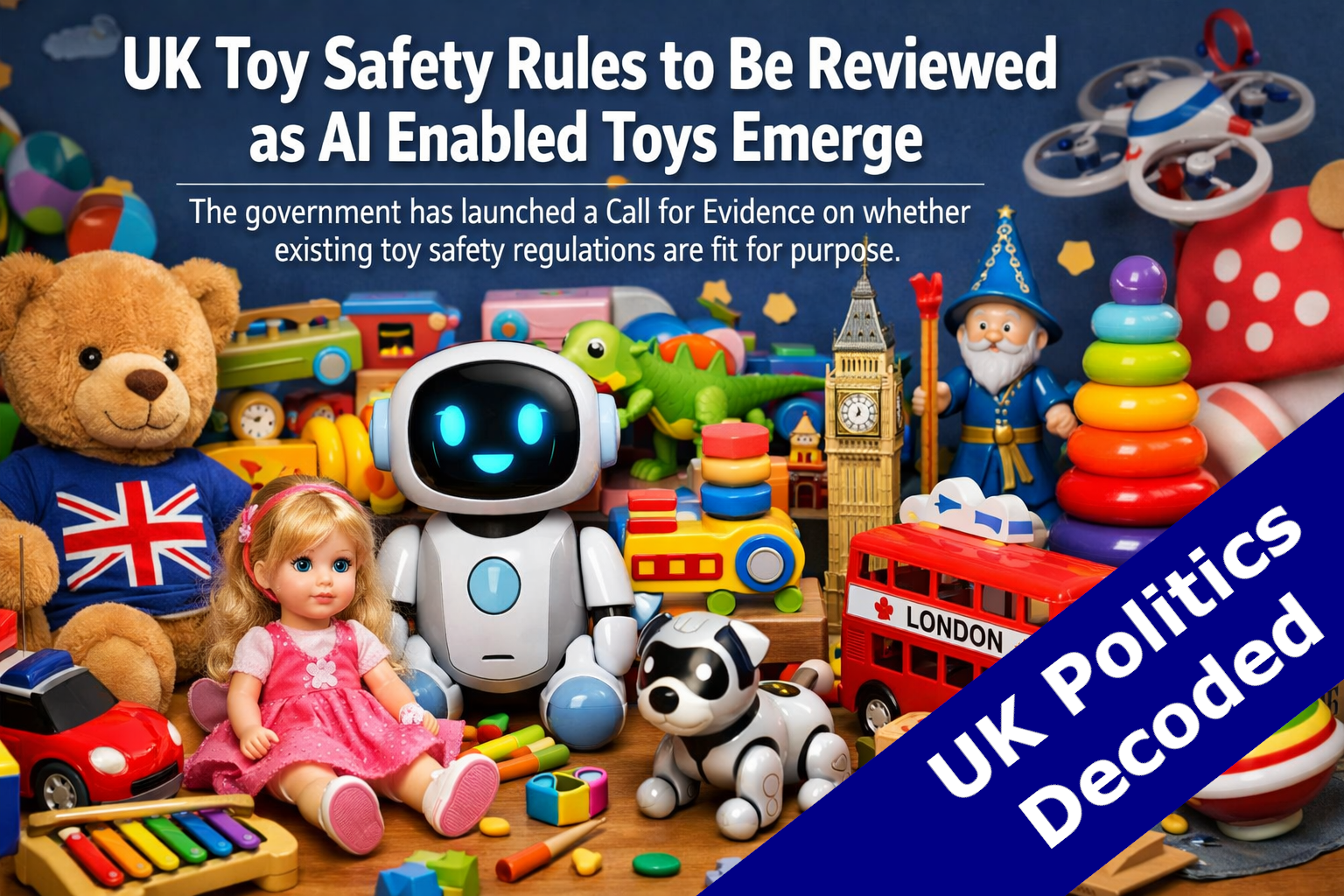
The government launched a Call for Evidence on toy safety on 6 July 2026, asking whether UK regulations are still adequate as AI enabled products begin appearing in children's bedrooms across the country. The exercise is run jointly by the Department for Business and Trade and the Office for Product Safety and Standards, and will remain open until 6 October 2026.
Kate Dearden, Minister for Consumer Protection, said every parent should be able to buy toys "with complete confidence that they are safe." She acknowledged that the way children play and the way families shop have both shifted with new technologies and the growth of online retail, and that safety rules need to keep pace with those changes.
At a glance
- What's under review: Chemical safety in toys and the emerging category of AI enabled products
- Open until: 6 October 2026
- Who can respond: Parents, consumer groups, businesses, enforcement authorities, and the general public
- Wider context: Part of the government's "once in a generation" product safety framework reform, launched in March 2026
- Status: Evidence gathering exercise, no legislation has been proposed
AI enabled toys are a relatively new product category that existing safety law was not written to cover. Unlike a conventional toy, some AI products can hold conversations, respond adaptively to what a child says, and depending on how they are designed can potentially collect or process voice data. They can also build profiles of behaviour over time through repeated use.
UK toy safety legislation predates products of this kind. The Call for Evidence will seek views on whether those rules are adequate, whether they require updating, and what specific risks these products might present to children. The government has not proposed any new restrictions or standards at this stage. Dearden described the emergence of AI toys as part of a broader technological shift that means rules written for the high street "may not be fit for a modern age."
Chemical safety is the second area under review. The government has not specified which substances are under scrutiny, but the call acknowledges that scientific understanding of chemical hazards develops over time and that regulations updated some years ago may no longer reflect the current evidence base.
The growth of online marketplaces complicates enforcement across both areas. Products sold by third party sellers on platforms can, in some cases, bypass the certification processes that apply to goods sold through traditional retail. The government's March 2026 product safety reform described at the time as "once in a generation" included specific measures to address unsafe products sold through online routes, though the toy review sits as a sector specific layer on top of that wider work.
The toy safety review is one strand of a larger consumer protection programme the government has been developing this year. It has already introduced statutory protections against fake online reviews and drip pricing, and is in the process of closing loopholes around subscription services. A consumer action plan is expected to be published later in 2026.
The government has framed this programme in economic terms, pointing out that consumer spending accounts for more than 60% of UK GDP. Ministers argue that when people can trust the products they buy, they are more willing to spend, which benefits businesses and supports living standards more broadly.
The Call for Evidence runs until 6 October 2026. The consultation document is available on GOV.UK. The government has not indicated a timetable for formally responding or whether the exercise will lead to legislative changes. Responses are welcomed from parents, consumer groups, businesses, enforcement authorities, and members of the public.
Key Takeaways
- The government launched a Call for Evidence on toy safety on 6 July 2026, covering AI enabled toys and chemical safety
- AI toys which can converse, respond adaptively, and potentially collect children's data are not covered by purpose built safety rules in the UK
- The consultation is open until 6 October 2026, welcoming responses from parents, businesses, enforcement bodies, and the public
- The review sits within a wider product safety framework reform launched in March 2026, which also targets unsafe goods sold through online marketplaces
- No legislation has been proposed, the government has not set out a timetable for responding to findings