AI Use: AI tools were used to support source discovery and to structure the article for clarity. All research, verification, drafting, and final editorial decisions are fully human led. Learn about our AI policy.
UKPoliticsDecoded is an IMPRESS regulated public interest publisher. Read our editorial standards.
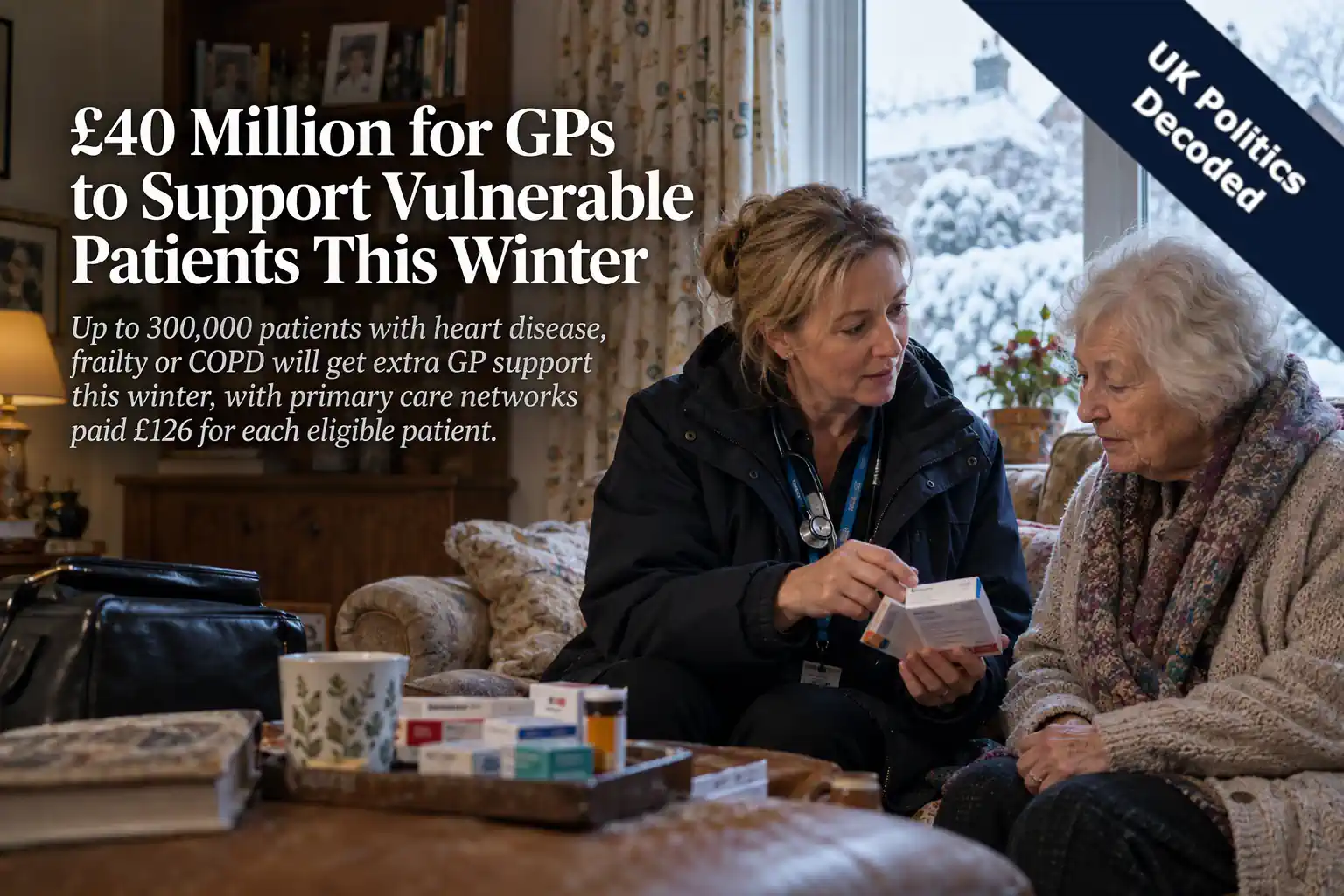
GP practices in England will be paid to reach out to the patients most likely to end up in hospital this winter. The government announced a £40 million programme on 9 November 2026, set out by the Prime Minister, Andy Burnham, and the Health and Social Care Secretary, Yvette Cooper.
The money is ring fenced and aimed at people with conditions such as heart disease, frailty and chronic obstructive pulmonary disease (COPD). The idea is to catch problems early through health checks, home assessments and medication reviews, before a patient reaches the point of an emergency admission.
At a Glance
- The government has committed £40 million to support up to 300,000 vulnerable patients through their GP this winter.
- Primary care networks can receive £126 for each eligible patient they support.
- The extra care is aimed at patients with heart disease, frailty, emphysema and other forms of COPD.
- Support could include medication reviews, health checks and nurse led respiratory clinics.
- The programme sits alongside £140 million for 14 urgent care schemes and 25 new or expanded urgent care sites opening for winter.
Who Qualifies for Extra GP Support This Winter?
Under the scheme, GP practices will identify the patients they consider most at risk of becoming seriously unwell over the colder months. The government says the funding is aimed particularly at people with heart disease, frailty, emphysema and other types of COPD, and that up to 300,000 people across the country could benefit.
What each patient receives will depend on their needs. The announcement lists medication reviews, health checks and nurse led respiratory clinics as examples, and NHS England’s Dr Amanda Doyle pointed to home assessments to prevent falls. The stated aim is to stop patients reaching what the government calls a crisis point, where hospital becomes the only option.
Practices, rather than central government, decide who qualifies. That puts the judgement with clinicians who already know their patients’ histories, a point several of the organisations quoted in the announcement made themselves.
How the £126 Per Patient GP Funding Works
The funding is ring fenced, meaning it must be spent on this purpose. Primary care networks (PCNs), the groups of neighbouring practices that work together, can receive £126 for each eligible patient they support.
The announcement also refers to extra flexibility for practices. Since October, practices have been able to use GP reimbursement funding to bring in locum GPs, which the government says gives them more freedom to respond to local demand as pressure rises.
How the Programme Is Set Up
- The £40 million is ring fenced funding for general practice.
- Practices identify the patients they consider most at risk of serious illness this winter.
- Primary care networks can receive £126 for each eligible patient supported.
- The programme could reach up to 300,000 people across the country.
Are There More GPs and Appointments? What the Latest Figures Show
The announcement leans on recent primary care data to make its case. According to the government, there are now more than 2,800 additional GPs compared with July 2024, and more than 30,500 fully qualified full time equivalent GPs working in general practice, which it describes as the highest number in over a decade.
Appointment numbers have also risen. More than 400 million appointments were delivered over the past year, around 24 million more than in the equivalent 12 months running up to July 2024, according to the release.
The government also cites the 2026 GP Patient Survey. More than three quarters of patients rate their overall experience of their local practice as ‘good’, and satisfaction with ease of access has risen to 75.5%, up 15 percentage points from July 2024.
What Supporters Say
- NHS England says GPs are well placed to spot patients at greatest risk of becoming very unwell.
- The National Association of Primary Care says the ambition is right and calls the scheme a valuable first step.
- Asthma + Lung UK says the investment helps GPs identify and support those most at risk of COPD flare ups.
- The Institute of General Practice Management welcomes preventative care in general practice this winter.
Welcome has come with calls for more. Professor Victoria Tzortziou Brown, President of the Royal College of GPs, backed the focus on prevention but said short-term initiatives alone cannot deliver the sustained improvements patients with complex needs require. She asked that the scheme recognise health inequalities and give practices flexibility, and said she hoped its evaluation would inform a longer-term approach backed by sustainable investment in general practice. The National Association of Primary Care called the scheme a valuable first step and said it wanted national policy to go further, while the NHS Alliance said the next step is to make proactive care a permanent part of how neighbourhood health is funded and delivered.
Where the £40 Million Fits Into the NHS Winter Plan
The government describes the GP programme as one part of a wider winter push. It sits alongside additional urgent care funding, an expanded Pharmacy First service and the winter vaccination programme. Yvette Cooper said the NHS had faced a heavy summer because of the heat, and that preparations now include flu vaccinations, extra urgent care capacity and stronger partnerships with social care.
On vaccination, the release says more than 13.6 million people in England had received their flu vaccine by 1 November 2026, around 300,000 more than at the same point last year. Among school aged children, 2.4 million had been vaccinated, almost half a million more than a year earlier.
Capacity in hospitals is part of the picture too. The NHS received £190 million in the Budget to manage winter pressures, alongside £140 million for 14 new urgent care schemes, which the government announced on 18 October. A further 25 new or expanded urgent care sites will be open this winter.
One example is a £29 million same day emergency care unit at William Harvey Hospital in Ashford, Kent, which opened on 20 October. It is expected to accommodate an additional 60 patients a day at an emergency department that normally sees around 350.
The release also points to almost 2,000 new or replacement frontline ambulances delivered since July 2024, and to 125 additional CT and MRI scanners operational across the NHS since March 2024, which it says have helped deliver a million more scans.
Burnham and Cooper on Keeping Patients Out of A&E
Prime Minister Andy Burnham said the government wanted to back GPs to reach the most vulnerable people early, “before a small problem turns into a trip to A&E”. He added that he was not going to pretend the winter would be easy, but that new technology, hospital upgrades and more care closer to home would help the NHS be there for everyone who needed it.
Yvette Cooper described the scheme as a practical plan to help GPs and local teams support the frailest patients in the community through the winter. She said that was better for patients and made hospital care less likely to be needed.
The government’s case is that moving care out of hospitals and into the community eases pressure on emergency departments, so they can focus on patients in greatest need of urgent care. It also says patients benefit from receiving care in their own neighbourhood rather than making unnecessary and time consuming hospital trips.
The announcement does not set out how the scheme will be evaluated, or what happens to proactive care funding after this winter. The Royal College of GPs and the NHS Alliance both referred to longer term arrangements in their responses, and the Royal College said it hoped an evaluation would shape what comes next.
Key Takeaways
- The government announced a £40 million ring fenced programme on 9 November 2026 to help GPs support up to 300,000 vulnerable patients this winter.
- Primary care networks can receive £126 for each eligible patient they support, and practices choose which patients they consider most at risk.
- Patients with heart disease, frailty, emphysema and other types of COPD are the main targets for medication reviews, health checks and nurse led respiratory clinics.
- The programme is one strand of a wider winter plan that includes £140 million for urgent care schemes, expanded Pharmacy First services and flu vaccination.
- The Royal College of GPs and other sector bodies welcomed the focus on prevention but called for a longer term approach backed by sustainable funding.