AI Use: AI tools were used to support source discovery and to structure the article for clarity. All research, verification, drafting, and final editorial decisions are fully human led. Learn about our AI policy.
UKPoliticsDecoded is an IMPRESS regulated public interest publisher. Read our editorial standards.
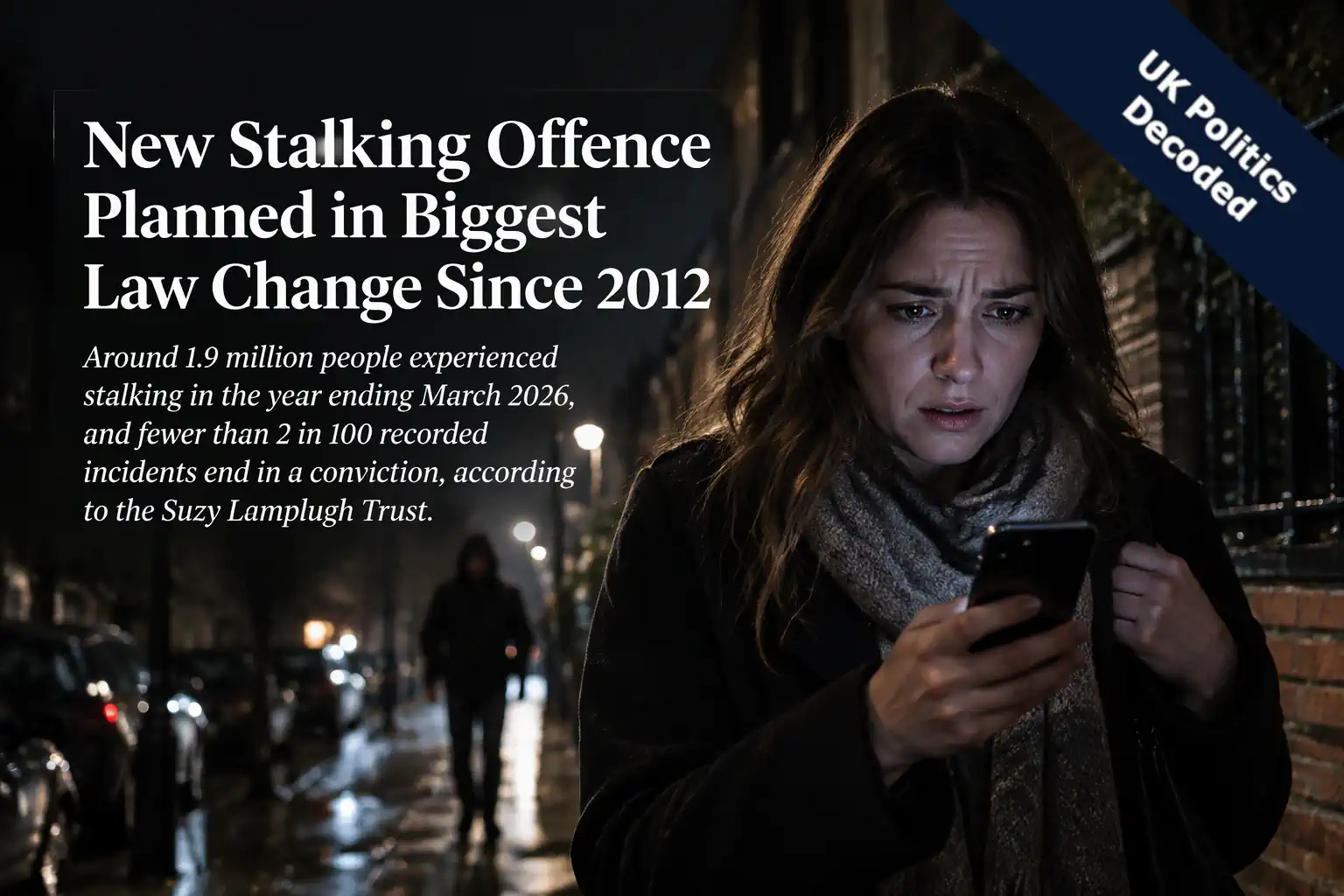
Stalking is to get its own standalone criminal offence, replacing the two offences that currently sit in law, in what the Home Office and the Attorney General's Office call the biggest shake up of stalking legislation since 2012.
The announcement was made on 26 November 2026 alongside the publication of an independent review by Richard Wright KC and the government's formal response to it. Courts also gained the power from the same day to impose stalking protection orders directly. There is no date yet for the new offence itself, ministers say they will legislate when parliamentary time allows.
At a Glance
- The government will create one standalone stalking offence to replace the two that currently exist, and will bring forward legislation when parliamentary time allows.
- The new offence is intended to focus on what the perpetrator did rather than on whether the victim was visibly afraid, and the government is considering a "reasonable person" test.
- From 26 November 2026, courts can impose a stalking protection order directly, including where the person has no criminal conviction.
- Around 1.9 million people aged 16 and over, or 3.9% of that age group, experienced stalking in the year ending March 2026.
- The reforms follow an independent review led by Richard Wright KC, which found that the current legal framework causes confusion and that stalking is often too hard to tell apart from harassment.
Why the Government Is Replacing Two Stalking Offences With One
The review that triggered the change was commissioned after concerns about how police handled stalking cases. Richard Wright KC concluded that the existing framework can cause confusion, and that stalking is frequently too difficult to distinguish from harassment. A single offence, the government says, will make the law clearer and help authorities spot stalking and pursue those responsible.
The review was published on the same day as the government's response, which the Alice Ruggles Trust says accepts the central recommendation of a single stalking offence. The charity Paladin noted that the Home Office has only partially accepted the review's recommendations, though the government statement does not say which ones are not being taken forward.
The scale of the problem is the backdrop. The government cites around 1.9 million people experiencing stalking in the year ending March 2026, equivalent to 3.9% of everyone aged 16 and over. The Suzy Lamplugh Trust, which brought the stalking super complaint that fed into the review, put the conviction rate at only 1.2% of stalking incidents recorded by police and called it shockingly low.
How the New Law Would Judge Stalking. Behaviour, Not Fear
The most significant change is one of focus. Under the current law, the government says, stalking can be harder to prosecute where a victim does not show fear or does not know they are being stalked. The reforms aim to close that gap by looking at the perpetrator's behaviour rather than at how the victim responds.
One option under consideration is a "reasonable person" test, which would judge the likely impact of the perpetrator's actions. The government has not said how the test would be worded, and the detail will only emerge when a bill is drafted.
Alice Ruggles' parents, Clive Ruggles and Sue Hills, said the change would spare victims from having to admit how frightened they are, which they argued can further empower the stalker. Alice was killed ten years ago by her ex-boyfriend after a campaign of stalking. Stalking has been an offence in England and Wales for 14 years, they noted.
What happens now, and what comes next
- On 26 November 2026, the government published the Wright review and its formal response, committing to a single standalone stalking offence.
- From 26 November 2026, courts can impose a stalking protection order directly on a perpetrator, even where there has been no criminal conviction.
- The orders can restrict a perpetrator's behaviour and place requirements on them.
- The new offence will be legislated for when parliamentary time allows, and no timetable has been published.
Stalking Protection Orders, What Courts Can Do From Today
While the new offence waits for legislation, the immediate change is to stalking protection orders. Courts can now impose them directly, and they can apply even when nobody has been convicted. That matters because it lets restrictions be placed on someone's behaviour before a case reaches a verdict, if it ever does.
The Alice Ruggles Trust said it welcomed the commitment to strengthen the use of the orders, including a duty for courts to consider one in every case on conviction or acquittal. The government statement does not set out that duty itself, so it should be read as the charity's description of the direction of travel rather than a confirmed measure. The trust also stressed that orders should be sought at the earliest possible point in an investigation.
The victims leads for the Association of Police and Crime Commissioners, Clare Moody and Matthew Scott, referred to updated guidance on the orders and wider availability of protective measures, and said commissioners would keep pressing for sustainable funding for victim support.
Under the current law
- Stalking is covered by two separate offences, which the Wright review found can be confusing to apply.
- Stalking can be difficult to separate from harassment in practice.
- Prosecutions can be harder where a victim does not show fear or is unaware of the stalking.
- The Suzy Lamplugh Trust puts the conviction rate at 1.2% of incidents recorded by police.
Under the planned approach
- A single standalone offence would replace the two existing ones.
- The law would focus on the perpetrator's behaviour rather than the victim's reaction.
- A reasonable person test could be used to judge the likely impact of the conduct.
- Stalking protection orders can already be imposed directly by courts, with or without a conviction.
How Stalking Reform Fits the VAWG Strategy
The government places the announcement almost one year after it published its Violence Against Women and Girls Strategy, describing it as a further step in a commitment to bring the full power of the state to bear on abusers. It also lands on the same day that Domestic Abuse Protection Orders come into force across England and Wales, which ministers say give victims the strongest ever protections and let law enforcement intervene earlier.
Satvir Kaur, the Minister for Safeguarding and Violence Against Women and Girls, called stalking a hideous crime that can take over every aspect of a victim's life. Attorney General Ellie Reeves KC said the clearer law would give police and prosecutors stronger tools to identify stalking and pursue perpetrators.
Victims' Commissioner for England and Wales Claire Waxman OBE welcomed the response, noting that it reflected concerns she raised in her London Stalking Review more than two years ago, later reinforced by the super complaint. She urged the government to move at pace and to work with victims, campaigners and specialist organisations so the legislation is right.
Stalking Law Reform, What Is Still Undecided
Several organisations welcomed the direction but pressed for more. Paladin urged careful thought on the timing of legislative changes and on the language used in the legislation, arguing that terminology must reflect the nature of stalking so that agencies interpret and apply it consistently.
Nick Gazzard OBE, who lost his daughter Hollie after her ex-partner's stalking escalated into violence, and who founded the Hollie Gazzard Trust, pointed to education. He said research shows that almost every woman killed by an ex-partner is stalked beforehand, and that young people need to understand the risks. The Alice Ruggles Trust made a similar case for prevention through education.
Several details remain open. The government has not given a date for introducing the legislation, has not said how the reasonable person test would work, and has not set out which of the review's recommendations it has accepted only in part. Those points will shape how far the new offence changes outcomes for the roughly 1.9 million people the statistics say experience stalking each year.
Key Takeaways
- The government plans a single standalone stalking offence to replace the two that exist now, the biggest change to stalking law since 2012.
- The new offence is meant to look at the perpetrator's behaviour rather than require proof of how afraid the victim was, with a reasonable person test under consideration.
- Courts have been able to impose stalking protection orders directly since 26 November 2026, including where there is no criminal conviction.
- The Suzy Lamplugh Trust says only 1.2% of stalking incidents recorded by police result in a conviction, a figure the reforms are intended to improve.
- No date has been set for the legislation, and the government has said only that it will act when parliamentary time allows.