AI Use: AI tools were used to support source discovery and to structure the article for clarity. All research, verification, drafting, and final editorial decisions are fully human led. Learn about our AI policy.
UKPoliticsDecoded is an IMPRESS regulated public interest publisher. Read our editorial standards.
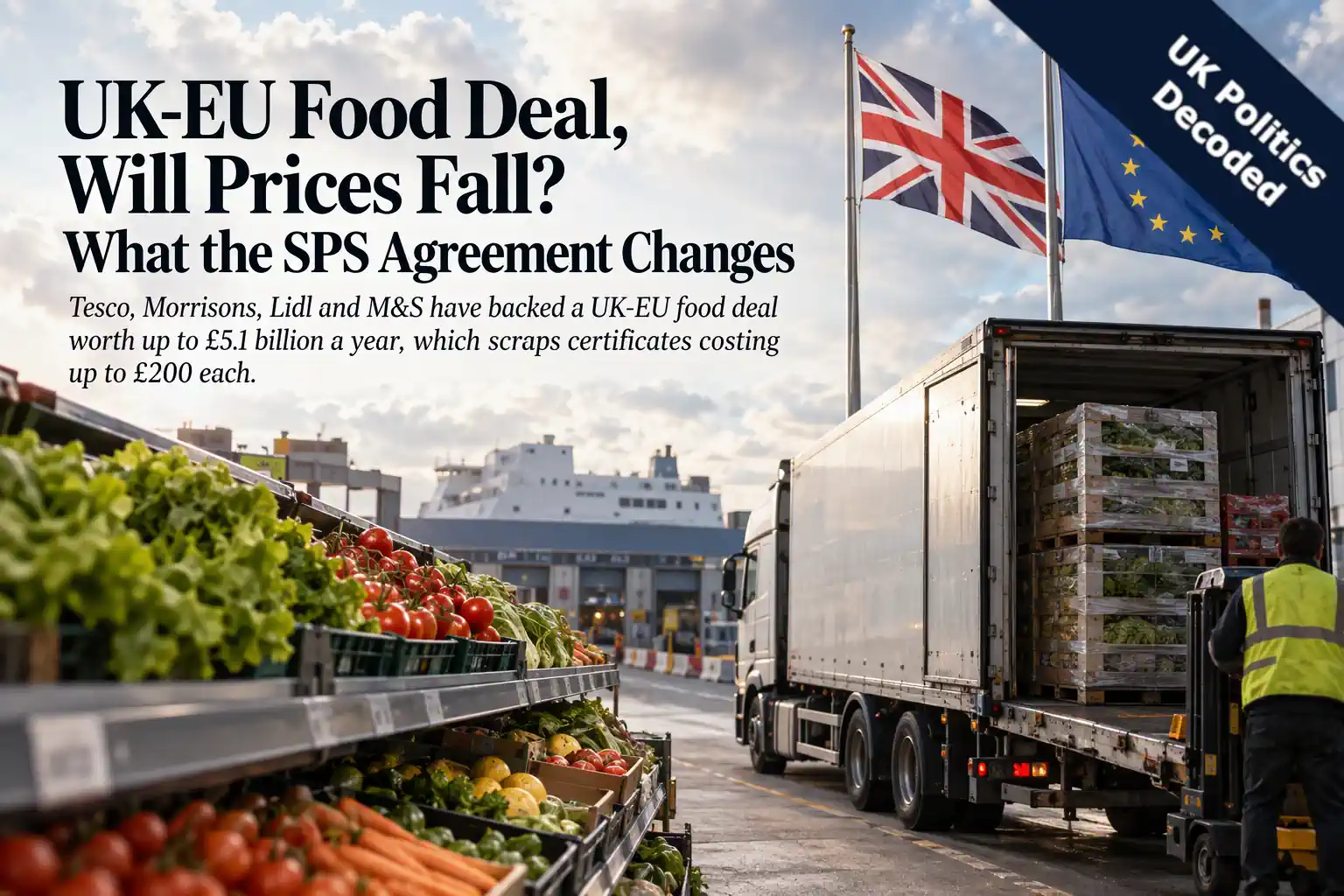
Some of Britain's biggest food retailers have publicly backed the government's new food trade agreement with the European Union, saying it will cut paperwork, speed up deliveries and ease pressure on household budgets. The Prime Minister, Andy Burnham, struck the deal at the UK-EU Summit in Brussels on Friday 20 November 2026.
Behind the supermarket endorsements sits a technical agreement on animal, plant and food safety rules. It changes how goods are checked and certified at the border, not what shoppers pay at the till, and the government has been careful on that point. The details matter, because several claims about the deal have already drifted from what the published documents say.
At a Glance
- The government says the UK-EU Sanitary and Phytosanitary Agreement is worth up to £5.1 billion a year by 2040 and could increase UK GDP by up to 0.14%.
- Morrisons, Tesco, Asda, Lidl, Co-op and M&S are among the retailers the government says back the deal, with M&S saying it could add up to two days of shelf life on some products.
- Export Health Certificates costing up to £200 each, and phytosanitary certificates costing around £25 each, will no longer be needed for goods moving between Great Britain and the EU.
- The government describes the benefit as easing pressure on food prices, and neither of its published documents puts a figure on any change in shelf prices.
- The agreement is due to apply from 1 March 2028, subject to UK and EU procedures, and will be implemented through the European Partnership Bill.
Why Tesco, Morrisons and M&S Are Backing the UK-EU Food Deal
The retailer endorsements were published by the government on the day of the announcement, so they should be read as statements the government chose to release. They are still useful, because they show where the industry expects the savings to land.
Rami Baitieh, chief executive of Morrisons, said removing trade barriers "helps improve the cost of living" and that cutting red tape on food imports from the continent "promises to ease a source of pressure on food prices". He added a note of caution, saying the industry would need to work with government to "efficiently navigate the regulatory alignment necessary to unlock these benefits". Tesco chief executive Ken Murphy called the agreement "good news for British farmers and food producers" and said lower barriers would help more UK businesses reach new customers.
The most vivid account came from Alex Freudmann, M&S Managing Director of Food. Getting a Spaghetti Bolognese from Lincolnshire onto a shelf in Dublin, he said, takes "hundreds of extra miles, mountains of paperwork, a vet's signature and even the Latin name of a cow". Once the deal is in force, he said, food will reach shelves fresher, with up to two extra days of shelf life, less waste and a fuller range.
Co-op's interim chief executive Kate Allum said members and customers remain concerned about the cost of living, and that the group looks forward to working with government over the coming months. Lidl GB's chief executive Ryan McDonnell welcomed what he called "much needed predictability and efficiency" across agri-food supply chains. James Bielby, chief executive of Food and Drink Wholesale UK, said the removal of paperwork, certification and border checks would make it easier and cheaper to supply schools, hospitals, shops, pubs and restaurants.
Will the UK-EU Food Deal Bring Down Supermarket Prices?
Not directly, and the government's own language reflects that. The press release says the agreement "could ease pressure on food prices" and is expected to "help put downward pressure on food price inflation". The SPS explainer says the deal will "help to ease pressure on food prices". Neither document promises cheaper food or gives a figure for what a typical shopper might save.
What the documents do set out is a list of costs that businesses currently carry and will no longer have to. The explainer says Export Health Certificates will go for goods moving between Great Britain and the EU, saving businesses up to £200 per certificate. Phytosanitary certificates will also be scrapped, saving around £25 per certificate and at least £127.60 per load in inspection fees. Routine SPS border checks on goods such as dairy, fish and meat will be eliminated, which the government says will help food get to market more quickly.
Those savings fall on suppliers, importers and retailers first. Whether they reach shelf prices depends on commercial decisions that the documents do not address. The scale of the opportunity is clearer when set against how much food Britain brings in. Defra's United Kingdom Food Security Report 2024 found that in 2023 the UK relied on imports for roughly 40% of its food. The EU is the biggest part of that picture, accounting for 69% of UK agri-food imports and 58% of exports in 2025, according to the press release.
So the more accurate reading is about friction. Lower administration costs, fewer checks and a shorter journey to the shelf for perishables should reduce the cost and delay of moving food across the Channel. That is the government's case, and the retailers' statements are consistent with it. The sources do not quantify how much of it, if any, will be passed on to customers.
Does the SPS Agreement Limit UK Trade With Countries Outside the EU?
Some posts on social media have suggested that the agreement ties the UK's hands on trade with the rest of the world. Nothing in the two GOV.UK documents supports that. The agreement is confined to a defined set of rules, which the government calls the Common SPS Area. Those rules cover animal health and breeding, plant health, food and feed safety, animal welfare, fishery products, food labelling, organics, and the regulation of pesticides and biocides. Neither document places any restriction on the UK agreeing trade deals with countries outside the EU.
The second point of confusion is whether the UK simply takes EU rules without a say. The agreement works on what the government calls dynamic alignment, meaning the UK and EU apply the same rules at the same time, on an ongoing basis, in the areas covered. The explainer says that where the UK aligns, it will have "an early decision shaping role" on EU rules while they are still in development, and describes this as essential for ensuring UK interests are reflected. It uses the term decision shaping and does not set out the mechanics in detail, so the exact working of that role is something to watch as the legal text and legislation emerge.
What the Agreement Changes
- Export Health Certificates and phytosanitary certificates are no longer required for goods moving between Great Britain and the EU.
- SPS border checks on goods such as dairy, fish and meat are removed.
- British products previously blocked from the EU, including fresh sausages, fresh burgers, seed potatoes and shellfish, regain access.
- Most certificates, routine checks and paperwork on agri-food goods moving from Great Britain to Northern Ireland are removed.
What It Leaves Alone
- Wine and spirits are outside the scope of the Common SPS Area.
- The EU's Common Fisheries Policy is not included, so the UK keeps autonomy over fisheries management.
- The UK keeps its ban on exporting livestock and horses for fattening or slaughter outside the British Islands.
- England's precision breeding framework stays in place until July 2028, with products marketable under it until October 2029.
The government also says the UK will retain the ability to take targeted action to protect its borders where there is a clear biosecurity threat, and will gain access to EU agencies and databases including the European Food Safety Authority. Animal welfare and biosecurity protections, the press release says, remain in place.
When Does the UK-EU Food Deal Start? What Changes for Exporters
The press release points to a decline in exports to explain why ministers wanted the deal. It says food and drink exports to the EU have fallen by around a quarter in real terms since 2018, and that the new agreement could increase major agricultural exports from the UK to the EU by around 16%. The SPS explainer uses a different measure and baseline, saying UK agrifood exports to the EU have fallen by 32.5% since 2019. The two figures are not directly comparable.
The change will not arrive soon. The agreement is due to apply from 1 March 2028, subject to UK and EU procedures. The domestic legislative changes it needs will be implemented through the European Partnership Bill and a programme of secondary legislation, and the details of some early measures, including early access to EU food and feed market authorisations and health and ID marks, remain subject to those legislative processes.
Transition arrangements are meant to soften the switch. Goods already on the Great Britain market when the agreement applies can continue to be sold and used, even if they do not comply with EU rules. Farmers get between 9 and 21 months for final use of certain pesticides, depending on the product. Organic poultry housing and egg production changes get a 12 month transition.
For now, nothing changes on the shop floor or at the port. The government encourages businesses to start preparing by checking GOV.UK guidance and signing up for updates, and says it will keep working with industry. Several of the retailers quoted in the press release said much the same, stressing that they expect to work with ministers over the coming months to realise the benefits.
UK-EU Food Deal, What Is Still Unclear Before March 2028?
The supermarket endorsements are real, but they are endorsements of a deal that has not yet taken effect and has not yet passed through Parliament. The government's headline figure of up to £5.1 billion a year is a projection compared with expected levels in 2040, not a forecast for the first year of operation.
The questions that will decide how much shoppers notice are still open. The legal detail of the European Partnership Bill is yet to come, the working of the UK's decision shaping role is yet to be tested, and the link between lower border costs and shelf prices is, for now, a commercial matter rather than a policy guarantee.
What is clear from the published documents is the scope. This is a rules agreement for food, animals and plants, with defined exceptions, and a start date of 1 March 2028.
Key Takeaways
- The government says the SPS Agreement could add up to £5.1 billion a year to the UK economy by 2040 and ease pressure on food prices, but it does not promise lower prices in shops.
- The savings are aimed at businesses, including up to £200 per Export Health Certificate, around £25 per phytosanitary certificate and the removal of routine SPS border checks.
- The UK relied on imports for roughly 40% of its food in 2023, according to Defra, which is why border friction on food matters to supply chains.
- The published GOV.UK documents place no restriction on UK trade with countries outside the EU, and describe a UK decision shaping role on future EU rules in the areas covered.
- The agreement is due to apply from 1 March 2028, subject to UK and EU procedures, and depends on the European Partnership Bill and secondary legislation.
Sources & Further Reading
- GOV.UK: Supermarket sweep: Morrisons, Tesco and M&S back Government's business-boosting food trade deal with Europe Archived copy (OGL): archived page
- GOV.UK: UK-EU Summit 2026 Explainer, Sanitary and Phytosanitary Agreement Archived copy (OGL): archived page
- GOV.UK: United Kingdom Food Security Report 2024, Theme 2: UK Food Supply Sources Used to verify the UK's reliance on imports for roughly 40% of its food (2023 data)
- GOV.UK: UK Food Security Index 2024 Further reading on UK food production, imports and food security